Get Full Government Meeting Transcripts, Videos, & Alerts Forever!
Get email alerts on the Deed Budget Sf1832 topic
No spam. Unsubscribe anytime.
DEED presents restrained budget with new workforce initiatives; SF1832 laid over for possible inclusion
Summary
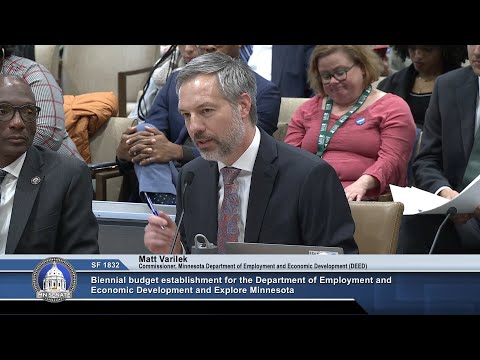
The Department of Employment and Economic Development outlined the governor’s fiscal‑year 2026–27 budget recommendations to the Senate Committee on Jobs and Economic Development on March 5, saying the request is restrained overall while advancing two workforce priorities: a new Office of Public Service and continued funding for Drive for 5.
The Department of Employment and Economic Development outlined the governor’s fiscal‑year 2026–27 budget recommendations to the Senate Committee on Jobs and Economic Development on March 5, saying the request is restrained overall while advancing two workforce priorities: a new Office of Public Service to translate public service positions into career pathways and continued funding for the Drive for 5 workforce initiative.
Commissioner Matt Verlick told the committee the budget proposal holds a limited general‑fund increase for DEED while targeting investments to workforce programs. "The governor recommends $3,000,000 per year in '26 and '27 and then $500,000 per year in the out years for a service to success initiative," Verlick said. The initiative would fund an office at DEED, interagency alignment and grants to expand recruitment, retention and completion for public‑service programs such as AmeriCorps.
Why it matters: committee members asked whether the proposal’s modest net general‑fund increase sufficiently protects workforce and business development programs while managing operating and indirect cost increases. Lawmakers probed potential statutory and technical changes to several DEED programs, the Minnesota Forward Fund and grant definitions.
Key items in the budget presentation
- Service to Success initiative: Verlick said the proposal would create a DEED office to coordinate state investments in public‑service programs, align those programs with career pathways and grant to host organizations to increase recruitment and completion. The administration budgeted $600,000 to establish the office, $150,000 for interagency workforce alignment and $2.25 million for grants to service organizations.
- Drive for 5 continuation: the governor proposes $8,000,000 annually to continue and expand the Drive for 5 workforce grants, a program created in 2023 that focuses on training for technology, caring professions, trades, manufacturing and education.
- Minnesota Forward Fund amendments: Verlick said the Forward Fund was created to match federal investments in large projects (CHIPS, IIJA, IRA). Because federal matching opportunities have become less available, DEED proposes several budget‑neutral statutory changes to allow the remaining Forward Fund dollars to be used for large state projects without requiring a federal match and to keep those funds available until spent.
- Minnesota Job Skills Partnership changes: DEED proposed increasing allowable indirect charges and the cap on grants to make MJSP more usable and competitive for higher‑education training providers who run employer‑specific training for expansions.
- Reporting and credential definition: Verlick proposed updating DEED reporting to count industry and non‑postsecondary credentials (for example, commercial‑driver licenses or coding bootcamps) as recognized outcomes in workforce program reporting.
- BDPI eligibility: DEED suggested adjusting Greater Minnesota Business Development Public Infrastructure (BDPI) eligibility to allow plant‑based processing projects (for example, corn and soybean processors) to receive infrastructure support.
Questions and committee discussion
Senator Drayheim asked whether the operating increase includes employer contributions for paid family and medical leave; DEED said it would follow up. Senator Pratt criticized the continued operating increase request amid projected budget deficits and urged the agency to find efficiencies. Senators also questioned forward‑fund changes that would remove the federal‑match requirement and make fund balances available until spent; DEED said the change is aimed at enabling support for large expansion projects that no longer carry a federal match opportunity.
Committee action
Senator Champion closed the hearing by moving to lay over Senate File 1832. The committee recorded the bill as laid over for possible inclusion in the omnibus package.