Get Full Government Meeting Transcripts, Videos, & Alerts Forever!
Get email alerts on the Committee Roundup topic
No spam. Unsubscribe anytime.
Senate Judiciary committee hears funding requests for victim services, civil legal aid, public‑safety programs; lays bills over
Summary
The Minnesota Senate Judiciary and Public Safety Committee on March 5 heard testimony on a range of funding bills, including a proposal to create a state victim‑services special revenue account, an expansion of civil legal aid, nonprofit security grants, and mental‑health supports for first responders; the panel adopted two amendments to the victim‑services bill and laid most items over for further work.
The Minnesota Senate Judiciary and Public Safety Committee on March 5 heard testimony on a string of funding and policy proposals ranging from a state crime‑victim services fund to expanded civil legal aid and nonprofit security grants. Committee members laid each bill over for further work rather than taking final action.
Committee chair (recorded in the hearing as Chair Lats) opened the meeting saying the panel planned to consider roughly eight bills in a two‑hour block and asked members and witnesses to keep testimony succinct.
The most extensive discussion centered on Senate File 852, a bill sponsored in the hearing by the committee author (recorded in the transcript as Senator Umuverabet) to create a special revenue account for crime victim services and to add reporting requirements and new revenue sources. The sponsor and multiple victim‑services advocates testified that federal Victims of Crime Act (VOCA) funding has plummeted in recent years and that Minnesota programs face cuts that could force layoffs or closures. Sarah Kern, executive director of Hope Coalition, described services her organization provides in rural Goodhue and Wabasha counties including a recently opened forensic exam room and mobile outreach; she said local rental scarcity and lack of transportation make it harder for survivors to flee abusive situations. Bobbie Holtberg, executive director of the Minnesota Alliance on Crime, told the committee VOCA funding in 2018 reached about $58 million nationally and called estimates that federal money could fall to about $7 million this year “devastating,” and detailed a state need for tens of millions of dollars in supplemental funding. Sarah Gangelhoff of the Women’s Foundation of Minnesota and Molly Montague of RAINN also testified in favor of the bill’s goals.
Senators pressed the author on proposed revenue sources in the bill, including increments to civil marriage license fees and assessments on corporate criminal penalties. Senator Limmer raised separation‑of‑powers concerns about language that would require courts to impose penalty assessments on convicted corporations and forbid waiver. Sponsor statements and committee back‑and‑forth indicated the provision is modeled on another state’s approach and would be discussed further with the administration and stakeholders. The committee adopted an author’s “delete‑all” amendment (A5) and later approved a staff technical fix clarifying the allocation amount for one premarital education fee line; the bill was then laid over for possible inclusion in the larger policy or omnibus budget package.
Committee members also heard:
- Senate File 914 (civil legal services): Testimony from JusticeNorth’s Dori Rapoport and program administrator Bridget Germander outlined a multi‑year plan to expand statewide civil legal aid, citing a continued shortfall in capacity that leaves about one in two eligible people without help. The presenters described a 10‑year plan and requested roughly $8.83 million additional in FY26 and an additional $20.51 million in FY27 above the current base (the base cited in testimony was about $34.17 million). The bill was laid over.
- Senate File 679 (Hometown Heroes Outdoors): The committee heard from Chris Tetreault, president of Hometown Heroes Outdoors, and Brian Peters of the Minnesota Police and Peace Officers Association. Witnesses described outdoor programs they say reduce stress, address PTSD, and help first responders re‑engage with community and work. They requested state support (testimony referenced a $1,000,000 request across companion bills) and said the organization stretches funds so roughly 90% go directly to programming. The bill was laid over.
- Senate File 1580 (Violence Prevention Project Research Center): Jillian Peterson and James Densley described research on gun violence, extreme risk protection orders, officer‑involved shootings and related topics. They told the committee federal research funding has tightened and asked the legislature to continue state support for an independent, public‑facing research center based at Hamline University. The bill was laid over.
- Senate File 1835 (Children’s Law Center): Susan Diori of the Children’s Law Center described pro bono and staff legal representation for children in foster‑care and child‑protection matters and asked for $150,000 per year to continue services and training for volunteer attorneys. The bill was laid over.
- Nonprofit security grants (Senate File 734): Rob Allen of the Jewish Community Relations Council and security staff from Shiloh Temple described physical‑security and monitoring needs for houses of worship and other nonprofits after a string of vandalism, threats, and attacks. Witnesses asked for supplemental funding to mirror the federal Nonprofit Security Grant process for applicants that did not receive federal awards. The bill was laid over.
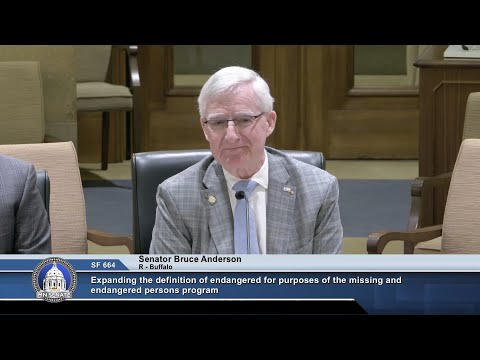
- Missing persons / criminal investigative data and endangered‑person alerts (bills identified in the hearing as Senate Files 631 and 664): A family member of a 2002 missing‑person case and legal counsel described a statutory gap (Minnesota Statutes 13.82, subdivision 7, on criminal investigative data) that can complicate records access for families when cases do not clearly fit a criminal‑investigation model. A separate bill would expand alerting for missing older adults and people with dementia; stakeholders urged caution about enumerating diagnoses but expressed support for quicker alert activation. The bills were laid over.
- Minnesota Family Resiliency Partnership (Senate File 543): Testimony summarized a long‑running displaced‑homemaker program and noted proposals to increase fees and allocations from marriage‑related fees to support the partnership; proponents said the program has not had a funding increase in decades and serves many survivors of domestic violence. The bill was laid over.
Votes at a glance
- SF 852 (author’s delete‑all A5 amendment): A voice vote adopted the author’s amendment; sponsor moved adoption. A subsequent technical amendment to change a premarital fee allocation (suggested by committee staff) was also adopted by voice. The bill was laid over for possible inclusion in a larger policy or budget package. - SF 914 (civil legal services): Laid over. - SF 679 (Hometown Heroes Outdoors): Laid over. - SF 1580 (Violence Prevention Project Research Center): Laid over. - SF 1835 (Children’s Law Center): Laid over. - SF 734 (nonprofit security grants): Laid over. - SF 631 / SF 664 (missing persons / data & alert changes): Laid over. - SF 543 (Minnesota Family Resiliency Partnership): Laid over.
What happened next
No bill received final committee passage. The chair and authors repeatedly described many bills as being “laid over for possible inclusion” in future policy or budget negotiations; committee members requested follow‑up materials on several items (detailed budget breakdowns, statutory language clarifications and stakeholder review on court‑sentencing language).
Why it matters
Witnesses framed the funding requests as responses to concrete gaps: plunging federal VOCA revenues for victim services, capacity shortfalls in civil legal aid, rising threats that leave nonprofits vulnerable, and unmet mental‑health needs among first responders. Sponsors urged further stakeholder work on revenue mechanisms and statutory language before final action.
Remaining questions for policy makers
Lawmakers in subsequent hearings will need to weigh tradeoffs between competing revenue proposals (including small increases in marriage‑license or premarital‑education fees), address constitutional or separation‑of‑powers concerns raised about mandatory judicial assessments, and evaluate which requests should be prioritized in a constrained budget environment.
Ending note
Committee members scheduled the next hearing for March 10 and left the bills open to further amendment and negotiation.