
Senate panel hears request to fund University of Minnesota green ammonia research
Get AI-powered insights, summaries, and transcripts
Sign Up Free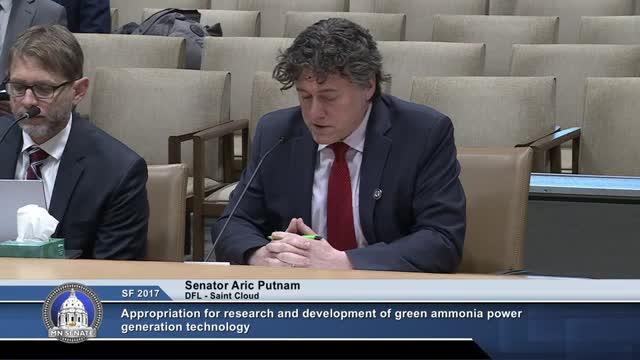
Summary
The Senate Energy Committee heard testimony on Senate File 2017, a proposal to appropriate $12 million from the Renewable Development Account to the University of Minnesota for green ammonia research, prototype development and pilots. Committee members questioned safety, emissions and costs; the bill was laid over for possible inclusion.
Senate File 2017, a bill to fund research and demonstration of so-called green ammonia at the University of Minnesota, drew testimony and technical questions from the Senate Energy, Utilities, Environment and Climate Committee on March 5.
The bill would appropriate $12,000,000 from the Renewable Development Account (RDA) to the University of Minnesota to support development of green ammonia technology, including prototype development, performance evaluation, emissions measurement and pilot programs, Senator Putnam told the committee.
Supporters told the committee that the University of Minnesota has been a leader in green ammonia research for more than a decade and that ammonia can act as a hydrogen carrier and a long‑duration storage medium for renewable energy systems. Mike Reese, director of operations and renewable hydrogen–ammonia research lead at the University of Minnesota West Central Research and Outreach Center in Morris, said the Morris program built the world’s first “wind to ammonia” pilot plant in 2013 and is scaling up with a next‑generation pilot supported by the U.S. Department of Energy and industry partners including Shell and GE Research.
"Ammonia is transformative, from a standpoint of the hydrogen economy," Reese said, adding that ammonia is more economical to store and transport than hydrogen. Professor Will Northrop, director of the Thomas E. Murphy Engine Research Laboratory at the University of Minnesota, described laboratory demonstrations converting engines and burners to ammonia and identified remaining technical challenges such as material compatibility, fuel handling, unburned ammonia control and nitrogen‑oxide emissions.
Committee members asked technical and safety questions. Senator Klein asked about fuel handling and ignition risks; Reese responded that ammonia is already the second most‑transported chemical worldwide and is widely handled in Minnesota because of fertilizer storage and transport. On emissions, Northrop said laboratory work has shown NOx can be reduced to levels comparable with hydrocarbon combustion and that unburned ammonia can be controlled with after‑treatment catalysts under development.
Members also asked about cost comparisons to diesel and propane. Testifiers said green ammonia could be competitive in some applications, and Northrop estimated that once infrastructure is deployed green ammonia could be about 10% or more cheaper than propane in some scenarios, though he cautioned costs depend on broader market and infrastructure development.
The committee took no final action on SF 2017 but laid the bill over for possible inclusion. The committee’s stated intention was to "lay over this bill and all the bills for possible inclusion," and Senator Putnam closed by thanking members and testifiers.
Context and next steps: The proposal would fund additional research, prototypes and pilots intended to accelerate commercialization of green ammonia for use as fertilizer and a fuel or energy storage medium. The committee held technical questioning but did not vote to advance the bill; it was laid over for further consideration.