Get Full Government Meeting Transcripts, Videos, & Alerts Forever!
Get email alerts on the Special Education Overview topic
No spam. Unsubscribe anytime.
Senate committee hears statewide special education overview, funding shortfalls and paperwork concerns
Summary
Saint Paul assistant superintendent Heidi Nissler briefed the Minnesota Senate Education Policy Committee on federal and state special education requirements, program structure, rising enrollment and funding gaps. Committee members asked about paperwork burdens and state-federal alignment.
Heidi Nissler, assistant superintendent of specialized services for Saint Paul Public Schools, told the Minnesota Senate Education Policy Committee on March 5 that federal and state laws together shape how special education is delivered in Minnesota and that the costs of meeting those requirements create funding pressures for districts.
Nissler said the Individuals with Disabilities Education Act, or IDEA, is “the most well known and most impactful” federal law and that it requires every student identified with a disability to receive a FAPE — a free and appropriate public education. “Free is easy. Free means at no cost to parents,” she said, adding that what counts as “appropriate” has been shaped by decades of case law and must be “reasonably calculated for that individual student to make progress in light of their individual circumstances.”
The overview explained how IDEA intersects with Section 504 of the Rehabilitation Act and the Americans with Disabilities Act and how Minnesota law can add protections. Nissler noted Minnesota’s own statutes and rules sometimes exceed federal minimums and pointed to the Minnesota Human Rights Act as a state anti‑discrimination statute that also applies to students with disabilities.
Nissler described how special education operates in practice: each eligible student receives an individualized education program, or IEP, developed by an IEP team that includes parents, general and special educators, a district representative and others with knowledge of the student. She outlined the “continuum of services” used to place students in less‑to‑more restrictive settings and said Minnesota districts collaborate through cooperatives and intermediate districts to operate the most intensive “setting 4” programs.
On enrollment and categorical definitions, Nissler said Minnesota currently serves about 50,000 students with special education services and that figure has risen “from about a 10,000 students, less than 10 years ago,” according to the presentation. She said autism diagnoses have been a major contributor to recent growth in eligibility and that Minnesota uses 13 categorical disability areas aligned to IDEA.
Nissler also reviewed finance. She said most special education funding in Minnesota comes from the state under a prior‑year reimbursement model; state special education aid covers about 75% of an initial cost, and districts use general education dollars for remaining costs (the so‑called cross‑subsidy). Nissler reported the statewide cross‑subsidy for the 2022‑23 school year as $726,000,000 and noted federal IDEA funding in Minnesota covered roughly 6 to 8 percent of special education costs in recent years (federal allocations for 2023 in Minnesota were cited at about $203,000,000). She also described third‑party billing (Medicaid/MA) as a growing revenue source, reporting more than $69,000,000 statewide in the most recent completed fiscal year.
Committee members asked several questions about paperwork and administrative burden. Senators and committee members said paperwork contributes to teacher fatigue and shortages; Nissler and other witnesses said some paperwork reflects due‑process protections from case law and federal court decisions and that both statutory requirements and district‑level procedures contribute to workload. Nissler said districts and advocacy groups have been discussing possible procedural changes that might reduce redundant work while preserving legal protections and parental rights.
The committee did not take a vote on policy changes during the informational presentation. Several bills on the agenda for that day followed Nissler’s briefing and were considered separately by the committee.
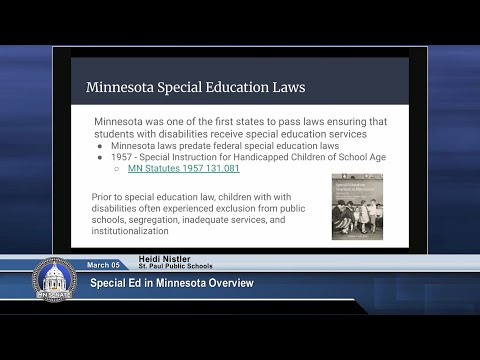
Less urgent details: Nissler noted Minnesota historically enacted protections for students with disabilities earlier than many states, and she described birth‑to‑3 early intervention services as provided by local school districts in Minnesota, with services available up to age 22 in some circumstances. She also said re‑evaluations are required at least every three years and that an IEP must be reviewed at least annually.