Get Full Government Meeting Transcripts, Videos, & Alerts Forever!
Get email alerts on the Local Manufacturing Fertilizer topic
No spam. Unsubscribe anytime.
Senate hearing: Minnesota‑made fertilizer grant bill laid over after testimony from farmers and industry
Summary
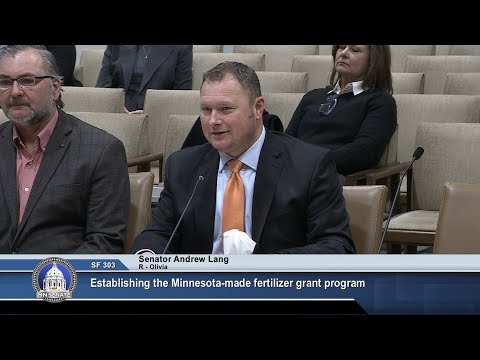
Senator Lang introduced Senate File 303, a proposal to create a grant program supporting in‑state fertilizer blending/processing. Testimony from farmer Randy Tersteeg described opportunities and startup costs; the committee laid the bill over for possible inclusion.
Senate File 303, sponsored by Sen. Andrew Lang, would establish a Minnesota‑made fertilizer grant program to encourage local blending and processing of fertilizer coproducts. Lang introduced the bill during the March 5 Senate Agriculture and Rural Development Committee meeting and said the proposal has been discussed in multiple sessions.
"A lot of the fertilizer that's produced, or I should say, utilized in the state of Minnesota, comes from outside the state," Sen. Lang said. He described the bill as a grant program whose dollar amount would be determined during the budget process and turned the floor over to farmer Randy Tersteeg of Olivia, Minnesota, who testified in favor of the idea.
Tersteeg, who described himself as a farmer with experience operating "nontypical fertilizer operations," said Minnesota produces coproducts — including animal manures, calcium products from sugar‑beet processing and wood ash — that could be blended and processed into farm‑ready fertilizer products. He testified such small, regional blending facilities could reduce reliance on imported potash and decrease transportation risks tied to barging and international supply chains.
Tersteeg estimated startup costs for small blending facilities could range from about $1 million to $5 million depending on scale, and he said a modest network of smaller plants would be more practical than one large plant. He also said some existing, underused facilities (mentioned in committee as Benson and a former Fiberman site) could be repurposed.
Senators asked about supply chain risk (Tersteeg noted the United States sources large shares of potash from Canada), tariff exposure and how quickly a blending operation could be stood up (Tersteeg suggested many operations could be viable within about 12 months and that manure hauling is often feasible within a roughly 50‑mile radius). Several senators expressed support or interest.
Commissioner Tom Peterson said MDA has engaged with proponents, that the department has visited local facilities and “supports the concept and the idea” even though the program is not in MDA’s current budget. Following testimony and questions, Chair Putnam said Senate File 303 would be "laid over for possible inclusion" in future committee action.