Get Full Government Meeting Transcripts, Videos, & Alerts Forever!
Get email alerts on the Suicide Prevention topic
No spam. Unsubscribe anytime.
Senate committee hears bill to fund permanent suicide barriers on Washington Avenue Bridge
Summary
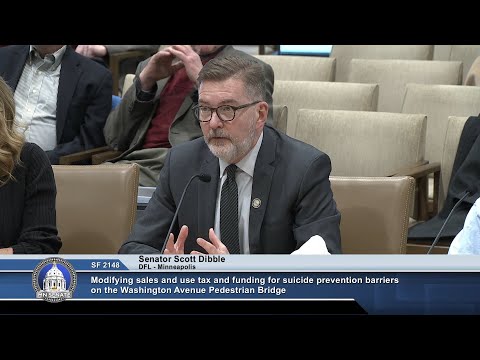
On March 5, 2025, the Minnesota Senate Transportation Committee heard Senate File 2148, introduced by Sen. [Steve] Dibble, proposing use of Metro-area sales-tax transit funds for permanent pedestrian suicide-prevention barriers on the Washington Avenue Bridge at the University of Minnesota; the bill was laid on the table for budget consideration.
Senate File 2148, introduced in the Minnesota Senate Transportation Committee on March 5, 2025, would fund permanent pedestrian barriers on the Washington Avenue Bridge that connects the University of Minnesota’s East and West Banks. The bill’s author, Senator Dibble, said temporary fencing already in place has been helpful but a permanent solution is needed.
The bill was prompted in part by testimony from family members and suicide-prevention advocates, who said the bridge has been a recurring site for fatal suicide attempts. MJ Wise testified that her daughter, Kayla Gable, died by suicide on the bridge on Nov. 9, 2023. “She left behind a 2-year-old son and a 3-year-old daughter,” Wise said, and described forming the advocacy group Kayla’s Hope with other families and SAVE (Suicide Awareness Voices of Education).
John Abbotts, a board member of SAVE, told the committee the bridge’s waist-high railing offers little protection and that temporary chain-link fencing installed by the university has stopped several attempts. “Since she put up that bridge, 6 other suicide attempts have been thwarted,” Abbotts said, referring to the temporary fencing the university installed.
Senator Dibble described the funding mechanism the bill would use: a portion of the metro-area sales tax enacted in the 2023 transportation finance bill that flows through the Metropolitan Council and the Transportation Advisory Board for a regional solicitation. The proposal would reserve a one-time portion of those bike/pedestrian-dedicated funds for the Washington Avenue Bridge project. Dibble acknowledged alternatives — general fund, bonding or county payment — are being pursued in other proposals and called this approach “one way we can get this done.”
Committee members asked about who should pay and the county’s role. Senator Jasinski said she supported the goal but questioned using metropolitan regional transit tax dollars for a bridge owned by Hennepin County. Dibble responded that the bridge’s upper deck primarily serves the university campus and that the state has a role; he said further conversations with the county about cost sharing would follow.
Advocates and bicycling representatives said barriers reduce impulsive suicides and improve safety for pedestrians and cyclists. Michael Wojcick of the Bicycle Alliance of Minnesota, testifying later about another bill but referencing the bridge, said the alliance “would see this as being a safer design.”
Senate File 2148 was laid on the table at the conclusion of the committee’s discussion so it can be considered in upcoming budget work.
Proponents urged the committee to move quickly. Committee members and testifiers noted temporary fencing already in place and said state funding commitment could accelerate design and installation of a permanent barrier system.
The committee did not adopt final design or a dollar figure in committee; the bill was laid on the table for further budget negotiations and potential inclusion in a finance bill.