Get Full Government Meeting Transcripts, Videos, & Alerts Forever!
Get email alerts on the Criminal Justice Self Defense topic
No spam. Unsubscribe anytime.
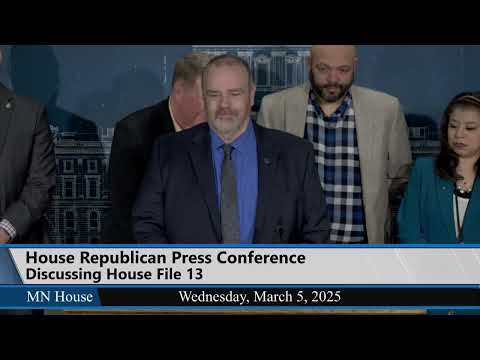
Rep. Matt Bliss outlines HF 13 to reverse Minnesota Supreme Court's 'duty to retreat' expansion
Summary
State Rep. Matt Bliss presented House File 13, saying the bill would clarify that reasonable force may be used to resist an attack in public without a duty to retreat, responding to a Minnesota Supreme Court ruling he described as judicial overreach. No formal vote was recorded during the presentation.
State Representative Matt Bliss, R-District 2B, presented House File 13 to attendees, saying the bill would amend Minnesota law to make clear that a person may use reasonable force to resist an attack in public regardless of whether a reasonable possibility to retreat exists.
"House file 13 was created in a response to a Minnesota Supreme Court decision regarding the duty to retreat," Bliss said, adding that "nowhere in the Minnesota statute does it call for the duty to retreat. This was judicially created in self defense." He characterized the court's ruling as an insertion of language the Legislature should, not the judiciary.
Bliss said HF 13 would add the phrase that "reasonable force may be used in resisting or aiding another to resist an offense against the person regardless of whether a reasonable possibility to retreat to avoid danger exists." He told the group that "reasonable force is left to be interpreted by a judge or a jury" and disputed characterizations of the bill as a "shoot first" measure.
During questions, Bliss noted that Minnesota law already provides a form of "stand your ground" protection for people inside their homes and said HF 13 applies to the public sphere. He described the underlying court case as involving a man on a train platform who displayed a weapon and was later convicted of brandishing, a conviction that ultimately led to the state Supreme Court decision he cited.
Bliss cited a dissent by Justice Justin Thiesen to argue the court's ruling was "divorced from the statutory text" and "unprecedented in The United States." He gave a hypothetical example about a woman using keys in her hand as a deterrent, saying the court's interpretation could make such a defensive action unlawful. "This ruling not only prohibits a woman from using her keys to fend off an attacker, she's expected to run away," he said.
Bliss framed the bill as a response to judicial overreach and said the three-branch structure of government reserves lawmaking to the Legislature. He did not describe any scheduled committee referral, hearing date, or vote during the presentation.
Questions from attendees touched on application inside a home versus public spaces; Bliss reiterated that current law removes any duty to retreat for someone inside their home and that HF 13 targets public-space situations. The presentation included a short question-and-answer exchange but no formal motion or recorded vote.
No formal action was recorded during the presentation: HF 13 was introduced and explained, and audience members asked clarifying questions. The bill's text, committee referral, and legislative status were not specified during this session.
Bliss closed by saying he would take questions and discuss the bill further with members of both parties; he expressed skepticism that members of the DFL caucus had read the bill, saying opponents had framed it as a "shoot first" bill despite his description of its language and intent.