Get Full Government Meeting Transcripts, Videos, & Alerts Forever!
Get email alerts on the Rare Disease Council Funding topic
No spam. Unsubscribe anytime.
Committee hears request to make Minnesota Rare Disease Advisory Council funding permanent
Summary
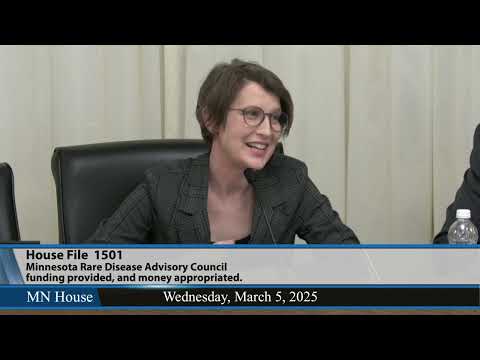
The Minnesota House Health Finance and Policy Committee heard testimony on House File 1501, which would make the current fiscal-year funding for the Minnesota Rare Disease Advisory Council an ongoing base appropriation; supporters said the council helps speed diagnosis and advise on cutting-edge therapies.
The Minnesota House Health Finance and Policy Committee on Friday heard from lawmakers and the executive director of the Minnesota Rare Disease Advisory Council on House File 1501, a bill that would make the council’s current fiscal-year funding an ongoing base appropriation.
Supporters told the committee the council helps patients with uncommon conditions get diagnosed faster and advises state agencies and the Legislature on treatments such as gene therapy. Erica Barnes, executive director of the Minnesota Rare Disease Advisory Council, said the council’s mission is to improve care for the roughly "one in 10 Minnesotans living with a rare disease" and to provide policy recommendations and support tools for clinicians and patient communities.
Barnes said the council moved from the University of Minnesota to become a small state agency in 2022 and that the funding requested in the bill reflects the budget the council and Minnesota Management and Budget identified to meet agency compliance requirements and execute the council’s statutory duties. She told the committee the council currently operates on a mix of ongoing and one-time money and that the request before the committee would set as the permanent base the funding level the council has been using.
According to testimony, last session the council received a total appropriation of $668,000 for the biennium: an ongoing base of about $326,000 and a one-time addition of roughly $342,000. Barnes said returning to the lower ongoing base would reduce council staffing to about 1.8 full-time equivalents and force the council to stop some programs launched with the one-time funds.
Representative Murphy, who presented the bill, described the council as a unique state body that includes legislative members and two senators, and he cited University of Minnesota and Mayo Clinic participation as part of the council’s expert membership. Committee members asked for clarification on budget line items and how the funds were used; Barnes said she had submitted a document with detailed line items and offered to provide additional information to committee members.
No public opponents testified. After questions and discussion the chair laid the bill over for possible inclusion in the omnibus appropriation bill.
The committee did not take a final vote on House File 1501 during this hearing; the bill was laid over for further consideration.