Get Full Government Meeting Transcripts, Videos, & Alerts Forever!
Get email alerts on the State Income Tax topic
No spam. Unsubscribe anytime.
Minnesota lawmaker pitches cut to first income-tax bracket; critics warn cuts would disproportionately benefit higher earners and shrink state revenue
Summary
Representative Weiner presented House File 812 to cut Minnesota's lowest individual income-tax bracket, saying it would provide relief to workers under $38,000. Budget analysts and nonprofit advocates said the bill is poorly targeted, would leave many low-income households without benefit and could cost billions, forcing cuts to services.
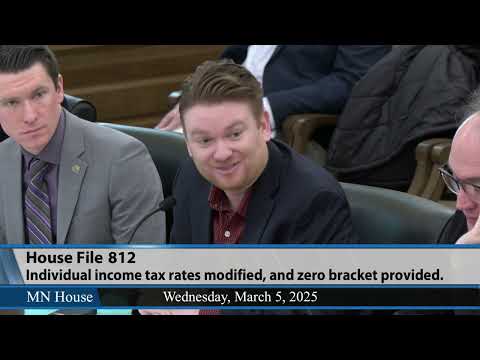
Representative Matt Weiner introduced House File 812 on the floor of the House tax committee, saying the measure would reduce Minnesota's lowest individual income-tax bracket and deliver immediate relief to residents earning under about $38,000 a year.
"Imagine if you will, you're making under $38,000 a year. If this bill were passed, it would be like getting 50¢ to a dollar per hour onto your check," Representative Matt Weiner told committee members, calling the proposal "transformative." He framed the bill as addressing Minnesota's high marginal rates and making the state more competitive with neighboring states.
Diane Madden, director of the Minnesota Budget Project at the Minnesota Council of Nonprofits, testified in opposition, saying the bill as drafted would not focus relief on households most in need. "The Department of Revenue estimates that 20% of Minnesota income-tax filers would not receive any benefit from this proposal," Madden said, and she warned that the fiscal cost—she cited a ballpark figure of about $4 billion annually—would likely mean cuts to services such as health care, supports for seniors and people with disabilities, schools and transportation.
Committee members pressed on distributional effects. Representative Ursula Smith summarized an included fiscal memo and said the largest share of revenue loss would go to higher-income filers: "Those who have an income of greater than $100,000 will account for 53.7% of the decrease in revenue," Smith said, pointing to the memo's modeled distribution. Other members framed the question in budgetary terms: if the cut created a multi‑billion dollar hole, what programs would be trimmed to pay for it.
Weiner acknowledged the bill would reduce revenue and said he was open to amendments to better target relief, including changing bracket breaks. "I would be more than willing to work with anybody to make this bill better," he said, and described the change as a starting point for further negotiations.
Action: Representative Weiner moved that House File 812 be laid over for possible inclusion in the omnibus tax bill; the motion was renewed and the item was laid over for further consideration. No formal vote tally was recorded in the transcript.
Why it matters: The committee hearing highlighted competing aims that frequently appear in tax debates—providing near-term tax relief to households while preserving state revenues that fund health care, education and local aid. Advocates for the bill emphasized worker relief; budget analysts and nonprofit representatives emphasized distributional fairness and fiscal risk.
What's next: Committee discussion and staff work on revenue estimates and potential amendments to narrow or re-target benefits were left as next steps when the bill was laid over.