Get Full Government Meeting Transcripts, Videos, & Alerts Forever!
Get email alerts on the Elections Administration topic
No spam. Unsubscribe anytime.
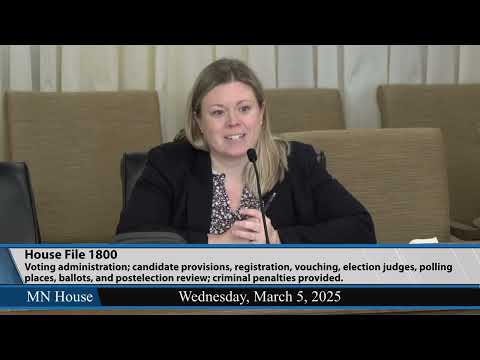
Committee advances House File 1800 after hours of debate over voter privacy, observers and result transmission
Summary
The House Elections Finance and Government Operations Committee voted 6-5 to recommend passage of House File 1800, an elections administration bill that drew sustained questions about voter privacy, party-affiliation disclosure for election judges, the handling of cast-vote records and new rules for observers and photographs.
The Minnesota House Elections Finance and Government Operations Committee on a 6-5 vote recommended passage of House File 1800, a broad elections administration bill, and re-referred it to the Public Safety Committee.
Representative Duane Quam, the bill's sponsor and chair of the committee, described the measure as primarily technical and aimed “to clarify procedures and make sure that we have an orderly election.” The bill, as introduced and later amended, includes changes to who may serve or be identified as election judges, how precinct results are handled, rules about observers in polling places and limits on public release of certain election data.
The bill’s most vocal external witness, Nicole Freeman of the Office of the Secretary of State, told the panel that “the provisions in the bill, I think, largely our office is in opposition to many of them.” Freeman urged more local-administrator input and flagged multiple provisions she said could reduce election-administrator flexibility or risk voter privacy and election-judge safety.
Why it matters: committee members said the measure is intended to reduce administrative confusion that has led to litigation in past elections; opponents warned several provisions could undercut ballot secrecy, complicate administration in large or rural counties, and discourage election-judge recruitment.
Key issues discussed
Election-judge affiliation: The bill would make party-affiliation information for election judges more readily available in some contexts. Quam and several supporters said providing that information helps ensure legally required party balance for certain duties; opponents said forcing public disclosure of affiliation could deter volunteers. Freeman said local practice varies and cautioned that making party lists public could harm recruitment and election-judge safety.
Cast vote records and ballot images: Committee members debated data elements produced by tabulators known as cast vote records (CVRs). Freeman recounted prior state actions to limit what parts of CVRs are public and warned that time, date or method fields could be combined with images and local knowledge to reconstruct how individual voters voted. After discussion, the committee accepted an oral amendment reinstating language to identify ballot images as protected, nonpublic data (line reinstated at page 17, line 17.32). As Quam noted during debate, the draft also adds criminal penalties for accessing preliminary results before polls close: “the last 3 words is a felony,” he said.
Observers, photography and videos: The bill creates or clarifies a role described as an “observer” (in addition to current challengers) and would allow observers to take photographs or videos of election activities “so long as the photographs and videos are not disseminated until after the polling place is closed,” language that several lawmakers and witnesses called problematic. Representative Mary Framing (spoken in debate as Representative Grama) and others warned that photographs or videos taken without context could be shared later and spark harassment, misinformation or doxxing of election workers. Quam said he was open to further clarifying language that would prohibit photographing voters or otherwise protect privacy while preserving the ability to document unlawful activity.
Result transmission and poll books: Members questioned language that would limit when and how preliminary precinct tallies may be transmitted to central reporting locations. Critics said the deletion of a provision allowing precincts to electronically transmit accumulated tallies could create delays for counties that rely on certified electronic systems rather than physically transporting memory cards. The bill also provides that some local entities may opt for paper poll books instead of electronic ones, a change opponents said could complicate administration in jurisdictions that cross multiple local boundaries.
Other administrative items: Freeman and other witnesses raised concerns about chain-of-custody language, retention requirements for ballot envelopes and rules for vouching in residential facilities. Freeman recommended further clarification or removal of some requirements and said the Secretary of State’s office would work with the sponsor on several provisions.
Votes at a glance — The committee recorded several formal actions on House File 1800: Representative Duane Quam moved that House File 1800 be recommended to pass and be referred to the Public Safety Committee; that motion was renewed and passed 6-5 at the final roll call. The committee adopted an A2 amendment clarifying applicability for towns and townships with fewer than 5,000 residents. The committee also adopted an oral amendment to reinstate language protecting ballot images as nonpublic data (the amendment passed on a roll call, 6 ayes to 5 nays). The final committee vote on the bill was 6 in favor and 5 opposed.
What happens next: The committee re‑referred House File 1800 to the Public Safety Committee for further consideration. Committee members said they expect additional stakeholder input and possible further amendments, including to privacy and observer provisions.
Speakers quoted in this report spoke during the committee hearing and are listed in the attribution section below. No new facts or outcomes beyond those recorded in committee proceedings are asserted.