Get Full Government Meeting Transcripts, Videos, & Alerts Forever!
Get email alerts on the Philly Tree Plan topic
No spam. Unsubscribe anytime.
Council hearing reviews Philly Tree Plan progress, spotlights maintenance, funding and canopy protections
Summary
At a public hearing Oct. 27, Philadelphia city agencies, researchers and community groups described planting and partnership gains under the Philly Tree Plan while flagging gaps in maintenance funding, staffing, enforcement and recent large park tree removals that critics say undercut the plan’s goals.
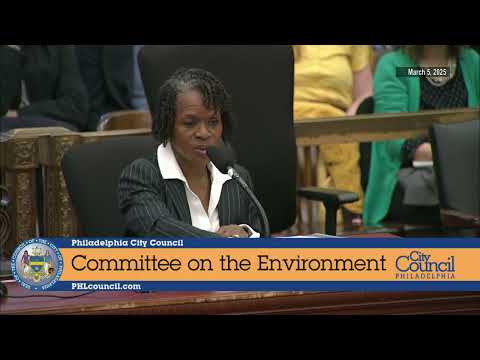
The Philadelphia City Council Committee on the Environment held a public hearing Oct. 27 to evaluate progress implementing the Philly Tree Plan, the city’s 10-year strategy to grow and care for its urban tree canopy.
The hearing centered on what city agencies and nonprofit partners have accomplished since the plan’s 2023 release, the constraints that remain, and community concerns about recent large-scale removals in city parks.
Councilwoman Gauthier, chair of the Committee on the Environment, opened by noting the plan’s origins and uneven canopy across neighborhoods and said, “While the federal government is abandoning its duty, Philadelphia is going to have to step up. And if we have to do this work alone, we will because with so much at stake, inaction is not an option.”
City parks officials described planting and staffing gains but emphasized maintenance and workforce shortages as the main implementation constraints. Susan Slauson, Commissioner of Philadelphia Parks and Recreation, said PPR is steward of the city’s parks and street trees and reported that “we have planted 3,724 trees along city streets and park natural lands and as part of the yard tree giveaway program in fiscal year 24.” She told the committee PPR manages roughly 130,000 street trees and more than 10,000 acres of parkland and has increased pruning and maintenance capacity in recent years.
Erica Smith Fitchman, the city forester, described the department’s move from reactive requests toward a proactive inspection cycle for street trees and said existing inspectors and contract managers currently perform planting, pruning and removals “by request from residents,” and that a comprehensive inventory and a USDA Forest Service study will inform how the city phases in a fully proactive inspection program.
Researchers and health professionals testified about the plan’s equity and health rationale. Hamill Pearsall (professor, Temple University) and Paul Devine Batone (pediatrician and adolescent health specialist) said tree canopy gaps follow historic disinvestment and redlining and emphasized links among canopy, heat, air quality and health outcomes in neighborhoods with low tree cover. Batone told the committee that “tree cover represents an environmental determinant of health,” citing heat, pollution and associated health disparities.
Nonprofit partners and neighborhood groups described how volunteer and community-led efforts complement city work and where support is still needed. Justin Trezza, senior director of Healthy Neighborhoods at the Pennsylvania Horticultural Society, described the Philly Tree Coalition (administratively housed at PHS) as the planned coordinating vehicle for fundraising, implementation and community outreach. He said the coalition and partners jointly secured a $12,000,000 federal grant that is currently frozen and “recently a near $2,000,000 grant from the William Penn Foundation.” Trezza also said PHS has trained roughly 6,000 tree tenders and supports over 80 active volunteer tree-tender groups that plant approximately 2,000 trees a year.
University City District and other workforce-focused groups urged that maintenance be reframed as both an environmental necessity and an employment opportunity. Nate Hummel (director of planning and design, University City District) described a Green City Works workforce model that trains residents for landscaping and tree-care jobs and urged funding to prioritize both ongoing maintenance and job pathways.
Residents and community tree groups stressed three recurring barriers: (1) maintenance burden and costs falling on homeowners, (2) requirements that homeowners sign tree-planting applications that exclude renters or place the onus on landlords, and (3) upfront prerequisites — damaged sidewalks, dead-stump removal, hydrant access — that can make tree plantings cost-prohibitive for low-income households. Several witnesses said outreach and design charrettes that show species at maturity and explained noninvasive-root species have helped increase acceptance on some blocks.
A major theme of public comment was opposition to recent large removals in city parks. Multiple speakers — including community organizers, certified arborists and volunteer leaders — urged the council to pause or reevaluate removals at FDR Park and other parklands and to strengthen protections for mature and heritage trees. Speakers said parts of FDR Park were cleared and maintained trees older than 80 years were lost; one arborist questioned whether the city’s replacement-caliper formula meaningfully replaces lost canopy and called the park removals inconsistent with the Philly Tree Plan’s protection goals. Commenters also asked for better public accounting, saying the city’s canopy inventory did not mark trees on the western side of FDR Park and asking for that data to be shared.
City officials and partner groups described several steps underway to address issues raised at the hearing: hiring and designating a city forester position, increasing street-tree maintenance funding, committing to a three-year report card on plan progress due in spring 2026, partnerships with the U.S. Forest Service on inventory and canopy assessments, and the creation of the Philly Tree Coalition to coordinate fundraising and community engagement. Parks officials said they are working with the planning commission, Licenses & Inspections and Streets on zoning and code changes that already include fees for removed trees and eliminated some prior exemptions in the zoning code.
No formal votes or motions were taken at the hearing; the session was a public review and information-gathering opportunity for council.
The committee recessed the hearing “to the call of the chair” after public comment concluded.
What matters now: the hearing highlighted that planting alone will not sustain canopy gains. Witnesses and community leaders urged the council to pair planting with guaranteed, long-term maintenance funding, clearer protections and enforcement for large mature trees, renter-inclusive access to plantings, and workforce development tied to maintenance operations. The committee’s next steps include the planned three-year report card in spring 2026 and continued coordination with the Philly Tree Coalition and city agencies to turn planting gains into lasting canopy and neighborhood benefits.
Ending details: Testimony at the hearing included city officials from Philadelphia Parks and Recreation, researchers and health professionals, nonprofit leaders from PHS and University City District, and volunteer tree-tender group leaders and residents. Several witnesses asked the council to ensure transparency around park inventories and to prioritize maintenance budgets and policy changes that protect existing canopy while expanding equitable planting.