Get Full Government Meeting Transcripts, Videos, & Alerts Forever!
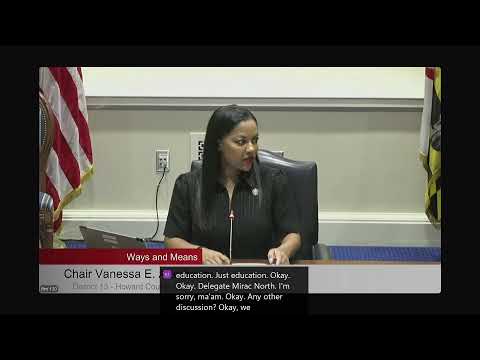
Ways and Means Committee approves multiple bills; debates special commercial property tax, child-care certification and school reentry instruction
Summary
The Maryland House Ways and Means Committee met March 5 and voted to report a package of bills favorably to the full House, including measures on an optional special commercial/industrial property tax (House Bill 23), child‑care first‑aid/CPR staffing ratios to be set by regulation (House Bill 150) and an instructive program about consequences of criminal convictions for some middle‑school students (House Bill 993).
The Maryland House Ways and Means Committee met March 5 for bill hearings and on a series of motions voted to report multiple measures favorably to the full House, including bills on optional local tax credits, school safety reporting, election audits and procedures for filling legislative vacancies.
House Bill 23: special commercial/industrial property tax
House Bill 23, introduced on the floor by Delegate Wells, would authorize counties to impose a special property tax rate on commercial and industrial property, with revenue required to be spent on transportation or education. The bill caps the special rate at 12.5 cents per $100 of assessed value and excludes the residential portion of mixed‑use buildings; counties could provide a credit for small businesses. An amendment, moved by Delegate Wells, clarified that the 12.5 cents cap applies cumulatively to any combined special rates for transportation and education. The committee adopted the amendment and later voted to report the bill favorably as amended.
Delegate Griffith objected to the bill in committee debate, calling the proposal "very, very aggressive" and saying he would vote no, citing rising commercial foreclosures and reduced commercial property values driven by remote work patterns. Madam Chair (presiding) called for a roll call after debate and the committee reported the bill favorably as amended.
Why it matters: The bill would give county governments an expanded, optional local revenue tool targeted at commercial and industrial parcels. Under the bill text described in committee, the revenue is restricted to transportation and education uses and the statutory cap is 12.5 cents per $100 of assessed value. The committee record shows both support for local flexibility and concern about placing added tax pressure on commercial properties in a market experiencing distress.
House Bill 150: first aid and CPR certification moved to regulation
House Bill 150, presented in committee by Delegate Plokovich Carr, repeals the statutory requirement that child‑care centers serving more than 20 children must have at least one staff member…
Already have an account? Log in
Subscribe to keep reading
Unlock the rest of this article — and every article on Citizen Portal.
- Unlimited articles
- AI-powered breakdowns of topics, speakers, decisions, and budgets
- Instant alerts when your location has a new meeting
- Follow topics and more locations
- 1,000 AI Insights / month, plus AI Chat