Get Full Government Meeting Transcripts, Videos, & Alerts Forever!
Get email alerts on the State Budget And Taxation topic
No spam. Unsubscribe anytime.
Ways and Means Committee approves multiple bills; debates special commercial property tax, child-care certification and school reentry instruction
Summary
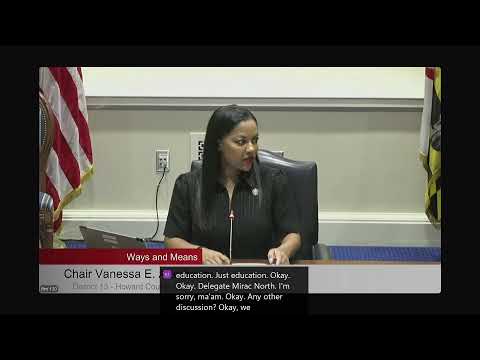
The Maryland House Ways and Means Committee met March 5 and voted to report a package of bills favorably to the full House, including measures on an optional special commercial/industrial property tax (House Bill 23), child‑care first‑aid/CPR staffing ratios to be set by regulation (House Bill 150) and an instructive program about consequences of criminal convictions for some middle‑school students (House Bill 993).
The Maryland House Ways and Means Committee met March 5 for bill hearings and on a series of motions voted to report multiple measures favorably to the full House, including bills on optional local tax credits, school safety reporting, election audits and procedures for filling legislative vacancies.
House Bill 23: special commercial/industrial property tax
House Bill 23, introduced on the floor by Delegate Wells, would authorize counties to impose a special property tax rate on commercial and industrial property, with revenue required to be spent on transportation or education. The bill caps the special rate at 12.5 cents per $100 of assessed value and excludes the residential portion of mixed‑use buildings; counties could provide a credit for small businesses. An amendment, moved by Delegate Wells, clarified that the 12.5 cents cap applies cumulatively to any combined special rates for transportation and education. The committee adopted the amendment and later voted to report the bill favorably as amended.
Delegate Griffith objected to the bill in committee debate, calling the proposal "very, very aggressive" and saying he would vote no, citing rising commercial foreclosures and reduced commercial property values driven by remote work patterns. Madam Chair (presiding) called for a roll call after debate and the committee reported the bill favorably as amended.
Why it matters: The bill would give county governments an expanded, optional local revenue tool targeted at commercial and industrial parcels. Under the bill text described in committee, the revenue is restricted to transportation and education uses and the statutory cap is 12.5 cents per $100 of assessed value. The committee record shows both support for local flexibility and concern about placing added tax pressure on commercial properties in a market experiencing distress.
House Bill 150: first aid and CPR certification moved to regulation
House Bill 150, presented in committee by Delegate Plokovich Carr, repeals the statutory requirement that child‑care centers serving more than 20 children must have at least one staff member certified in basic first aid and CPR per 20 children, and instead requires the Maryland State Department of Education (MSDE) to set a ratio by regulation. Committee amendments preserved a requirement that MSDE adopt a regulatory ratio for first aid and CPR certificate holders and the committee adopted those amendments and voted the bill favorably as amended.
Committee members debated the tradeoffs between codifying the 1:20 statutory ratio and allowing regulatory flexibility. Delegate Miller and others said they would vote no because they prefer the existing statutory protection, describing first aid and CPR certification as a high priority for young children. Supporters of the amendment said MSDE already is pursuing a regulatory change and that regulations offer a public‑notice and review process; Delegate Plokovich Carr and other sponsors said the agency will set the ratio through regulation, with subsequent review by the Joint Committee on Administrative, Executive and Legislative Review and a public comment period.
Why it matters: The change shifts the staffing‑ratio standard from statute to the regulatory process, which supporters say allows MSDE to update ratios based on evidence and stakeholder input. Opponents warned this reduces a statutory backstop guaranteeing a minimum number of certified staff per children.
House Bill 993: instructive program on consequences of criminal conviction for some middle school students
House Bill 993, as amended in committee, requires MSDE to develop an instructive program about the consequences of criminal convictions and for public middle schools to deliver that program to students when they are placed in in‑school suspension or when they return to school after suspension or expulsion. The original draft of the bill would have required a course for all middle school students focused on felony murder; the committee amendment broadened the subject matter to "consequences of a criminal conviction" for any offense and narrowed delivery to the situations above. The committee voted the amended bill favorably.
Several delegates debated whether the instruction should be given to all students rather than only those returning from disciplinary removal. Delegate Roberson and Delegate Young said they worry that targeting only students who have been suspended may unfairly single out children who were disciplined for nonviolent conduct; other members said the measure is intended as a deterrent and as targeted instruction for students at higher immediate risk of reoffending.
Other bills passed, moved or discussed
The committee also voted favorably on a number of additional measures with brief floor presentations and limited debate, including (but not limited to): - House Bill 59 (amendments concerning withholding properties from tax sale for water liens and changes to foreclosure posting timelines), reported favorably as amended. - House Bill 237 (procedures for political‑party central committees to fill General Assembly vacancies), favorably reported. - House Bill 426 (statewide and local risk‑limiting election audits before certification), favorably reported. - House Bill 477 (MSDE analysis of childcare regulatory requirements, interim report due 01/01/2026 and final report due 09/01/2026), favorably reported as amended. - House Bill 493 (designating Ruby Bridges Walk to School Day on November 14 and requiring MSDE model content), favorably reported as amended. - House Bill 596 (advanced enrollment for children of service members with protections for students with IEPs or 504 plans), favorably reported as amended. - House Bill 634 (income tax reconciliation program for incarcerated, justice‑involved individuals for tax years 2025–2029), favorably reported. - House Bill 672 (annual assessment and reporting of school health and wellness workforce; adding a school nurse seat to a council), favorably reported as amended. - House Bill 694 (school facility safety evaluations to identify accessibility issues affecting evacuation, with reporting requirements), favorably reported as amended. - House Bill 907 (adjustments to optional local property tax credit for urban agriculture, expanding eligibility), favorably reported. - House Bill 945 (moving the gubernatorial primary earlier in June), favorably reported. - House Bill 1122 (increasing membership of the Office of Child Care Advisory Council to add a library administrators representative), favorably reported. Several bills were withdrawn and committee recorded a consent motion to treat withdrawn bills as withdrawn for consideration.
Votes at a glance (committee action recorded in the hearing)
- HB 23 — Favorable as amended (motion adopted in committee) - HB 59 — Favorable as amended - HB 150 — Favorable as amended - HB 237 — Favorable - HB 426 — Favorable - HB 477 — Favorable as amended (interim report 01/01/2026; final report 09/01/2026) - HB 493 — Favorable as amended - HB 596 — Favorable as amended - HB 634 — Favorable - HB 672 — Favorable as amended - HB 694 — Favorable as amended - HB 907 — Favorable - HB 945 — Favorable - HB 993 — Favorable as amended - HB 1122 — Favorable (Several other bills listed in committee materials were withdrawn)
What the committee record shows
The hearing record shows active debate on how much local taxing authority counties should have for commercial parcels, how much statutory protection should be codified for child‑care staff first‑aid/CPR certification versus delegation to MSDE rulemaking, and whether instruction about criminal‑conviction consequences should be universal or targeted to students returning from suspension. Committee members repeatedly pointed to MSDE’s regulatory process and the Joint Committee on Administrative, Executive and Legislative Review as additional review points for agency regulations.
The committee chair closed the session after completing roll calls and noting withdrawn items; the hearing record documents speakers and roll calls for each motion.
Ending
The committee reported a range of bills favorably to the House floor. Several measures move regulatory duties to MSDE or require agency reporting; others change local tax or procedural rules. Bills with significant policy questions in committee (notably HB 23, HB 150 and HB 993) will be available for floor consideration where further debate and amendment are possible.