Get Full Government Meeting Transcripts, Videos, & Alerts Forever!
Get email alerts on the Committee Legislation topic
No spam. Unsubscribe anytime.
Economic Matters Committee advances range of bills including cut to uninsured employers assessment, AI work group
Summary
The Economic Matters Committee voted to advance several bills during its hearing and voting session, including an amendment reducing the uninsured employers fund's additional assessment, creation of an AI implementation work group, and measures affecting utility rate proceedings, HVAC licensing, social-worker evaluators and cannabis security.
The Economic Matters Committee advanced a package of bills during its hearing and voting session, passing several measures as amended and withdrawing others. The committee approved an amendment to House Bill 193 to lower an additional assessment rate on certain workers' compensation awards and settlements, voted to create a work group on artificial intelligence implementation, and moved forward bills affecting utility rate proceedings, licensing for HVAC sellers, authorization for licensed clinical social workers to perform certain workers' compensation evaluations, and permissions for licensed security guards to provide services to cannabis businesses.
The actions matter because they alter regulatory and administrative requirements that affect employers, injured workers, utilities, licensed tradespeople and regulated businesses across Maryland. Several bills were passed with little floor debate; others were amended before receiving favorable recommendations.
House Bill 193: The committee adopted an amendment that reduces the additional assessment that the Board of the Uninsured Employers Fund may direct the Workers' Compensation Commission to impose on specified awards and settlements from 2 percent to 1.5 percent. The bill passed as amended following a roll-call vote.
House Bill 917 (Maryland Securities Act filing fees): The committee approved an amendment that removes a fee for amended filings while otherwise increasing certain filing fees under the Maryland Securities Act. The bill passed as amended.
House Bill 956 (artificial intelligence work group): The committee voted favorably to establish a work group to monitor implementation issues related to artificial intelligence and to make recommendations. The motion carried on a roll call.
Electric cooperative rate proceedings (bill number not specified in transcript): The committee incorporated electric cooperatives into specified "make whole" rate proceedings before the Public Service Commission, directing that for an electric cooperative the process consider the company's debt service coverage ratio instead of a fair rate of return. An amendment added a requirement that the Public Service Commission order a public hearing in relation to such rate proceedings. The bill passed as amended.
House Bill 1,162 (HVAC licensing): The committee approved a bill prohibiting a person from knowingly selling or offering to sell heating, ventilation, air conditioning or refrigeration equipment unless the buyer or seller is licensed by the relevant state board, as framed in the bill. The measure moved forward on a favorable recommendation.
House Bill 11,71 (corporate/associations revisions): The committee considered amendments addressing corporate transfers of assets and related technical changes; a withdrawal and later amendment motion occurred during the discussion. The sponsor explained the bill removes a stockholder-approval requirement for certain transactions and makes technical corrections. The amendment and bill were moved favorably as amended.
House Bill 12,10 (licensed clinical social worker evaluations): The committee voted to authorize licensed certified clinical social workers to perform evaluations of permanent impairments for workers' compensation claims that include behavioral or mental disorder impairments. The committee recorded a favorable recommendation.
House Bill 13,47 (security guards and cannabis licensees): The committee approved language removing a duplicative requirement so that a person authorized to provide security guard services under Title 19, Subtitle 4 of the Business Occupations and Professions Article may provide security services for a cannabis licensee or registrant. The bill moved forward with a favorable recommendation.
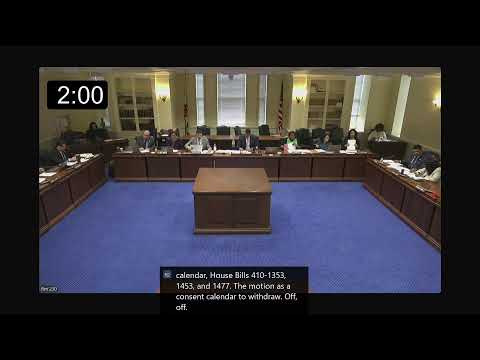
Consent items and withdrawals: A consent motion was used to withdraw several bills listed on the calendar (transcript references include bills listed as withdrawn; specific bill numbers named in the consent motion were included in the record). The committee chair closed the hearing and reminded members to follow up with staff and floor leaders about bills carried to the floor.
Votes at a glance (outcome): - House Bill 193: Passed as amended (amendment reduced additional assessment from 2% to 1.5%). - House Bill 917 (Maryland Securities Act filing fees): Passed as amended (removed fee for amended filings). - House Bill 956 (AI implementation work group): Passed (favorable). - Electric cooperative rate proceedings bill (number not specified): Passed as amended (added PSC public-hearing requirement). - House Bill 1,162 (HVAC licensing): Passed (favorable recommendation). - House Bill 11,71 (corporations/associations revisions): Moved favorable as amended after sponsor's explanation; one motion to withdraw was noted during the discussion. - House Bill 12,10 (LCSW-C impairment evaluations): Passed (favorable recommendation). - House Bill 13,47 (security guards and cannabis): Passed (favorable recommendation). - Several additional bills listed on a consent calendar were withdrawn by unanimous consent (transcript lists specific bill numbers in the consent motion).
The committee recorded roll-call votes on multiple measures; the transcript contains the roll-call statements and attendance markers. Where the transcript did not provide a clear, legible full tally for every member, committee minutes and the official roll-call record should be consulted for precise vote counts.
The committee adjourned its hearing and voting session after completing the day's calendar and reminded members to watch for emailed materials and to coordinate with staff on bills they will carry to the full floor.