Get Full Government Meeting Transcripts, Videos, & Alerts Forever!
Get email alerts on the Abortion Policy topic
No spam. Unsubscribe anytime.
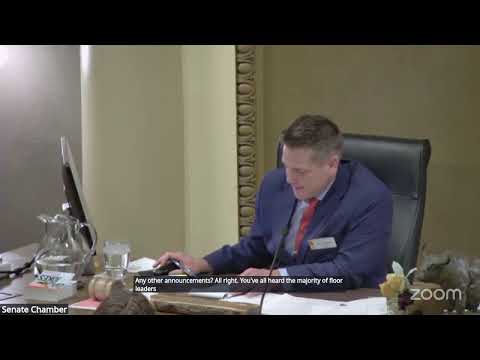
Wyoming Senate overrides governor—s veto of chemical-abortion restrictions after hours of debate
Summary
The Wyoming Senate on March 5 voted 22-9 to override the governor—s veto of House Enrolled Act 35, original House Bill 64, a measure that imposes new requirements on chemical abortions including a required ultrasound procedure and a 48-hour waiting period.
CHEYENNE, Wyo. — The Wyoming Senate on March 5 voted 22-9 to override the governor—s veto of House Enrolled Act 35, original House Bill 64, a measure that imposes new requirements on chemical abortions including a required ultrasound procedure and a 48-hour waiting period.
The motion to reconsider and override was made on the Senate floor under Article 4, Section 8 of the Wyoming Constitution. After roughly an hour of discussion and multiple rounds of remarks from senators on both sides, the chamber recorded 22 ayes and 9 nos and the override passed.
Supporters called the bill a protection for mothers and unborn children. "This bill is about protecting not only the mother but the child," Senator Pearson said on the floor. "…the facts are that these abortion drugs are not safe after a certain gestational period of the baby." Senator Crum, identifying as pro-life, urged passage while acknowledging the bill—s flaws, saying he had sought to remove the transvaginal ultrasound requirement and that the measure "needs some work."
Opponents said the law is punitive, medically unnecessary and risks re-traumatizing survivors of sexual assault. "I am against the veto override," Senator Raufelz said, reading from the governor—s veto message and urging colleagues to sustain the veto. Senator Case argued the bill "has no medical necessity" and called the required transvaginal ultrasound an "incredibly invasive procedure" that would add cost and delay to medical care. Senator Ralphs warned the statute would make access harder in rural areas and characterized the measure as an effort to "make it difficult" for people seeking abortions.
The debate repeatedly referenced constitutional and legal limits. The Senate conducted the reconsideration motion pursuant to Article 4, Section 8 of the Wyoming Constitution; Senator Case also invoked Article 1, Section 38, which addresses rights to make health-care decisions.
On procedure, the motion before the Senate was phrased as a reconsideration of House Enrolled Act 35 and a vote to override the governor—s veto. A message on the Senate floor explained that a vote of "aye" would override the veto and a vote of "no" would sustain it. The chief clerk called the roll after senators completed debate. The final announced result was "Veto override House Bill 64 22 I 9, no," and the presiding officer declared the motion carried.
The floor debate touched on specific provisions in the bill as drafted: a requirement for an ultrasound that some speakers described as transvaginal, an attendant fee for that procedure, and a mandatory 48-hour waiting period before a chemical abortion could be performed. Several senators said the bill was intended to protect life; others said the provisions were outside standard medical practice and would harm victims of sexual assault and people in rural communities who must travel for care.
Senators calling for sustaining the veto cited the governor—s veto letter and warned the measure would compound trauma for victims of sexual violence. "How does that make sense to traumatize these women who are at a terrible point in their lives and are victims ... to victimize them again," Senator Case said.
Supporters replied that the bill helps ensure accurate dating of pregnancies and protects health. "We give women an opportunity to make sure that they're making the right decision for themselves," Senator Smith said.
With the override passed, the law will become effective according to the timelines specified in the enrolled act and state law. The text of House Enrolled Act 35 (House Bill 64) and related legislative materials will be available from the Secretary of State and the legislative record.
Votes at a glance: The motion to override the veto of House Bill 64 passed with 22 ayes and 9 no votes, as announced on the floor.
The debate and vote on HB64 took place during the Senate—s March 5 session; remarks and roll-call votes are part of the public Senate journal and the recorded transcript for that day. The measure and the governor—s veto message were discussed on the Senate floor during the reconsideration and override process.