Get Full Government Meeting Transcripts, Videos, & Alerts Forever!
Get email alerts on the Homelessness Budgeting topic
No spam. Unsubscribe anytime.
Our City, Our Home oversight committee hears revenue forecast, midyear spending update as Prop M and litigation cloud outlook
Summary
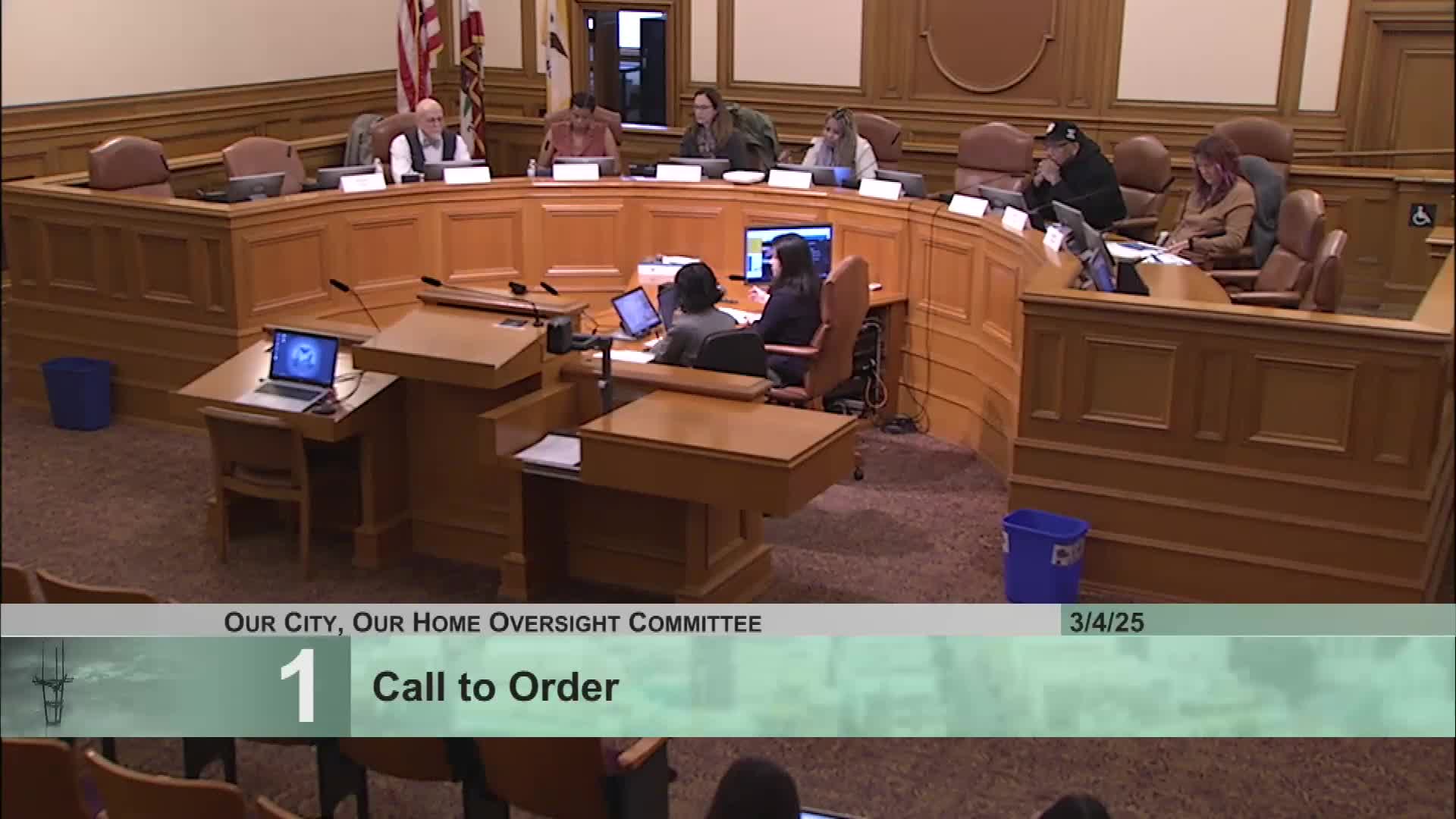
The Our City, Our Home Oversight Committee met in San Francisco on March 4, 2025, to review a new revenue forecast for the OCO fund and a midyear fiscal update showing program spending, reserves and outstanding obligations as the city prepares budget recommendations for the mayor and the Board of Supervisors.
The Our City, Our Home Oversight Committee met in San Francisco on March 4, 2025, to review a new revenue forecast for the OCO fund and a midyear fiscal update showing program spending, reserves and outstanding obligations as the city prepares budget recommendations for the mayor and the Board of Supervisors.
The presentations, led by Radhika from the Controller’s Office Budget and Analysis Division and Robbie (budget staff), showed the fund faces a structural gap between recurring spending and projected annual revenue, and identified litigation claims and the phased implementation of Proposition M as key risks to near-term availability of money.
Radhika said, "Forecasts are, of course, just our best thinking, at 1 point in time," and emphasized the timing of budget steps: departments submit proposals to the mayor in March, the mayor’s budget is released June 1, and the Board completes final action in July. She told the committee the current five‑year forecast focuses on the next two fiscal years and projects roughly $325 million in revenue for the first budget year and $336 million for the following year, while noting a 3% growth assumption and persistent volatility tied to office vacancies, business tax disputes and national economic conditions.
Key figures from the midyear presentation:
- The OCO fund’s revised budget authority is $785 million, which includes unspent prior-year allocations plus the $274 million budgeted for FY 2024–25.
- Departments reported $167 million spent in the first half of FY 2024–25 and project an additional $247 million in spending in the second half of the year.
- About $99 million is listed as obligated (mostly one‑time allocations for the Safer Families program and TAY housing expansions).
- The fund includes roughly $158 million in reserves and a projected remaining balance of about $115 million driven largely by one‑time program savings, including the mental health acquisition allocation.
The committee heard historic shortfalls in actual revenues compared with earlier budget projections. Radhika showed prior-year comparisons: the fund was budgeted at $335 million in the first full year but actuals came in near $279 million (a $57 million gap), and a subsequent year budgeted at $313 million came in at about $248 million (a $66 million gap). For FY 2024–25 the city initially budgeted $274 million and the current projection is roughly $268 million, though the presentation noted final revenue is not known until after fiscal year end in September.
Committee members and department staff discussed several program and operational details that could affect spending and the ability to deliver services.
- Permanent housing: Radhika and HSH staff said permanent housing remains the largest share of spending. State Homekey awards for two sites (listed in the presentation as 685 Ellis and 42 Otis) freed OCO allocations for other uses. The presentation also noted a midyear opening at 1174 Folsom and partial‑year operations for affected sites.
- Mental health: Departments reported continued expansion of residential treatment beds and outreach teams. The presentation cited a 33‑bed residential program for justice‑involved women (HER House) opened in early 2024 and identified a mental health facilities acquisition pool that accounts for a substantial portion of one‑time balances.
- Prevention and case management: Departments described full implementation of programs such as SF ERAP, problem solving and eviction prevention. MOHCD staff said they expect to spend their OCO emergency rental assistance funds down and noted some federal timing constraints that affect whether specific federal dollars can be spent within their required timeframes.
- Shelter and hygiene: The city opened a new cabin site (The Commons) in the Bayview and is carrying demobilization costs for the Candlestick vehicle triage center scheduled to close in March.
Staffing capacity was discussed as a continuing operational constraint. Christine Roland, budget director at the Department of Homelessness and Supportive Housing (HSH), said, "We have been staffing up," but added that internal promotions and new initiatives create ongoing vacancy and transition dynamics as HSH scales programs.
Legal and policy risks: presenters repeatedly flagged litigation and implementation of Proposition M as material uncertainties. Radhika cited recent litigation examples the presentation named as claims by General Motors ($40 million) and Lyft ($48 million) to illustrate how the city holds back revenue to cover litigation risk. The forecast also factors in Proposition M, but Radhika warned the full effect may not be known until November 2026, when implementation and filing timing are clearer.
Committee members asked for additional breakdowns and follow‑up information the departments agreed to provide. Member Friedenbach asked for a housing breakout by population and by program type (for example, how much of any remaining housing balance is in scattered‑site versus supportive‑site funding). HSH and controller staff said they would attempt to provide more detailed program‑level breakout and planned fuller budget briefings at liaison meetings. Vice Chair D'Antonio asked about how litigation and legal fees are accounted for; staff explained revenue is held back prior to appropriation to account for litigation risk and that litigation assumptions are embedded in the forecast.
No formal votes or motions were taken during the special meeting. Public comment periods for the agenda items produced no in‑person or phone comments.
Why this matters: The OCO fund supports the city’s core homelessness response—permanent housing, shelters, prevention and behavioral health—so shifts in revenue projections or use of reserves affect program continuity and potential changes to service levels. Departments told the committee they will rely on one‑time savings and reserves while revenue remains volatile and until Proposition M implementation and litigation risks are resolved.
Committee next steps and follow up: staff said departments will present detailed budget proposals to the committee later in March and liaisons will convene in April to form the committee’s budget and policy recommendations for the mayor’s June budget. Members requested additional data (program‑level spend projections by population, magnitude of litigation holds as a ballpark figure, and details on mental‑health acquisition negotiations) to inform those recommendations.
Ending note: The committee adjourned after the two agenda items. Staff indicated they will return with more detailed program and budget materials for liaison meetings and for the committee’s April deliberations.