Get Full Government Meeting Transcripts, Videos, & Alerts Forever!
Get email alerts on the Small Business Support topic
No spam. Unsubscribe anytime.
Budget panel hears case to extend First Year Free small‑business fee waiver
Summary
San FranciscoBudget and Finance Committee received updates on First Year Free, which has enrolled about 9,400 businesses and waived nearly $5 million in initial fees since November 2021, and was urged to extend the program beyond its July sunset to allow for technical upgrades and better interdepartmental coordination.
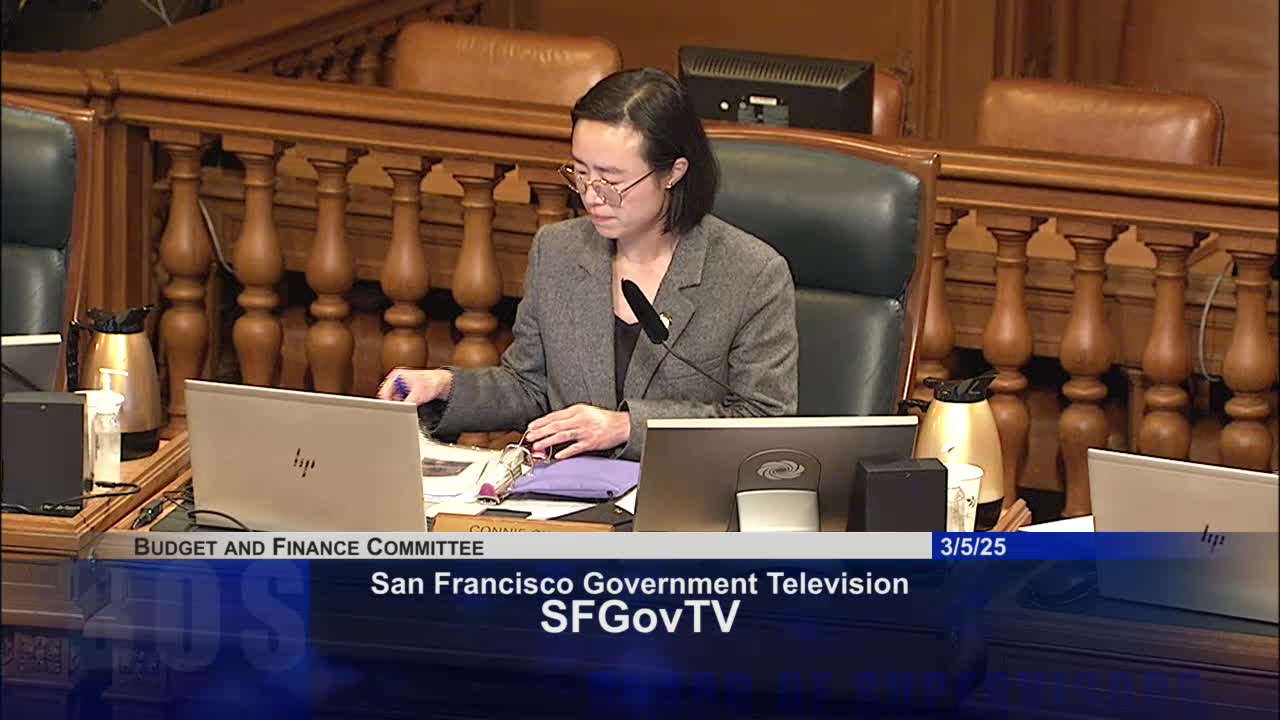
The Budget and Finance Committee on March 5 heard a report on First Year Free, the city program that waives initial registration, permit, application and initial license fees for newly registering small businesses and new storefront locations.
Supervisor Steve Sherrill, who requested the hearing, said First Year Free was intended to make it easier to open and sustain small businesses in San Francisco. Amanda Free, Chief of Policy and Communications at the Treasurer's Office, and Katie Tang, Director of the Office of Small Business, presented program results and operational challenges to the three-member committee chaired by Supervisor Connie Chan.
The program has enrolled about 9,400 businesses since it began in November 2021 and has resulted in nearly $5 million in waived fees, presenters said. To qualify, a business must have $5 million or less in San Francisco gross receipts and a registered commercial location. The Treasurer's Office described an automatic enrollment workflow: businesses that complete the city—orm new business registration are identified by embedded questions, receive a confirmation pop-up and follow-up email, and get a mailed letter they can show to permitting agencies. The office also maintains a lookup system that permitting departments can use to confirm eligibility.
"First Year Free is truly a multi‑departmental labor of love," Amanda Free said during the presentation. Katie Tang of the Office of Small Business described the program as a marketing and retention tool for entrepreneurs, offering examples of businesses that saved from roughly $1,800 to more than $11,000 on permit and license costs depending on the scope of work.
Presenters and committee members outlined several operational hurdles. The Treasurer's Office said city billing and collections are not uniformly integrated across departments: when contractors, architects or consultants pull permits the business account on the permit may not match the underlying business and the waiver may not be applied. In such cases, staff said the Treasurer's Office will contact the relevant agency and request a refund on behalf of the eligible business. The Treasurer's Office said two positions are funded there to support the programone in accounting to reconcile department reimbursements and one in customer service.
Committee members heard that, because First Year Free has operated as a pilot and been extended periodically, some departments have not invested in technology or process changes that would reduce administrative friction. Presenters said longer certainty would make such investments more feasible: a 5‑ to 10‑year runway would allow the city to upgrade systems, better integrate billing and permitting, and change business processes that currently create false negatives when identifying eligible businesses.
Committee members asked about overlap with Proposition M, the 2024 voter-approved restructuring of the city's business tax system. Amanda Free said Prop M provides a modest waiver that typically covers the first year of an annual health license; Prop M does not replace the broader suite of waivers covered by First Year Free and therefore does not eliminate the program's fiscal impact.
No members of the public spoke on the item. After questions and discussion, the committee voted 3–0 to "hear and file" the item; Chair Connie Chan moved the motion and Vice Chair Matt Dorsey and Supervisor Joe Ingardio voted aye.
Why it matters: Committee members and presenters framed First Year Free as a policy tool that can help fill vacant storefronts and encourage entrepreneurs to open or expand in San Francisco while noting the program's continuing budgetary impact and the technical work needed to make fee waivers reliably automatic across departments. The Treasurer's Office and the Office of Small Business recommended extending the program so the city can invest in the interdepartmental systems changes they say are necessary to maximize the program's efficiency.
The clerk noted items acted on at the committee are expected to appear on the full Board of Supervisors agenda on March 11 unless otherwise stated. The committee's action on First Year Free was recorded as "heard and filed."