Get Full Government Meeting Transcripts, Videos, & Alerts Forever!
Get email alerts on the Education Charter Schools Funding topic
No spam. Unsubscribe anytime.
Halau Ku Mana students urge OHA help after federal funding freezes threaten cultural programs
Summary
Students from Halau Ku Mana public charter school told the OHA committee that federal grant freezes imperil culture-based learning, off-island "week" trips and technology projects; they asked OHA for assistance to replace lost grants and preserve Hawaiian-language instruction.
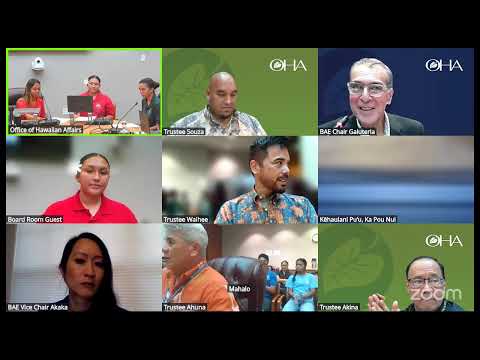
Eighth- and ninth-grade students from Halau Ku Mana testified to the Office of Hawaiian Affairs Committee on Beneficiary Advocacy and Empowerment on March 5, saying federal funding freezes have jeopardized school programs that support Hawaiian-language instruction and place-based, hands-on learning.
"Kumana receives 65% less funding per student compared to a regular DOE school," said Lillian Ordogaro, an eighth-grade student, describing why the school depends heavily on grants and federal support. "We depend so much on federal funding that this loss makes me worried that Halau Ku Mana could be shut down or go solely online." The students asked OHA to help identify replacement funding and to advocate with federal agencies for equitable treatment of Hawaiian-focused charter schools.
Why it matters: Students described field-based education called Aloha'aina education days and an annual multi-day "week" trip funded by a Bay Watershed Education and Training (BWET) grant; one student said the BWET funding loss represented about $530,000 for the school. Another student said Department of Interior funding freezes jeopardize roughly $430,000 for the school's environmental and cultural education.
Students' requests and examples Students and teachers told trustees that the programs pay for plane tickets, camping supplies and community-based cultural instruction. They gave specific examples of past activitiesplanting native trees with Aloha Tree Alliance, visiting Kauai and Molokai to work in wahi pana, and participating in the Onipa'a march.
Several students asked OHA to support a technology center at the school if private or federal resources remain unavailable. One student described a Department of Hawaiian Homelands offer to provide video equipment and asked OHA to help convene partners and funding sources for a classroom technology hub and improved Hawaiian-language staffing.
Board and staff response Trustees thanked students for testifying in person and said they would work to coordinate support. Trustee Souza said she had received multiple emails from students and would continue to pursue strategic ways OHA could help. OHA CEO Stacy Ferrera told the students the agency values their testimony and that trustees and staff view the students as future leaders.
No committee action was taken; the testimony was part of the meeting's community-concerns segment. Students and trustees said they expect ongoing follow-up outside the formal vote record.