Get Full Government Meeting Transcripts, Videos, & Alerts Forever!
Get email alerts on the Biking And Rolling topic
No spam. Unsubscribe anytime.
SFMTA board adopts long-range biking and rolling plan, asks staff for school-zone and crosstown implementation timelines
Summary
After three years of outreach the SFMTA board voted unanimously to adopt the city's new biking and rolling plan. The board and staff emphasized the plan is a policy guide, not an immediate funding authorization, and directed staff to return with school-zone and crosstown implementation plans.
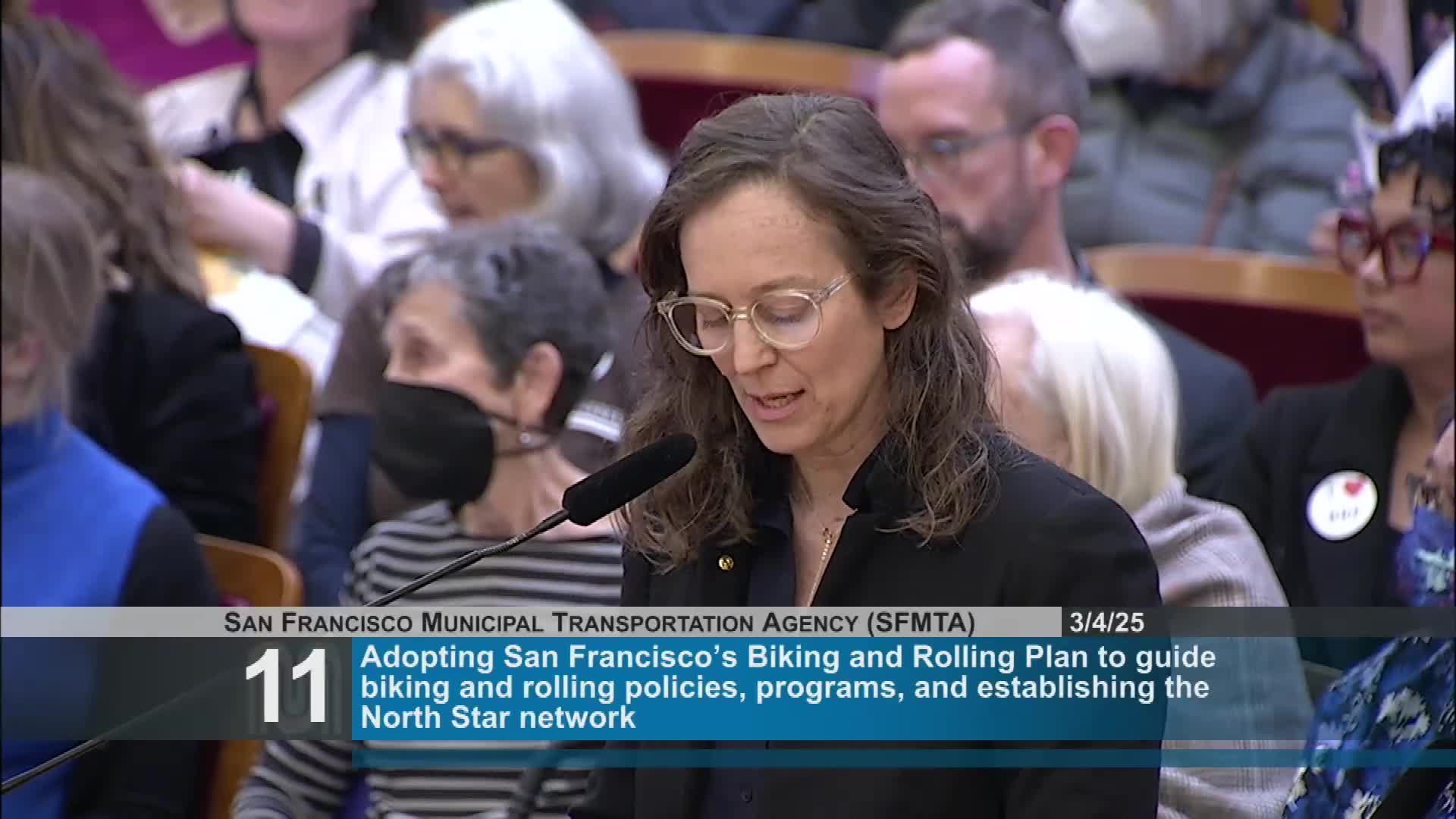
San Francisco ' The Municipal Transportation Agency board voted unanimously on March 4 to adopt San Francisco's long-awaited biking and rolling plan, a policy guide the agency says lays out a North Star network for protected bikeways and a framework for community action in historically underserved neighborhoods.
The plan, staff told the board, sets goals, policy direction and an annotated North Star network intended to bring an all-ages-and-abilities bikeway within a quarter mile of every resident. Planning Director Maya Small told the board the adoption does not approve specific capital projects or commit agency operating funds: "This plan guides where we might do projects in the future; it does not approve any projects. Approving this plan does not commit us to spending any money."
The vote capped nearly three years of outreach, technical analysis and contentious public comment. Supporters including Walk San Francisco, the San Francisco Bicycle Coalition and neighborhood advocates said the plan addresses safety, equity and the city's climate goals. Opponents and some merchants urged caution, saying the plan lacks short-term budgets and that boards should not adopt a document that could be read as pre-approval for future street changes.
What the plan does and does not do
SFMTA staff described the adoption as a policy-level endorsement and emphasized several limits. The plan does not: - Approve or fund any specific bikeway projects today. - Close any additional streets to cars as part of the adoption. - Reallocate operating funding for Muni service; staff said voter-directed sources and grants typically fund bikeway projects.
Staff noted funding for projects comes largely from dedicated grants and voter-approved measures that legally cannot be redirected to Muni operational budgets. The presentation named Prop B (street safety allocation), Prop D (TNC/traffic mitigation excise tax) and Prop L as examples of funding streams that are directed to street safety projects.
Board directions and follow-up
Board members pressed staff for clearer near-term accountability. Several directors asked for concrete follow-up steps; Vice Chair Kahina asked staff to return with a draft plan for slow school zones in nine months and for a formal adoption within a year. Multiple board members asked staff to return within 12 months with a roadmap for crosstown routes that meet all-ages-and-abilities standards.
Staff committed to returning with a school-connection plan and to ongoing reporting on project priorities, funding availability and community implementation steps. Streets Director Victoria Wise and project manager Kristy Osorio described community action plans developed for neighborhoods such as the Tenderloin, Bayview Hunters Point and the Mission; staff said those community-led plans will inform prioritization and local outreach.
Public comment and main arguments
Supporters said the plan will reduce crashes, lower emissions and expand options for people who depend on transit, walking or biking. Walk San Francisco's Fiona Yim and the Bicycle Coalition's Christopher White told the board that left-turn reintroductions and other design changes should always be evaluated against safety data; both urged keeping safety central to design decisions.
Opponents including Save Muni and some neighborhood speakers said the plan lacked cost estimates, that outreach did not capture all affected residents, and that approving a comprehensive map without time lines risked making future projects harder to oppose. Bob Feinbaum of Save Muni said the plan's maps and lists of candidate projects were effectively a streets plan and urged the board not to adopt a plan that could be read as pre-approval for dozens of future actions.
Why it matters
SFMTA staff framed the plan as part of citywide policy commitments including Transit First, Vision Zero and the Climate Action Plan. Staff said biking and rolling projects tend to increase ridership for short trips, improve neighborhood connections to schools and transit, and can be funded from grants and voter-directed street safety funds rather than Muni operating revenues.
Ending
Board members voted 5-0 to adopt the plan and directed staff to return on a set of near-term deliverables, including a school-zone implementation framework within nine months and a plan for prioritized crosstown routes within a year. The SFMTA will continue to present specific projects and funding requests to the board for individual approvals.