Get Full Government Meeting Transcripts, Videos, & Alerts Forever!
Get email alerts on the Native Hawaiian Burial Sites topic
No spam. Unsubscribe anytime.
OHA committee approves working group to study transfer of Native Hawaiian burial duties from SHPD
Summary
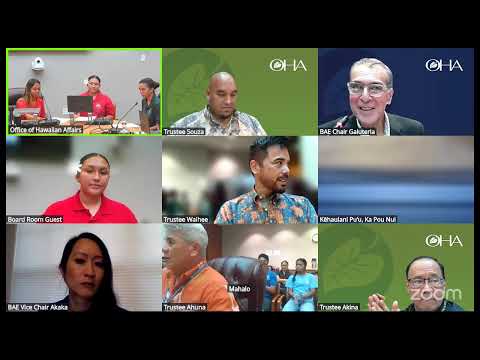
The OHA Committee on Beneficiary Advocacy and Empowerment approved a resolution on March 5 to form a working group to examine transferring, or partially transferring, Native Hawaiian burial-site duties under Hawaii Revised Statutes Chapter 6E from the Department of Land and Natural ResourcesState Historic Preservation Division to the Office of Hawaiian Affairs.
The OHA Committee on Beneficiary Advocacy and Empowerment approved a resolution on March 5 to form a working group to examine transferring, or partially transferring, Native Hawaiian burial-site duties under Hawaii Revised Statutes Chapter 6E from the Department of Land and Natural Resources(DLNR) State Historic Preservation Division(SHPD) to the Office of Hawaiian Affairs.
The working group is intended to study the scope, staffing, costs and statutory changes that a transfer would require. "To have a bill just abruptly transfer the native Hawaiian burial component to OHA would be really disruptive," said Lena Alalei, OHA chief advocate, during the committee discussion. "There needs to be...full information from the agencies about the impacts, how this is gonna happen." The committee voted to adopt the resolution after agreed edits to remove several paragraphs that SHPD had flagged as unduly critical of the division.
Why it matters: The duties under HRS Chapter 6E affect how burial sites discovered during construction or land development are handled, how island burial councils (IBCs) operate, and how families register kupuna burials so future property owners receive notice. Shifting responsibilities would change which agency provides training, legal support and archaeological review for projects that may affect burials.
Discussion and proposed working-group scope Members and staff described the program as large and administratively complex. Committee materials and staff remarks listed example duties that the working group would evaluate, including: processing applications for recognition of lineal and cultural descendants; training and supporting IBC members on statutory and administrative responsibilities; recording and registering kupuna burial sites; and operating the historic-review process, which typically requires archaeologists to assess proposed development activity.
The resolution proposes a working-group membership that would include two OHA representatives, two SHPD representatives, representatives from island burial councils, and a representative from the primary repatriation organization OHA has worked with (identified in committee comments as Kui'i'i Kua Mo'o). OHA staff said the group would also ask questions about staffing, infrastructure, funding sources and how legal advice would be provided to burial councils.
Trustees and public commenters emphasized that the working group is an examination, not a transfer. Trustee Wahei asked what would happen after the working group makes a recommendation; staff said a final recommendation would come first to the OHA Board of Trustees, which could then consider legislative proposals.
Amendments and outcome OHA staff reported having discussed the draft with SHPD and proposed deleting three paragraphs that SHPD found overly critical; the chair accepted those amendments into the record. The committee adopted the amended resolution and established the working group; the motion passed with no recorded opposition.
What the committee did not decide The committee did not adopt any statutory language effecting an immediate transfer and did not set a timetable for the working grouponly that it be formed to examine options and report back for Board consideration.
Next steps OHA staff said the working group would collect information on current SHPD staffing and costs, identify gaps, and evaluate the funding that would be needed for OHA to assume listed duties. Any recommendation to change state statute would require separate Board action and likely legislation.