Get Full Government Meeting Transcripts, Videos, & Alerts Forever!
Get email alerts on the Arts Funding topic
No spam. Unsubscribe anytime.
Cambridge committee hears update on arts funding, ARPA relief and cultural programs
Summary
City officials and nonprofit partners reviewed Cambridge Arts programs, pandemic recovery grants funded with ARPA dollars, and new efforts to preserve and expand cultural space, including a proposed cultural facilities endowment and artist residencies.
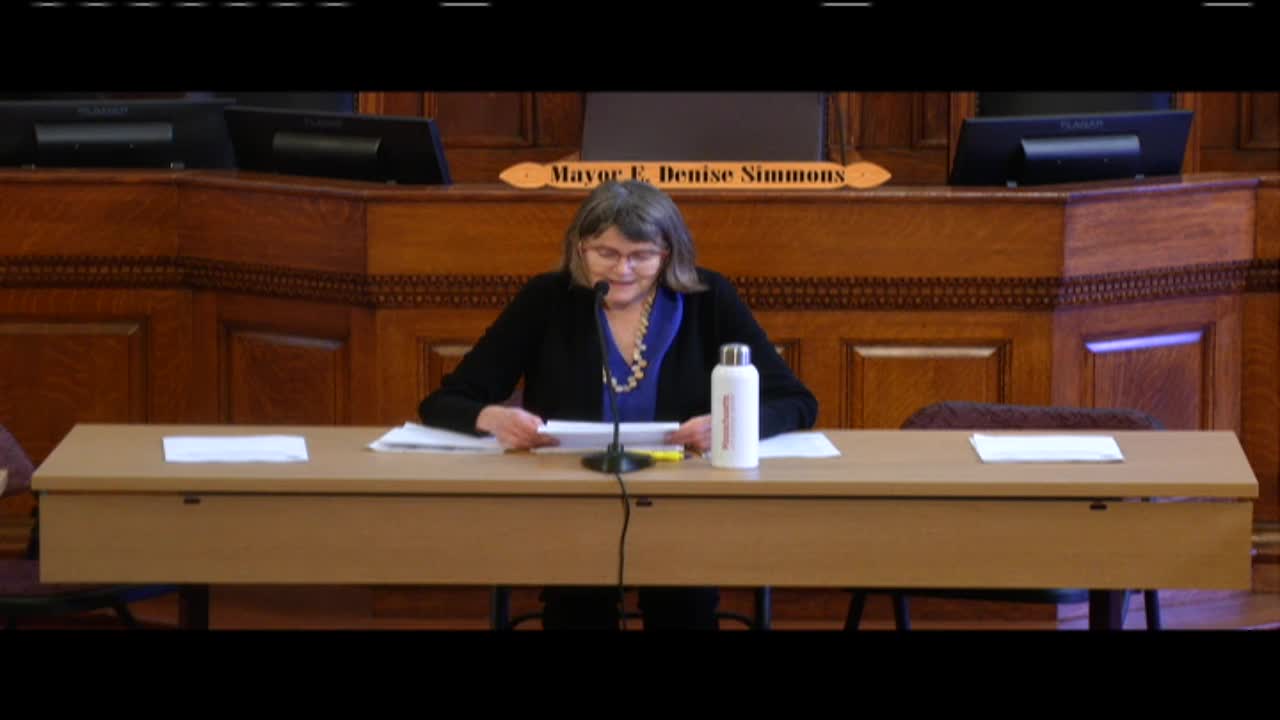
Councilor Kathy Zusi, co-chair of the Neighborhood and Long Term Planning, Public Facilities, Arts, and Celebration Committee, opened the meeting by urging the city to invest more in arts and artists, saying, “Currently, we dedicate less than $2,000,000 of our $1,000,000,000 city budget to the arts and celebrations.”
The committee heard from Jason Weeks, executive director of Cambridge Arts, who described Cambridge Arts' three core roles — funding, presenting and connecting creative activity — and highlighted the department's use of American Rescue Plan Act (ARPA) funds to support artists and cultural organizations during pandemic recovery.
Cambridge Arts presented a mix of operating and programmatic work that city staff and nonprofit partners said aims to strengthen both artists and arts organizations. Weeks noted the city's public art collection has nearly 600 discrete parts and described grant programs that include organization support, project-based grants, and arts-for-social-justice awards. He also highlighted recent participatory-budgeting work that produced a community mural on Pemberton Street.
Matt Nelson of the city manager's office said the city has distributed nearly $2.5 million from ARPA to arts and culture initiatives, including a $450,000 Create Cambridge recovery grant pool that supported local organizations. Christina Turner, vice president of programs and grantmaking at the Cambridge Community Foundation, and Geeta Pradhan, the foundation's president, described the foundation's responsive grantmaking and its work to build a longer-term cultural capital fund. Turner said, “Last year more than 20%, about $178,000 worth of our grants through the Community Fund were awarded through arts and arts and culture organizations.” Pradhan said the foundation aims to develop a cultural facilities fund and noted the foundation has begun a feasibility study; she said the fund’s initial internal endowment is approximately $250,000 and that a $5 million target has been discussed.
Claudia Zarazua, arts and cultural planning director at the Community Development Department, described new professional development workshops for artists (topics include grant writing and financial literacy), a pilot municipal artist-in-residence program with the public health department and library, and a nightlife grant pilot that will provide awards up to $5,000 to support public performances. Zarazua also described climate- and health-focused creative initiatives, including temporary shade structures in public parks built with MAPC grant support.
City staff said they are compiling data to map cultural spaces across Cambridge and with neighboring Boston and Somerville to identify at-risk venues and guide policy, including rezoning language that would incentivize creation and preservation of cultural space in the Central Square district. Staff also said the city issued an RFI for redevelopment of municipal Lot 84 Bishop Allen with an explicit request for cultural space; responses have been received and will be summarized in a forthcoming report to council.
The meeting included several nonprofit partners who described grant uses and ongoing needs. Cambridge Arts and the Cambridge Community Foundation encouraged residents and private donors to support multi-year operating and capital funding to sustain small and legacy arts organizations.
City and foundation representatives said they are coordinating to improve directories and asset inventories; panelists noted a Mass Cultural Council asset inventory will be circulated statewide in March and could be used to build a more comprehensive Cambridge directory.
Looking ahead, staff said they will provide the council with a summary of RFI responses for municipal lots, continue the participatory artist-in-residence and professional development initiatives, and work with the foundation on the cultural capital feasibility study.