Lifetime Citizen Portal Access — AI Briefings, Alerts & Unlimited Follows
Beaverton staff briefs council on how transportation safety decisions are made under state, federal rules
Loading...
Summary
City staff explained Beaverton’s multi-tiered process for handling transportation requests — from minor repairs to extreme hazards — and described how the Manual on Uniform Traffic Control Devices and state rules limit local discretion.
Beaverton city staff told the City Council on March 2025 that transportation decisions — from replacing a fallen sign to installing traffic-calming devices — follow a tiered process set out in the city code and must align with state and federal guidance.
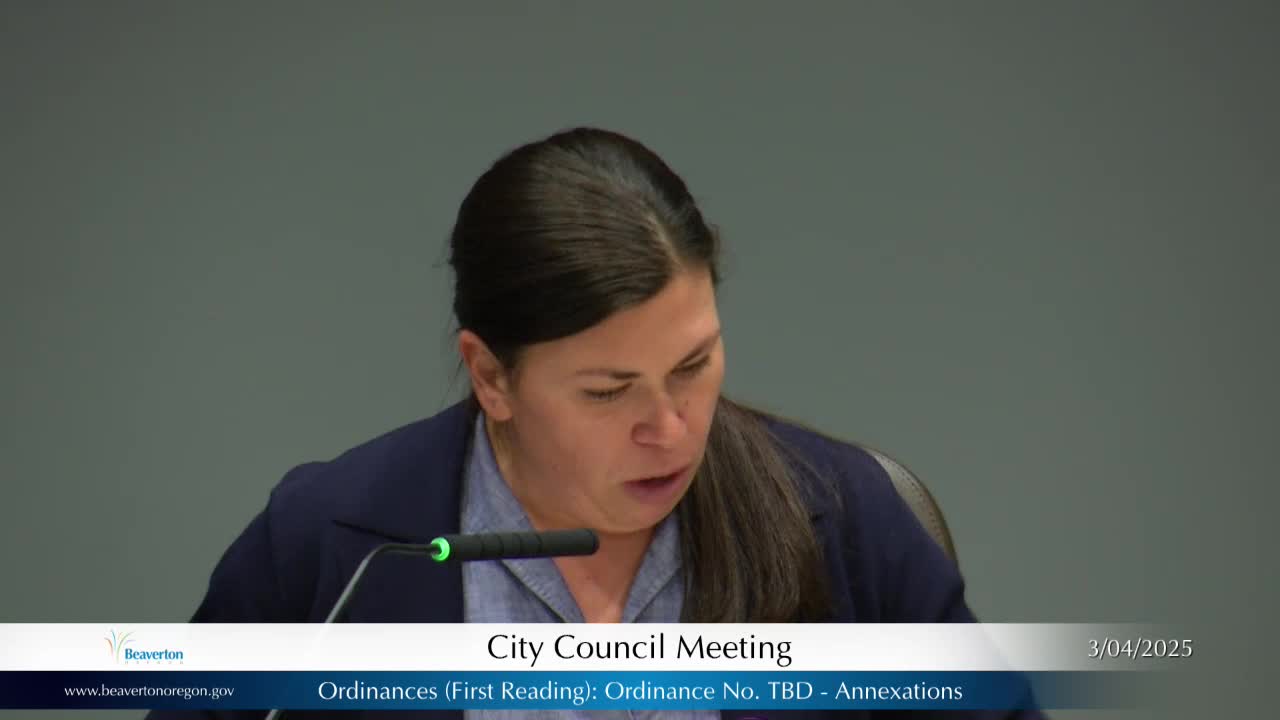
"The two questions that we're here to answer tonight are, first of all, what is the process for addressing transportation issues? And then when does the city have flexibility to deploy context-based solutions versus following state or federal standards," said Carol Hall, Beaverton's assistant transportation engineer and traffic engineer, at the start of the work session on Agenda Bill 25,037.
Hall said the code designates three decision-makers: the City Council, the Traffic Commission and the city traffic engineer, and defines five categories of requests: development review, minor issues, major issues, emergency issues and extreme hazards. Minor items — such as fixing a fallen sign or enforcing existing parking limits to restore sight lines — can be decided by staff and implemented after notifying the requester. Major changes, like citywide on-street parking removals or traffic-calming devices, are typically routed through Traffic Commission for public hearing and then to the council for final approval.
Tim, a city transportation staff member, described why state and federal guidance constrain local choices. "The cardinal sin of any transportation engineer is to surprise the driving or traveling public," he said, arguing that the Manual on Uniform Traffic Control Devices (MUTCD) promotes consistency and helps limit legal liability. He said failure to follow the MUTCD can increase the city's exposure in lawsuits and risk loss of federal funds for projects.
Hall and Tim also described two faster tracks: an "emergency issue" process, which the city manager may designate to speed a major change to council for approval before implementation, and an "extreme hazard" authority that allows immediate staff action — without prior council approval — when an urgent safety closure is needed. Hall said the city could find no record of either the emergency or extreme-hazard processes being used in the last 20 years.
Both staff members reviewed the hierarchy of applicable documents: city code and engineering standards; the Beaverton Transportation System Plan; Oregon Revised Statutes and Oregon Administrative Rules; and the MUTCD and its state supplement. Hall noted Oregon must adopt the 2023 update to the MUTCD by January 2026, and the state supplement will then govern local practice in Oregon. Hall also corrected the transcript reference to the federal accessibility guidance as the Public Rights-of-Way Accessibility Guidelines (PROWAG).
Hall described the MUTCD’s experimentation pathway, which allows jurisdictions to propose an experimental treatment to the Federal Highway Administration, collect performance data and report results. She cited two examples: the flashing yellow arrow for left turns — which entered general use after successful experimentation that included Beaverton — and a high-visibility green bike lane trial in Southern California that did not survive the experiment.
Council members asked how much local flexibility exists for speed limits and other controls. Hall said the Oregon Department of Transportation (ODOT) has authority under state law to set many statutory speed limits and that cities can request a speed investigation by ODOT or, in some residential cases, apply limited local authority to alter lower statutory limits. She gave the example of a local request that led ODOT to lower a posted limit from 35 to 30 mph on a corridor identified in a recent investigation.
Council members also raised process questions: whether code updates would be needed after the state adopts the new MUTCD (Hall said Beaverton's code is written to follow the state-adopted MUTCD automatically), whether projects already in progress must be redesigned if standards change (staff said changes are governed by the project's approval stage), and how citizens should report issues (the city's "Report a Problem" webpage routes requests to public works).
On timelines, staff said minor repairs and sign replacements can be implemented in weeks, routine parking restriction changes typically take three to six months depending on workload and hearing schedules, and neighborhood traffic-calming programs often take about a year because of multi-stage review and public outreach. Hall said the city is planning program changes, including temporary implementations for traffic-calming trials, to shorten time to delivery.
During Q&A, several councilors voiced interest in delegating more authority to staff for lower-risk changes and in reviewing the code's multi-step review for potential consolidation. "If the council wanted us to come back with some flexible approaches and modify the code, you can," Hall said.
The meeting also handled routine business earlier in the agenda: the council approved the consent agenda — which included a letter of support for a Revolutionary War monument proposed for Beaverton Veteran Park and a recommendation that staff review memoranda of understanding with Tualatin Hills Park & Recreation District — by roll call, 6–0 with one absence.
Mayor Lacey Beatty praised the staff presentation at the end of the session: "This is one of the best presentations we've had all year," she said. The council had no further new business and adjourned at the end of the session.
The staff presentation provides a roadmap of how Beaverton evaluates transportation requests and the legal and technical constraints that shape local options. City staff said they will return with more details about the neighborhood traffic-calming program and possible code changes to speed lower-risk actions.