Get Full Government Meeting Transcripts, Videos, & Alerts Forever!
Get email alerts on the Solid Waste Assessment topic
No spam. Unsubscribe anytime.
Marion County commission approves ordinance increasing residential solid-waste assessment to $215
Summary
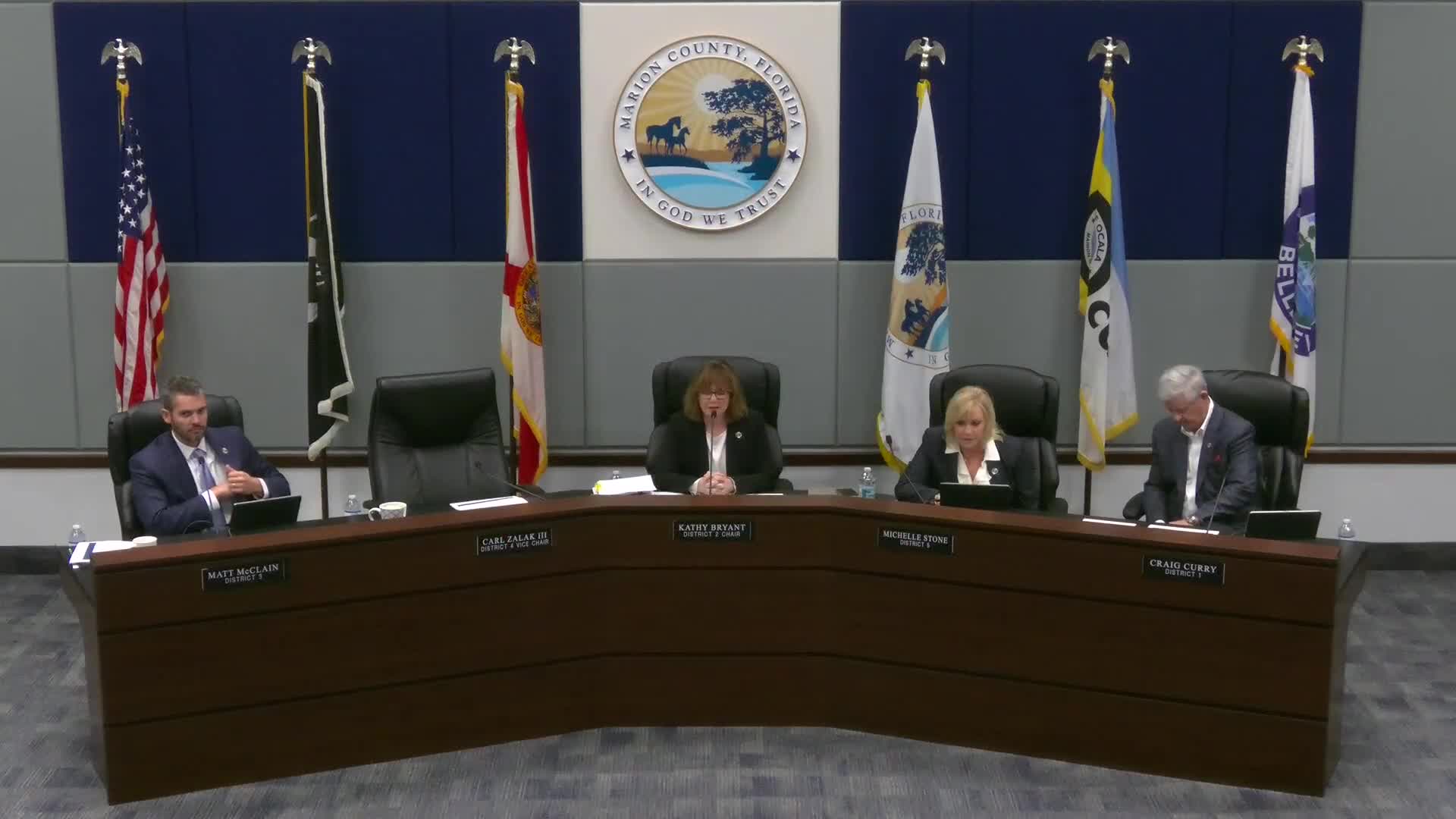
The Marion County Board of County Commissioners unanimously approved an ordinance amending Chapter 16 of the county code to raise the residential solid-waste assessment from $87 to $215 per year, with an annual cap of $225, citing exhausted prepaid landfill capacity, rising disposal costs and storm-recovery risk.
The Marion County Board of County Commissioners on a unanimous vote approved an ordinance to amend Chapter 16 of the Marion County Code to change the residential solid-waste assessment from $87 to $215 per year and to establish an annual cap of $225.
Mark Johnson, director of solid waste, told the commission the change responds to “revenue sufficiency for our solid waste fund” after the county began exhausting prepaid landfill capacity and has seen rising tonnage and costs. Johnson said the county has consumed 36% of its purchased capacity at the Heart of Florida landfill and projected county tonnage at about 207,000 tons for the current year.
The ordinance replaces language in Chapter 16 that tied annual adjustments to 1.5 times the Consumer Price Index and sets the assessment at $215, with authority for annual adjustment by resolution so long as the total does not exceed $225 per year for any assessable property. Johnson presented a track-changes version of the proposed code language during the hearing.
Nut graf: County staff and commissioners said the assessment change is intended to restore structural balance to the solid-waste fund, build reserves for storm debris and landfill closure obligations, and allow the county to pursue an expansion of its baseline landfill as a lower-cost alternative to continuing long-haul disposal at market rates.
Commission discussion focused on two implementation options: a phased-in approach (three-year ramp to a $225 cap, with intermediate steps at $150 and $190) versus a one-time increase to $215. Johnson and consultant Eric Rauch of Stantec outlined projected reserve outcomes: under the phased approach, unrestricted reserves in fiscal 2026 would be about $8.6 million; under a one-time $215 assessment, reserves would be about $16.6 million in that year. Johnson said the $215 option “brings that money in for unrestricted reserves earlier.”
Rauch said both options correct the structural imbalance, but the faster build of reserves under the one-time approach would leave more funds available to respond quickly to a major storm. Commissioners also noted that not all reserve use would be limited to storms: staff and the county attorney explained reserves are also required by law for landfill closure and for financing capital improvements tied to expanding the baseline landfill.
Public commenters urged different approaches. Joseph Walker of District 1 suggested a two-tier charge for homeowners and nonresidents, saying renters and businesses generate more waste; Walker asked, “Why don't we have a 2 tier on here?” Kirsten Angel, who identified herself as an Ocala resident, said she was worried about the proposed increase from about $80 to around $200 and requested more public outreach and time to review materials.
County officials answered questions about historical choices that lowered costs for residents. Vice Chairman Zalick and other commissioners said Marion County purchased 2,500,000 tons of disposal capacity at Heart of Florida in 2011 at a prepaid tipping fee of $8 per ton, which the board credited with keeping the assessment at $87 for many years. Commissioners warned that rapid population and tonnage growth has reduced the remaining life of that prepaid capacity and that market tipping fees elsewhere are substantially higher — Johnson said a prevailing regional rate is about $30 per ton and could rise to $36–$38 per ton by the time county capacity is exhausted.
Officials also reviewed storm-recovery examples and borrowing costs. Johnson cited Saint Petersburg’s recent $50 million borrow for storm cleanup at a 4% interest rate, producing roughly $4 million per year in debt service and $23 million total interest over 15 years; county staff noted FEMA reimbursement rules may not cover interest for cleanup costs and that FEMA reimbursement timing can be slow and uncertain.
After public comment the board voted. Commissioner Stone moved to approve the ordinance; Commissioner Curry seconded. The chair called the vote and the motion passed unanimously.
Ending: The ordinance was approved during the public hearing; staff and commissioners said they will follow the statutory TRIM notice deadlines and the county will proceed with next steps for rate notices and planning for landfill expansion and permitting work.