Get Full Government Meeting Transcripts, Videos, & Alerts Forever!
Get email alerts on the Emergency Preparedness Vulnerable Populations topic
No spam. Unsubscribe anytime.
Legislative hearing finds gaps remain in Californias protections for vulnerable residents during wildfires
Summary
At a joint legislative oversight hearing, the state auditor and advocacy groups described persistent shortcomings in county emergency plans, alerting systems and language access for older adults and people with disabilities, while Cal OES officials outlined training and guidance updates the agency has implemented.
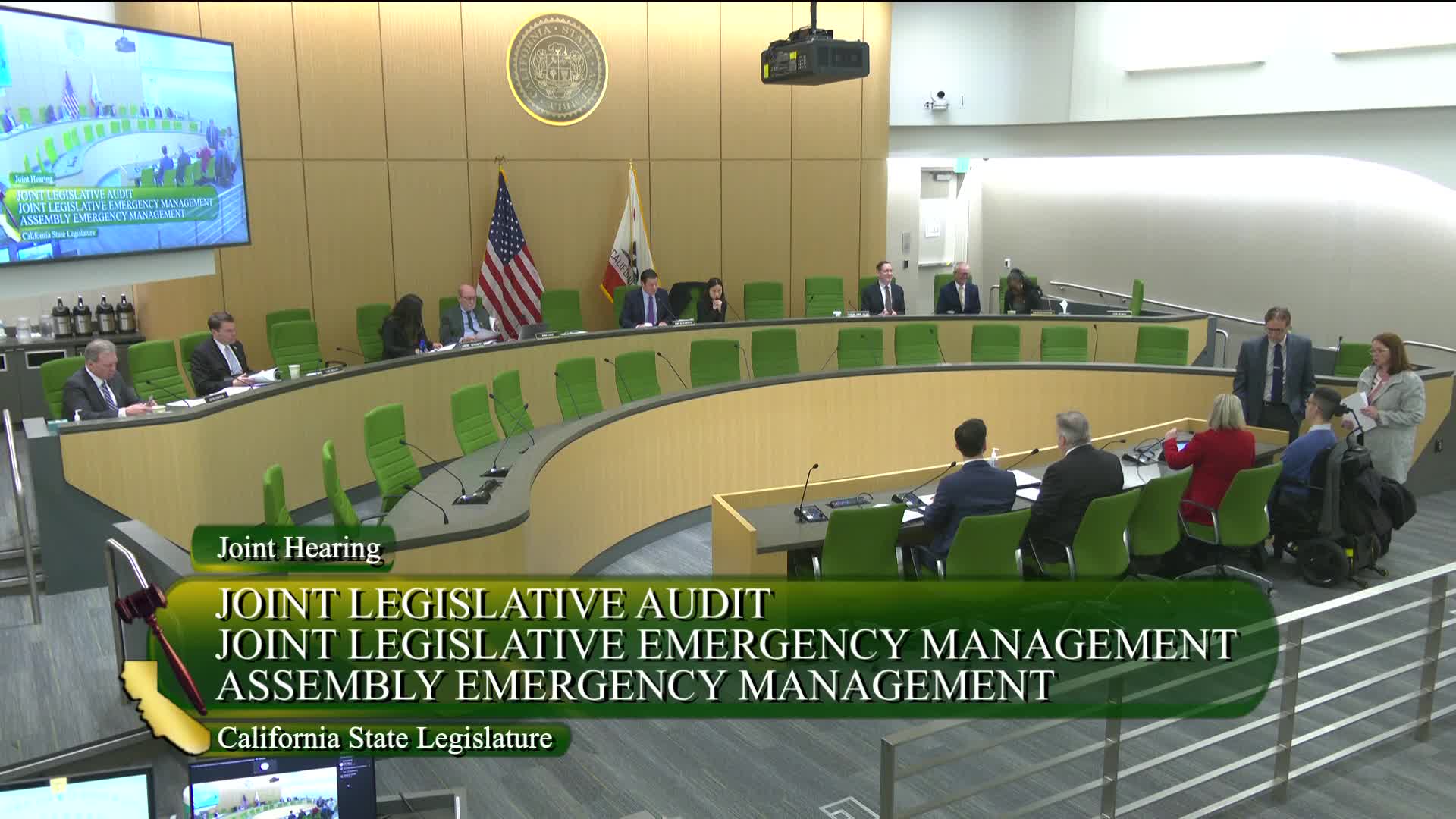
A joint oversight hearing of several California legislative committees heard that gaps identified in a 2019 state audit persist in how counties and the state prepare to protect older adults, people with disabilities and limited-English populations during wildfires and other disasters.
State Auditor Grant Parks summarized findings from the report California is not adequately prepared to protect its most vulnerable residents from natural disasters, saying the audit found county emergency plans were often missing, outdated or not aligned with FEMA best practices and that Cal OESs guidance was incomplete. "None of the counties we visited had complete and updated plans," Parks said, and he added that Cal OES at the time of the audit did not include best practices for people with access and functional needs in the state plan as required by law.
The audit examined three counties affected by 2017-18 firesButte, Sonoma and Venturaand flagged multiple problems: emergency alerts that did not use the FEMA wireless emergency alert (WEA) system or that failed to identify the message source, mass-notification calls that had 50 to 60% connection failures, and no systematic distribution of alerts in languages other than English. Parks told the committee that Butte, Sonoma and Ventura "could not demonstrate that they had solicited the perspectives and input of groups representing these vulnerable populations" when developing plans, and that counties lacked sheltering resources such as accessible beds and durable medical equipment.
Cal OES officials said the agency has since added resources, training and guidance. Laurie Najura, deputy director for planning, preparedness and prevention at the Governors Office of Emergency Services, said Cal OES and its Office of Access and Functional Needs have created a state AFN (access and functional needs) advisory committee, a priorities population task force, multi-language guidance and a statewide alert-and-warning guideline. Vance Taylor, chief of the Cal OES Office of Access and Functional Needs, described new guides, online trainings and a disaster response interpreter credentialing program and said the agency now reviews a minimum of 10 county emergency operations plans (EOPs) annually under legislation passed since the audit.
Advocacy groups and experts told the committee the remaining shortfalls are both practical and structural. Dr. David Lindemann, chair of the California Commission on Aging, said older adults are disproportionately harmed in fast-moving fires because of mobility, medical needs and isolation: "The initial minutes of a natural disaster can be critical to survivability," he testified, noting over 1,300,000 older Californians live alone. Jim Frazier of The Arc of California and Noe Paramo of the California Rural Legal Assistance Foundation highlighted persistent problems with evacuation planning for people with intellectual and developmental disabilities and with limited-English and indigenous-language farmworker communities.
Committee members pressed Cal OES and the auditor on accountability and implementation. Parks and audit staff recommended the legislature direct Cal OES to review local plans and to involve AFN representatives in the state plan; the legislature has since enacted bills requiring Cal OES to review at least 10 county plans per year, to expand AFN input, and to shorten after-action-report deadlines. Najura said Cal OES has fully implemented some audit recommendations (for example, publishing multi-language alert messages and improving the AFN resource library) and is still incorporating other guidance into a draft state emergency plan.
The hearing included specific examples the audit flagged: Camp Fire casualty and destruction figures, failures of translated messages (counties reported alerts were rushed or the message sender was remote and lacked translated text), and Cal OESs backlog on after-action reports (the auditor reported that between January 2014 and December 2018 Cal OES had not completed after-action reports for 57 of 65 proclaimed disasters). Members emphasized the need for pretranslated, prescripted alert messages, tested software for WEA distribution, and cross-jurisdictional agreements for accessible transportation and surge capacity.
No formal votes or motions were recorded at the hearing. Lawmakers said they intend to pursue further oversight and possible legislative changes to improve local accountability, testing, and state-level redundancies so that alerts and evacuations do not fail when local systems falter.
Going forward, witnesses said additional resources and enforcement tools are necessary to translate planning into reliable action during rapidly unfolding emergencies. Parks told the panel that while planning cannot guarantee success, "a lack of planning is a contributing factor to failure during a disaster." Cal OES officials said the agency has taken steps but acknowledged more work is needed as disasters continue to challenge systems statewide.
The hearing brought attention to the audit's central conclusion: despite some state and local reforms since the 2019 report, California still faces implementation and accountability gaps that put older adults, people with disabilities, and limited-English populations at elevated risk during natural disasters.