Get Full Government Meeting Transcripts, Videos, & Alerts Forever!
Get email alerts on the Caloes Response topic
No spam. Unsubscribe anytime.
Cal OES outlines new AFN guidance, training and county reviews but officials acknowledge limits
Summary
Cal OES officials described new advisory committees, training, multilingual resources and an annual county-plan review process that they say have improved planning for people with access and functional needs, while acknowledging resource and authority limits and remaining gaps in redundancy and real-time fail-safes.
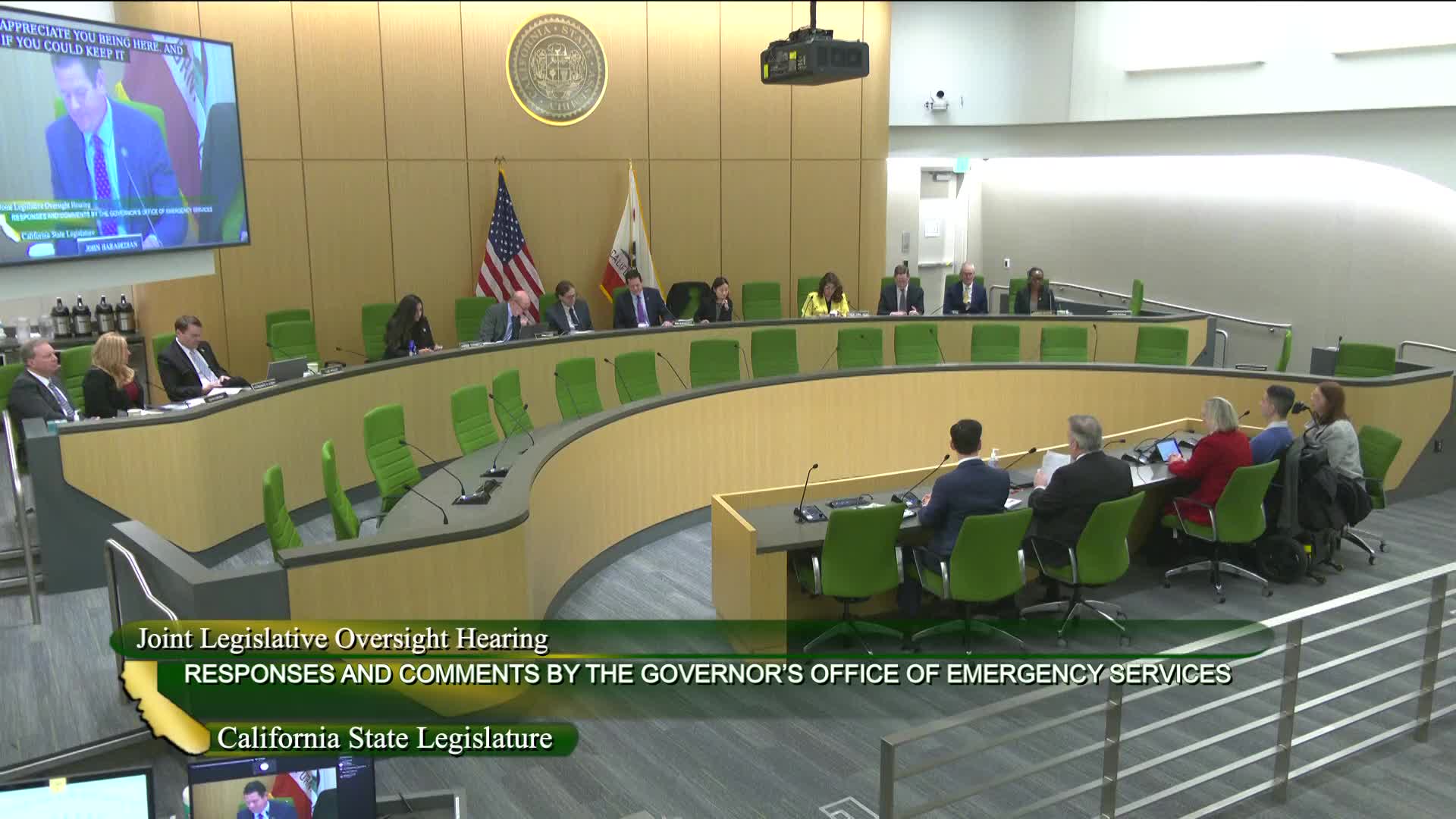
The Governor's Office of Emergency Services told lawmakers it has developed new guidance, training and advisory structures to improve planning and response for older adults, people with disabilities and those with limited English, but officials acknowledged the state cannot unilaterally enforce local compliance.
Laurie Najura, deputy director for planning, preparedness and prevention at Cal OES, said the agency and its Office of Access and Functional Needs (AFN) have created a suite of resources since the wildfires covered in the auditor's report. Najura told the committee the state had added language libraries, expanded style guides and updated a functional needs library; she said those improvements are part of implementing statute passed after the audit.
Vance Taylor, chief of Cal OES's Office of Access and Functional Needs, described two statewide structures: the AFN State Advisory Committee, created in 2020, and a "priority populations task force" convened by the governor in 2022 to coordinate agencies working with high-need groups. Taylor said the advisory committee includes organizations such as Disability Rights California, the Arc of California, Alzheimer's Association and others and meets quarterly to review guidance and provide feedback.
Cal OES said it has authored a California Statewide Alert and Warning Guidelines document for jurisdictions and alerting authorities; the guidance addresses technologies and AFN considerations and was used to provide backup alerting assistance to Los Angeles County during the 2025 fires.
Najura described training work through the California Specialized Training Institute (CSTI), including courses on creating accessible PDFs and social media, inclusive evacuation and sheltering, accessible messaging via IPAWS (the federal Integrated Public Alert and Warning System), and a "Disaster Response Interpreter" credentialing program for sign-language interpreters. Najura emphasized that many of the guidance documents and toolkits are available in multiple languages.
Cal OES also described the statutory review process now in place: under the legislative changes the auditor referenced, Cal OES will review a minimum of 10 county emergency operation plans (EOPs) each year until all 58 counties have been reviewed by 2028. Taylor said his office conducts AFN reviews of EOPs that include consultants with lived experience and offers in-person consultations when requested by local jurisdictions.
On limitations and accountability, Najura and Taylor acknowledged Cal OES is not a regulatory agency that can compel implementation. Najura said Cal OES provides written exit reports and recommendations to counties and can connect jurisdictions to resources and consultants; Taylor said some jurisdictions lacked capacity or did not post EOPs publicly so the state relies on collaboration and grant leverage to raise standards.
Ending: Cal OES officials told lawmakers the state has expanded AFN-focused guidance, training and an annual plan-review process; they asked legislators to sustain oversight and resources to close remaining gaps and to support testing and redundancy so state support can reliably backstop local failures in real time.