Get Full Government Meeting Transcripts, Videos, & Alerts Forever!
Get email alerts on the Audit Emergency Management topic
No spam. Unsubscribe anytime.
State auditor: California 'not adequately prepared' to protect vulnerable residents from disasters
Summary
A December 2019 audit and follow-up testimony on May 1, 2025 found gaps in county emergency plans, language access, alerting systems and Cal OES after-action reporting; the legislature responded with laws directing reviews and improvements, but auditors found incomplete implementation at the county level.
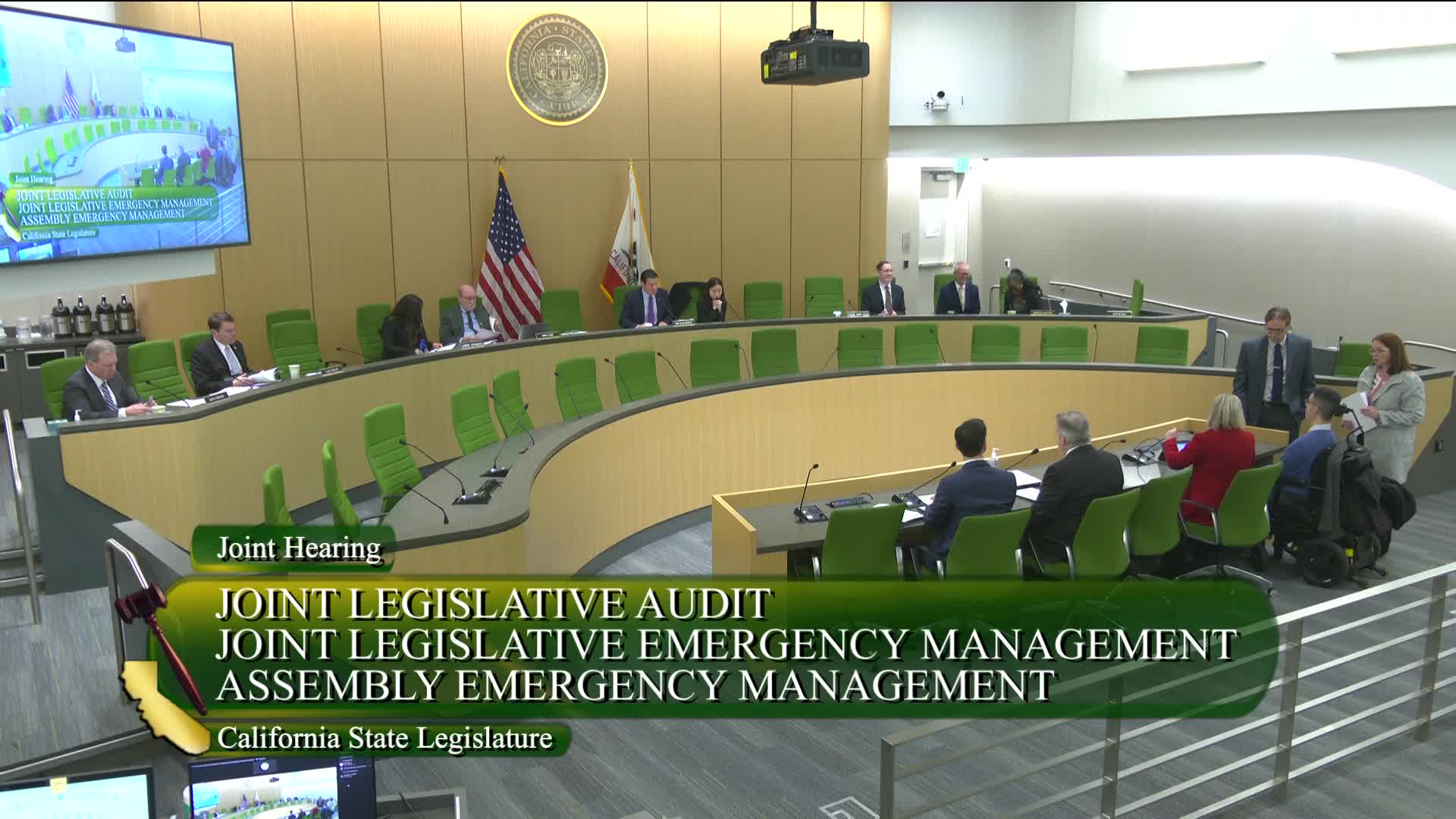
The California state auditor told a joint legislative oversight hearing that the state and several counties lacked complete, up-to-date plans and systems needed to protect older adults, people with disabilities and residents with limited English during wildfires and other disasters.
The audit, released in December 2019 and summarized by Grant Parks, the state auditor, found that Butte, Sonoma and Ventura counties had plans that were missing, out of date or in draft form and that local alerting and sheltering practices often did not follow FEMA best practices.
The audit matters because counties are the front line for evacuations and sheltering, and people with access and functional needs (AFN) are disproportionately affected, the auditor said. Parks told the committee: "A lack of planning is a contributing factor to failure during a disaster." He warned that failures in planning and alerting increase risk to life for people who have mobility, sensory, or language barriers.
At the county level, auditors said: - Butte County's emergency operations plan had not been updated in seven years, though FEMA recommends updates at least every two years. - Butte and Sonoma failed to use area-based wireless emergency alerts (WEA) effectively; instead they relied on landline or preregistered calls and experienced a 50–60% failure rate on those calls during the incidents audited. - None of the three counties consistently issued crucial alert messages in languages other than English; auditors estimated limited English residents composed roughly 10–14% of those counties' populations at the time. - Counties had limited evidence they solicited input from organizations representing AFN communities when drafting emergency plans; that lack of stakeholder engagement likely hampered response and sheltering.
At the state level, the audit said the Governor's Office of Emergency Services (Cal OES): - Did not incorporate AFN best practices into the state emergency plan as required by law (audit cites a statutory requirement dating to 2013). - Hosted AFN guidance on a separate, hard-to-use website rather than integrating it into the state plan, producing a library with many poorly labeled links and no English back-translations for non-English messages. - Had not timely completed after-action reports; auditors found that from January 2014 through December 2018 Cal OES had 65 proclaimed disasters requiring after-action reports and had not completed reports for 57 of those events. The most recent completed after-action report at the time of audit concerned a February 2015 event and was not finished until May 2019.
The audit included recommendations to the legislature, Cal OES and counties. Parks summarized the legislative follow-up he said had already occurred: "AB 32 67 (2020) required Cal OES to coordinate with access and functional need populations when it updates its state emergency plan and to complete after-action reports within 180 days," he said on the record. He also cited "AB 23 86 (2020)" requiring Cal OES to review a minimum of 10 county emergency plans annually for FEMA conformance, and "AB 5 80 (2021)" requiring counties to submit emergency plans to Cal OES and directing Cal OES to review all counties by January 2028.
Auditors recommended that Cal OES be directed to review local plans with AFN representatives, improve guidance on disaster registries and alert-message libraries, and broadly disseminate lessons learned. Parks told members that, while some progress has been made, the state and local jurisdictions still face gaps in implementation and testing of systems.
Committee members pressed auditors on whether the failures identified by the audit increase the risk of loss of life. Bob Harris, the audit principal, summarized counties' explanations at the time: rushed timelines, key personnel being unavailable, and untested software. Harris said counties had begun to improve practices after the audited events but that testing and prescripted translated alerts were best practices counties had not always followed.
Ending: Auditors told lawmakers the statutory changes after the audit created stronger review roles for Cal OES, but they urged continued oversight and testing to ensure the statutes' improvements translate into operational readiness across all counties. "No amount of planning will guarantee success during a disaster, but a lack of planning is a contributing factor to failure," Parks said.