Get Full Government Meeting Transcripts, Videos, & Alerts Forever!
Get email alerts on the Youth Vaping topic
No spam. Unsubscribe anytime.
Philadelphia committee hears wide-ranging testimony on youth vaping, enforcement gaps
Summary
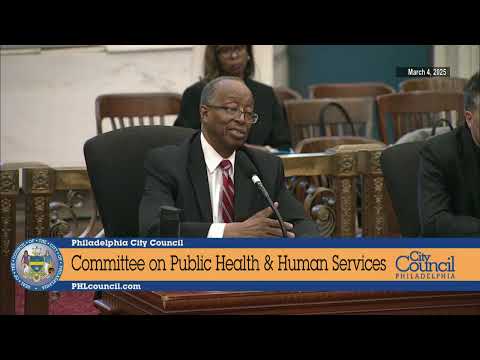
Philadelphia City Council’s Committee on Public Health and Human Services convened a public hearing on Resolution 241,149 to examine youth vaping and current enforcement efforts; testimony from prosecutors, public‑health officials, medical experts, school leaders, students and advocates described rising youth use, enforcement gaps and a mix of policy and education options.
Philadelphia City Council’s Committee on Public Health and Human Services convened a public hearing on Resolution 241,149 to examine the prevalence of vaping among children and the effectiveness of current enforcement efforts. Testimony came from the District Attorney’s office, the Philadelphia Department of Public Health, medical experts from Children’s Hospital of Philadelphia, School District officials, student witnesses and public-health advocates.
The hearing focused on three linked concerns: high and rising e‑cigarette use among Philadelphia youth, persistent retail and online availability of flavored and high‑nicotine products, and limitations on local action because of state law. Ryan Kaufman, tobacco policy and control program manager at the Philadelphia Department of Public Health, told the committee that local survey data show vaping is now the most commonly used tobacco product among Philadelphia high school students: “In 2023, 19 percent of high school students in Philadelphia had used an e‑cigarette within the past 30 days.” Kaufman also said about three‑quarters of tobacco products sold in the city from 2021–2023 were flavored.
Why it matters: witnesses said vaping threatens decades of progress in reducing youth tobacco use, poses acute and chronic health risks, and is being driven by flavored products, newer device designs and online sales. Medical and toxicology witnesses described rising poison‑control and hospitalization cases linked to vaping and warned of nicotine’s effects on the developing adolescent brain.
Legal framework and enforcement. Robert Lisenby, first assistant district attorney for the Philadelphia District Attorney’s Office, outlined Pennsylvania’s criminal framework for tobacco sale and possession (Title 18, section 6305) and said that sales to underage purchasers and furnishing tobacco to minors are summary offenses under state law. Lisenby told the committee that the DA’s diversion unit had seen very few recent summary prosecutions linked to vaping and that the office receives cases when arrests are made by police. “Vaping is legal. However, there are restrictions on age of use, age to purchase, and sales restrictions,” he said, adding that the DA’s office would work with the council and the health department on policy research and follow up.
Health‑department findings and constraints. Kaufman said the Department’s Division of Environmental Health Services enforces city tobacco retail laws and that local data show a recent rise in youth vaping: 30.8 percent of high‑school students had tried e‑cigarettes at least once, and the department recorded 291 youth vape compliance checks in 2024 with 14 violations (a 5 percent violation rate). He described enforcement difficulties and said city authority to regulate retail sales is constrained by Pennsylvania law and prior court rulings: Philadelphia code 9‑6‑38 had been challenged and a separate 2018 state law preempts municipal regulation of tobacco and vaping sales, the department testified. Kaufman said the department plans to increase compliance checks in 2025 and has proposed using settlement funds from litigation (Jewel Labs/Altria settlements) to expand prevention and enforcement work.
Clinical impacts and recommendations. Pediatricians and toxicologists described patient cases and regional poison‑control trends. Robert Bassett, associate medical director at the CHOP Poison Control Center, said exposures reported to CHOP surged from 20 in 2020 to 148 in 2024 and called the phenomenon “a crisis” that is producing nicotine toxicity, respiratory pathology and psychiatric harms among adolescents. Bassett recommended measures including a ban on flavored vapor products (except FDA‑approved cessation products), caps on nicotine concentration, stronger online age verification and designated vape‑free public spaces.
School responses and youth testimony. Jamie Banks, chief of student support services for the School District of Philadelphia, described a multi‑tiered school approach: a district policy (Board Policy 02‑22) banning possession/use on school property, health‑curriculum prevention content, counseling resources, and partnerships providing school‑based behavioral health and cessation supports. Banks said the district is reviewing Policy 02‑22 and plans family town halls and staff professional development in partnership with the health department.
Students who testified urged education and support rather than primarily punitive responses. Kevan Snaith, a senior at Constitution High School, said he polled peers and that 80 percent reported insufficient school education on vaping; he recommended peer‑led programming and in‑school sensors to detect vaping in bathrooms. Rochelle Meneses, a senior at Academy of Palumbo, said she sees students struggling with withdrawal and urged workshops, parental engagement and counseling rather than suspension alone.
Retail practices and community impact. Council member Cindy Bass and advocacy witnesses described unlicensed or repeat‑violating retailers, including shops selling counterfeit tobacco products and operating with building and code violations. Advocates urged mapping retailer density in low‑income neighborhoods, restricting retailer proximity to schools, and using settlement funds for community prevention and youth programs. Jacob Zajic of the American Heart Association and Markita Young of the Health Promotion Council highlighted that flavored products account for the majority of sales and that preemption limits local policy options.
Follow‑up and next steps. Committee members asked for concrete follow up: the health department agreed to follow up with the District Attorney’s office about information sharing and enforcement pathways; the department said it would increase compliance checks in 2025 and submit budget proposals to use settlement funds for youth vaping prevention. The School District said it will present an updated policy draft to the board this spring and hold family and student engagement events. No formal vote or ordinance was taken during the hearing; the session was a fact‑finding and public‑testimony hearing on Resolution 241,149.
The committee said it will continue investigation and coordination with the DA’s office, the health department, the School District and community partners to develop a multi‑pronged approach combining enforcement against unlawful retailers, expanded youth prevention and cessation services, and targeted public education and retailer‑density interventions.