Get Full Government Meeting Transcripts, Videos, & Alerts Forever!
Get email alerts on the Children Family Services topic
No spam. Unsubscribe anytime.
New Department of Children, Youth and Families outlines program transfers, budget and licensing timeline
Summary
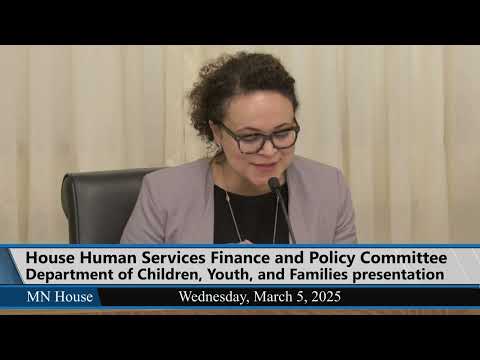
Commissioner Tiki Brown and CFO Ashley Reisenauer briefed the House Human Service Finance and Policy Committee on the creation of the Department of Children, Youth and Families, the timetable for program and Office of Inspector General transfers, the agencybudget and major IT and licensing issues raised by legislators.
The House Human Service Finance and Policy Committee heard an overview March 5 from Commissioner Tiki Brown and Chief Financial Officer Ashley Reisenauer of the newly created Department of Children, Youth and Families about program transfers, the department—s budget and the planned transfer of Office of Inspector General functions in June 2025.
Commissioner Tiki Brown, the head of the Department of Children, Youth and Families, told the committee the agency was launched July 1, 2024, to centralize state services for children and families and to "break[] down these silos" so families can more easily access benefits and services. Brown said the agency will use a whole-family systems framework and that programs transferred from four agencies will ultimately be organized into four administrations: Child Safety and Permanency, Early Childhood, Economic Opportunity and Youth Services, and Family Well-Being.
The department will assume programs and staff from multiple agencies, Brown said, including children and family services and Office of Inspector General functions from the Department of Human Services (DHS); early learning from the Department of Education; youth justice programs from the Department of Public Safety; and the Help Me Connect program from the Department of Health. Brown said the Office of Inspector General (OIG) functions scheduled to transfer in June 2025 will include family child care licensing, child care center licensing and certification, foster-care licensing and private child-placing agency licensing. She said the transfer should not change the split of responsibilities between counties and the state for licensing.
Ashley Reisenauer, DCYF chief financial officer, outlined the agency—s budget and staffing. Reisenauer said DCYF—s expenditures are projected at about $3.7 billion annually, with roughly $2.5 billion in federal funding, about $1.0 billion from the state general fund and roughly $290 million from other funds. She said DCYF oversees about $1 billion in technical and fiduciary funds, primarily the child support program. She said grants make up about $2.4 billion of DCYF spending and that approximately $1.2 billion of that is federal SNAP (food assistance) funding. Reisenauer said forecast programs (adoption/kinship assistance, childcare supports and others) total about $1.1 billion and that, when fully staffed, DCYF is expected to employ about 900 to 1,000 full-time equivalents, about 95% of whom will transfer from originating agencies.
Brown described the program integrity and licensing work that will move in June and said the OIG will continue licensing standard revisions started at DHS. She said the OIG will keep and use program-integrity tools including investigations from tips and data analysis, administrative actions (warnings, monetary recovery, fines, payment withholds, suspensions, terminations) and referrals to law enforcement such as the Bureau of Criminal Apprehension for provider-level fraud. She said program integrity work will cover child care assistance, Great Start compensation payments, MFIP and SNAP recipients and that audits may result in recoupment or referral to law enforcement.
Committee members raised issues including daycare providers— concerns about increased regulatory burden; reports of delays in Great Start compensation grant payments to providers; how CCAP licensing and OIG fraud-prevention work will transition; maltreatment investigations split between counties and state; coordination on youth trafficking across agencies; SNAP caseload and funding details; the number of FTEs transferring; and the age and stability of IT systems.
Brown said licensing standards will follow the DHS timeline and include community input opportunities before a final draft is prepared for legislation next February. She said the department—s inspector general, Randy Keyes, had joined for knowledge transfer and that the department was hiring managers for children—s mental health and disability services. On grant delays, Reisenauer said the department had not heard of systemic delays to Great Start compensation grants and would follow up with representatives who raised concerns.
On SNAP, Reisenauer said the program serves about 440,000 people in Minnesota and that the state spends more than $1 billion in federal SNAP benefits; Brown and Reisenauer said pandemic-era supports and federal policy changes have affected SNAP caseloads and supports, and they noted the existence of a summer EBT program to support children.
On information systems, Brown and staff identified SSIS (Social Services Information System) as the most critical modernization priority because counties report child-welfare workers spend excessive time in the system. Officials said DCYF has identified systems that will have a DCYF home, systems that will be shared, and plans for shared governance with DHS and MNIT for Maxis (cash assistance and SNAP), PRISM (child support), SSIS and MEC (Help Me Connect) modernization work. Brown said modernization would proceed "bit by bit" rather than all at once.
Committee members asked for additional details on OIG staffing transfers; Brown said about 89 licensing FTE are expected to transfer from DHS licensing and that many transfer and hiring decisions remain in process. Reisenauer confirmed the department is using originating-agency accounting structures during the transition year and that new DCYF accounting structures will begin July 1, 2025.
Committee Chair Schumacher thanked the presenters for the briefing and the committee moved to the next agenda item.
The presentation generated multiple follow-up requests from legislators for written follow-ups on grant timelines, the number of children served by MFIP childcare, details on maltreatment investigation case counts, and more granular IT modernization timelines.