Get Full Government Meeting Transcripts, Videos, & Alerts Forever!
Get email alerts on the Whistleblower Protections topic
No spam. Unsubscribe anytime.
House committee advances bill to add explicit "waste, fraud and abuse" language to whistleblower law after partisan debate
Summary
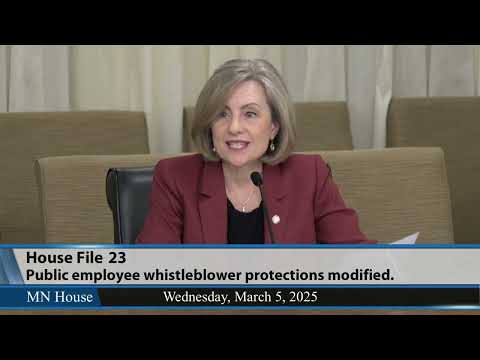
ST. PAUL, Minn. — The House Workforce, Labor and Economic Development Finance and Policy Committee debated House File 23 on March 5, a bill from Rep. Jared Robbins to expand Minnesota—s Whistleblower Protection Act by adding definitions of "waste, fraud and abuse" and explicitly allowing reports to law enforcement; after a contentious hearing and two failed motions to re-refer the bill, the committee voted to place the bill on the general register.
ST. PAUL, Minn. — The House Workforce, Labor and Economic Development Finance and Policy Committee debated House File 23 on March 5, a bill from Rep. Jared Robbins to expand Minnesota—s Whistleblower Protection Act by adding definitions of "waste, fraud and abuse" and explicitly allowing reports to law enforcement; after a contentious hearing and two failed motions to re-refer the bill, the committee voted to place the bill on the general register.
Supporters said the change is intended to remove uncertainty that keeps state employees from reporting suspected wrongdoing. "We want to give them robust protection so that they feel comfortable coming forward," Rep. Jared Robbins told the committee, saying agency employees contact him with fears about retaliation when they try to report suspected misuse of taxpayer funds.
The bill drew detailed testimony from Devin Bruce, director of legislative and political affairs for the Minnesota Association of Professional Employees (MAPE). Bruce said he supports extending protection but urged the committee to adopt simpler language already in the Senate companion. He warned that "the more definitions that we have that create unnecessary complexity, [the] don't encourage employees to come forward with information. It causes them to feel doubt of whether or not they are covered," and emphasized the statute—s existing two-tier system that distinguishes classified and unclassified employees.
Committee members pressed the author on whether existing statute covers the conduct the bill would add. Robbins cited existing statutory language and other chapters that use the phrases "waste, fraud and abuse," and said placing those definitions in the whistleblower chapter would give employees "clear and robust protection." Several members asked for concrete examples; Robbins pointed to recent state projects and programs that have experienced cost overruns or alleged improper payments as the type of problems employees have reported privately.
Opponents and skeptical members raised separation-of-powers and scope concerns, warning that broad definitions of "waste" or "abuse" could pull ordinary policy disagreements into litigation. Representative Lee Pinto repeatedly asked whether the bill would simply duplicate existing protections for violations of law and whether expanding the list of qualified recipients to include law enforcement could lead to law enforcement handling reports that are not violations. Representative Pinto said the text of clause 1 already covers "violations of law, rules, etcetera," and asked for clarity about what additional conduct the bill would change.
Representative Schultz, Representative Greenman and others said they supported protecting employees but sought clearer definitions and additional committee review. Several members noted the bill had bipartisan support in the Minnesota Senate but not yet in the House.
The committee considered procedural motions during the hearing. A motion to refer the bill to the Judiciary Committee was made; the chair called for a roll call and the motion failed. A second motion to re-refer the bill to the Fraud Prevention and Government Oversight Committee also failed on a roll call. After further discussion and offered amendments in subsequent sessions (members said amendment work would continue), the committee chair renewed a motion to move House File 23 to the general register. The roll call on that motion recorded 7 ayes and 5 noes, and the measure was placed on the general register.
The hearing record includes repeated references to statutory text and cross-references, including the Whistleblower Protection Act (section 6 references), Minnesota statute 127A.21 (language used in OIG provisions at the Department of Education), 179A.7 subdivision 1 (managerial policy exclusions) and Chapter 13 (data/privacy limits raised by members).
Representative Robbins said he will continue to work with members on language, including possibly adding unclassified employees and clarifying definitions. Bruce asked the committee to adopt the Senate approach of expanding existing section 6 to cover all public employees and to add law enforcement as a qualified recipient while avoiding definitional complexity that could deter reporting.
Votes (selected): - Motion to refer House File 23 to the Judiciary Committee: roll call requested; motion not adopted (members' roll-call votes recorded in the hearing transcript). - Motion to re-refer House File 23 to the Fraud Prevention and Government Oversight Committee: roll call requested; motion not adopted (5 ayes, 7 noes per the transcript). - Motion to move House File 23 to the general register: roll call passed 7 yes, 5 yes.
The committee closed public testimony after hearing from MAPE and moved on to other business. Robbins said he would continue negotiating statutory language with members and stakeholders.
Members and witnesses indicated they intend to continue working on narrower definitional language and possible amendments in coming weeks as House File 23 proceeds through the process.