Get Full Government Meeting Transcripts, Videos, & Alerts Forever!
Get email alerts on the School Age Care Levy topic
No spam. Unsubscribe anytime.
Senate file 1461 would let school districts use levy authority to support preschool students with disabilities in wrap‑around care
Summary
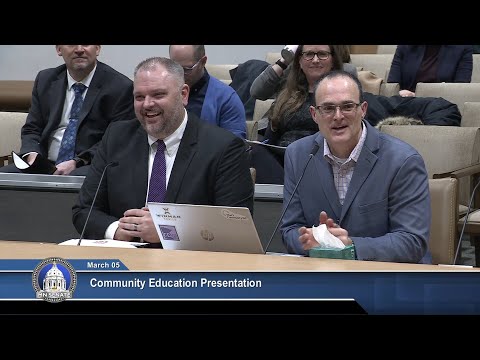
Senate file 1461 would extend school‑age care levy authority so districts can use levy funds to support preschool children with disabilities participating in district run wrap‑around care, the author and testifiers told the Education Finance Committee on March 5.
Senate file 1461, introduced and explained on March 5, would expand eligibility for existing school‑age care levy authority so districts may use levy funds to support children with disabilities who are enrolled in district‑provided preschool programs and participating in before‑ and after‑school wrap‑around care.
Author Senator Mae Quaid (presenting the bill to the committee) said current law allows districts to use levy authority to support kindergarten‑through‑grade‑6 students with disabilities in school‑age care programs, but it does not extend that support to preschool students with comparable needs. "This legislation does not provide funding for all day daycare. This is a really specific narrow bill for these services and things that children with disabilities who are in these after school programs would need in order to actually participate," the author said.
Corey Fransen, testifying for the Minnesota Community Education Association, described practical examples: a student who uses an enhanced listening device during the school day could access the same device in wrap‑around care; a kindergarten student with an IEP objective for social‑emotional skills could receive consistent staff support across the school day and after‑school program. Fransen said the levy helps districts provide paraprofessionals, interpreters, adaptive chairs, transportation for field trips and training for health‑related procedures.
Committee staff from the Department of Education (MDE) explained the fiscal calculation and assumptions. Because the bill does not change equalization, the additional revenue would be generated as levy authority. MDE said the first full effect would be felt in fiscal year 2027 (levies for FY26 were already certified). The fiscal note projects additional levy authority of $1,518,000 in FY26 (first affected collection assumed in FY27), $1,748,000 in FY27, $1,901,000 in FY28 and $2,069,000 in FY29, based on the number of preschool‑aged participants then in district school‑age care programs.
Committee discussion clarified that the bill’s language about children "experiencing family or related problems of a temporary nature" mirrors existing statutory language used in another section of the code (MDE staff cited Minnesota Statutes, section 124D.022, subdivision 1), and that the bill’s change is focused on adding preschoolers with disabilities into the existing eligibility definition rather than broadening permanent entitlement.
Action: Senator Quaid moved the bill; the committee laid Senate file 1461 over for possible inclusion. No committee roll‑call vote was taken during the hearing.
Why this matters: Advocates said expanding levy eligibility would close a gap that leaves preschoolers with disabilities without the same wrap‑around supports available to kindergarten and older students, enabling earlier intervention and continuity of services.
Ending: Legislators asked staff and testifiers for follow‑up technical clarifications; the bill remains laid over for possible inclusion in the committee’s package.