Adult basic education programs report rising demand and falling per‑hour reimbursement
Summary
ABE leaders told the committee that roughly 65,000 adults use ABE annually statewide, contact‑hour reimbursement has fallen as hours rise, and many consortia report substantial wait lists and larger class sizes.
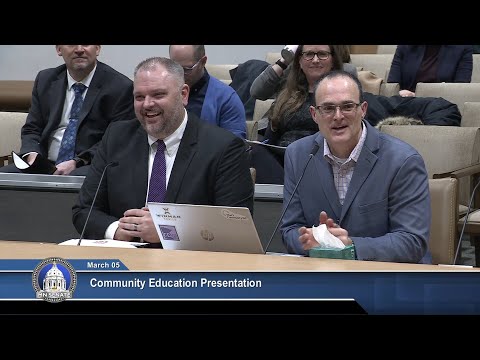
Adult basic education coordinators and providers told the State Education Finance Committee on March 5 that demand for ABE services is growing faster than funding, producing long wait lists and larger class sizes.
Scott Helland, who coordinates ABE at Harmony Adult Basic Ed and serves as legislative co‑chair for the Literacy Action Network, said approximately 65,000 adult learners participate annually and noted the ABE funding formula has four parts (population funding, EL‑based base funding, a component for adults over 25 without a diploma, and contact‑hour funding). He warned that a fixed pool for contact hours means more hours statewide reduce the reimbursement rate per hour.
"Two years ago, programs were reimbursed $11.03 per contact hour. Last year...that dropped the reimbursement rate to $9.64 per contact hour," Helland said, and he reported another 9% increase in contact hours this year that will push the rate lower. He and other witnesses said staffing costs rose after many districts added ABE teachers to teacher contracts, increasing local expenses by over 20% in some consortia.
Witnesses gave concrete examples of unmet demand: Mankato reported wait lists for English language classes by October; Minneapolis had wait lists as high as 200 at one time even after hiring additional teachers; Burnsville reported 83 students waiting; the North Metro consortium reported 418 learners tested and ready to start, with 317 at one location.
Providers described strategies to expand capacity — hiring, online and hybrid classes, cross‑district collaborations — but said technology and staff costs are barriers. Elizabeth Fontaine, director of education at the International Institute of Minnesota, said ABE pathways also connect learners to workforce training and college credits: "Our adult basic education workforce training programs place individuals into stable, family‑sustaining jobs each year."
Why this matters: ABE is a workforce pipeline for adults seeking English, GED/HiSET preparation and career pathways. Coordinators warned funding structure and rising labor costs are forcing programs to limit sections and create waiting lists while employer demand for skilled workers remains strong.
Ending: Providers urged the committee to consider funding adjustments that reflect rising contact hours, higher staffing costs, and the fixed‑pool allocation method that currently reduces per‑hour reimbursement as participation grows.
AI generated
The text on this page is AI generated. Summaries, highlights, analysis, and video transcripts are all produced from the original source material.
AI can make mistakes, so if you spot one, and we will fix it for everyone.
Note: the source content is unaltered by us. Any content source we link to, be it a video, an audio recording, or a document, is presented exactly as its publisher released it. That publisher is usually a government body, sometimes an individual official or another organisation.