Get Full Government Meeting Transcripts, Videos, & Alerts Forever!
Get email alerts on the Community Education topic
No spam. Unsubscribe anytime.
Minnesota community education leaders urge funding stability as programs expand statewide
Summary
Presenters from the Minnesota Community Education Association described the statutory role of community education, outlined funding streams and challenges — including a proposed bill to preserve program-dedicated revenue — and asked legislators to plan for rising costs tied to new licensure requirements.
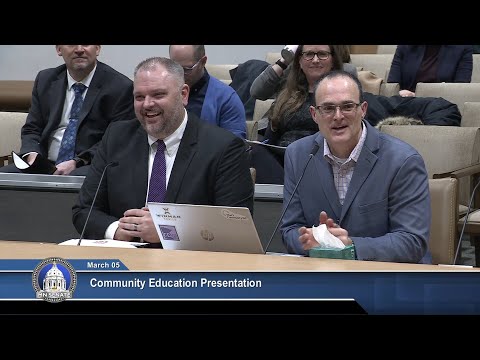
Matt Dickhausen, executive director of the Minnesota Community Education Association, and Corey Fransen, director of community engagement and community education for Elk River Area Schools, told the State Education Finance Committee on March 5 that community education is a state statutory program charged with expanding use of school facilities and human resources to serve learners of all ages.
"Community ed is to be that link between the school district residents and the school," Dickhausen said, describing advisory councils, licensed directors, and the program’s statutory authorization in Minnesota Statutes, section 124D.18. Fransen added that the program serves a wide range of functions — from early childhood screening and adult basic education to school-age childcare, recreation and specialized services.
The presenters provided an overview of Fund 4 revenue sources that support community education, including general community education revenue, youth service revenue, youth after school enrichment revenue, participation fees and targeted aids such as school readiness aid and home visiting aid. Fransen said participation fees remain a major revenue source for many districts: "roughly 70% of the revenue that their department receives comes from our users that are participating through their participation fees," citing Osseo as an example.
Presenters identified several near-term financial pressures. They oppose proposals that would allow districts to transfer community education–designated funds to general purpose levies, saying those dollars are already committed to operating programs. They also warned of fiscal effects from new early childhood teacher licensure requirements scheduled for 2028, noting many school readiness funds remain at 2017 funding levels and bargaining outcomes could increase program costs that currently are covered by a mix of state aid and participant fees.
Committee members asked about advisory councils, program flexibility across districts, and examples of community ed work. Fransen and Dickhausen described rural and urban models, partnerships with Special Olympics and other local organizations, and cross-district collaborations that expand offerings without duplicating services.
Why this matters: community education serves as both a hub for lifelong learning and a local provider of child care and family supports. Presenters asked legislators to preserve dedicated revenue, consider updates to levy and aid structures, and account for rising staffing costs tied to licensure and contract changes.
Fransen and Dickhausen closed by outlining MCA’s 2025 legislative priorities: appropriate early childhood funding, expansion of school-age care levy options, increased youth after-school enrichment aid, and clarification on unemployment insurance impacts for year-round community education employees.
The presentation included examples of program outcomes (credit recovery in Roseville, preschool tracking in Winona, consortium adult basic ed models) and invited committee members to follow up with district visits and conversations.
Ending: Committee members thanked the presenters and moved on to the next scheduled presentation, adult basic education.