Get Full Government Meeting Transcripts, Videos, & Alerts Forever!
Get email alerts on the Play Based Learning topic
No spam. Unsubscribe anytime.
Darien teachers show play‑based learning driving early‑childhood instruction
Summary
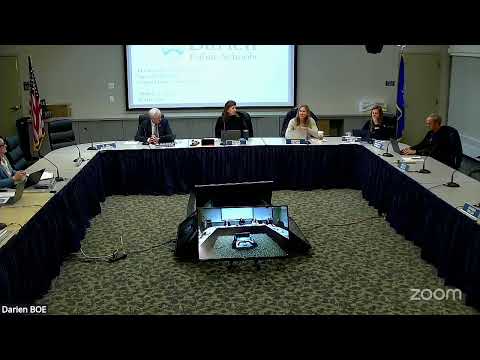
At a special Curriculum Committee meeting March 5, Darien preschool, ELP and kindergarten teachers presented classroom examples, assessments and curriculum units that the district says align play‑based learning with Connecticut Early Learning Standards and the district strategic plan.
Teachers and administrators from Darien School District presented classroom footage, assessment tools and unit plans to the curriculum committee on Wednesday, March 5, highlighting play‑based learning in pre‑K, ELP and kindergarten classrooms.
School leaders said play‑based learning is instructionally aligned with Connecticut Early Learning Standards and the district strategic plan, and described recently written units and scenarios that will be embedded in Eduplanet for spring implementation.
Educators showed a short video of a preschool classroom restaurant project and walked committee members through how a single five‑minute classroom interaction can evidence multiple standards. “When you go back and you look at it and compare it to the Connecticut Early Learning Standards, you see that there’s 14 standards that have been met,” Amanda Mergian, a preschool teacher, told the committee as she unpacked the clip.
Teachers described how play projects are started from student interest (in the example shown, students chose a restaurant after conversations about where food comes from), and how the work is intentionally planned to address learning progressions for numeracy, spatial awareness, oral language, fine motor skills and social cooperation. Mergian said the project included visits and collaboration with the school cafeteria and a local pizza manager to give students authentic exposure to restaurant roles.
Whitney Mullins, an early educator, walked committee members through the district’s documentation and assessment approach. She described use of a clipboard‑based observation system tied to a standards rubric that teachers use to record evidence across time and file under individual student tabs. Mullins said teachers typically target two assessment foci per week while remaining open to observing many standards during play-based work.
Administrators and teachers described a three‑phase rollout: initial professional learning and development of a district definition and continuum for play‑based learning; collaboration and unit development across early learning and kindergarten staff; and ongoing implementation support and visible documentation of student work. Julie Carrick (presenting staff) said the team produced a minimum of three scenarios or units for pre‑K, ELP and kindergarten, written in a UBD (understanding by design) format and slated for Eduplanet embedding in the spring.
Committee members asked about differentiation, classroom management and staffing. Teachers said classrooms rely on paraeducators to support multiple centers and noted that play often reduces behavioral incidents by increasing engagement. Teachers also described how the scenarios create multiple entry points so children can participate at different levels and teachers can pull small groups for targeted instruction during the same project.
Family engagement practices were described as routine and frequent: teachers said they send daily updates, invite community members into classrooms for demonstrations, and use projects as a vehicle for parent involvement. Mergian said she sent parents a description of standards and unit goals when food‑related work required nurse permissions.
Committee members and staff emphasized that the district’s approach is intended to extend beyond simply following state legislation. “The legislation is really not the why for the work,” an administrator said; staff said the district has aimed to move beyond the minimum state requirements this year.
The presentation closed with a request for continued board support for resources and time for professional learning. Staff described the earliest stages as already underway and said they would continue to share units and examples with the committee as implementation proceeds.