Get Full Government Meeting Transcripts, Videos, & Alerts Forever!
Get email alerts on the Solar Decommissioning topic
No spam. Unsubscribe anytime.
Subcommittee approves requirement for financial assurance before solar facilities begin operation
Summary
The Georgia House Energy, Utilities & Telecommunications Subcommittee voted to advance a committee substitute that requires evidence of financial assurance to cover decommissioning of utility-scale solar facilities before they begin operation.
The House Energy, Utilities & Telecommunications Subcommittee voted to approve a committee substitute for House Bill 249 (LC 550584S) requiring applicants for solar facilities to provide evidence of financial assurance before operations begin.
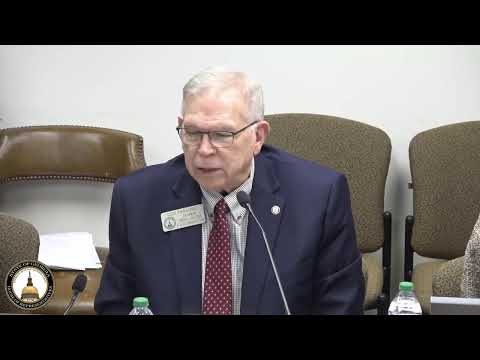
The measure, presented by Chairman Dickey, directs the Georgia Environmental Protection Division (EPD) to require documentation that developers have a financial instrument or other means to decommission and restore land when a solar installation reaches the end of its useful life. "I just really got a bad feeling that at some point in the future, these... solar facilities are gonna be obsolete and gonna be liabilities to the landowner and to the state of Georgia," Chairman Dickey said while presenting the bill.
The bill builds on a provision from Representative Kelly's bill last year, according to Chairman Dickey, and aims to ensure a party will be financially responsible for returning sites to their prior condition. The chairman thanked Jeff Cowen and his team at EPD and Tom Krause at the Public Service Commission for suggested edits, and acknowledged local government counsel Nick Tate for assistance.
Under the substitute, applicants would show EPD evidence of a financial instrument or comparable assurance prior to beginning operation. Chairman Dickey described the procedure as "very little work on EPD's part, very little on the developer," and said the substitute primarily formalizes a commitment developers have already made to restore sites.
Committee members had no recorded roll-call questions or objections during the presentation, and no outside witnesses signed in to speak for or against the bill. The subcommittee advanced the committee substitute by voice vote; the clerk recorded the motion to pass "committee substitute House Bill 249 (LC 550584S)." The chair called for ayes and noes by voice; the chair announced the bill passed and that it would be sent on for further consideration.
The subcommittee did not provide a roll-call tally in the transcript; the vote was taken by voice. The bill will proceed to subsequent legislative steps per the House rules.