Get Full Government Meeting Transcripts, Videos, & Alerts Forever!
Get email alerts on the Traffic Safety topic
No spam. Unsubscribe anytime.
City studies school‑zone speed cameras after pilot data; staff to clarify permitted uses of revenue under state law
Summary
Council discussed a staff review of speed‑zone camera programs under House Bill 2384, pilot speed measurements at several schools and conservative revenue scenarios; staff said state law restricts how camera revenue may be used and that council requested a legal interpretation and more analysis.
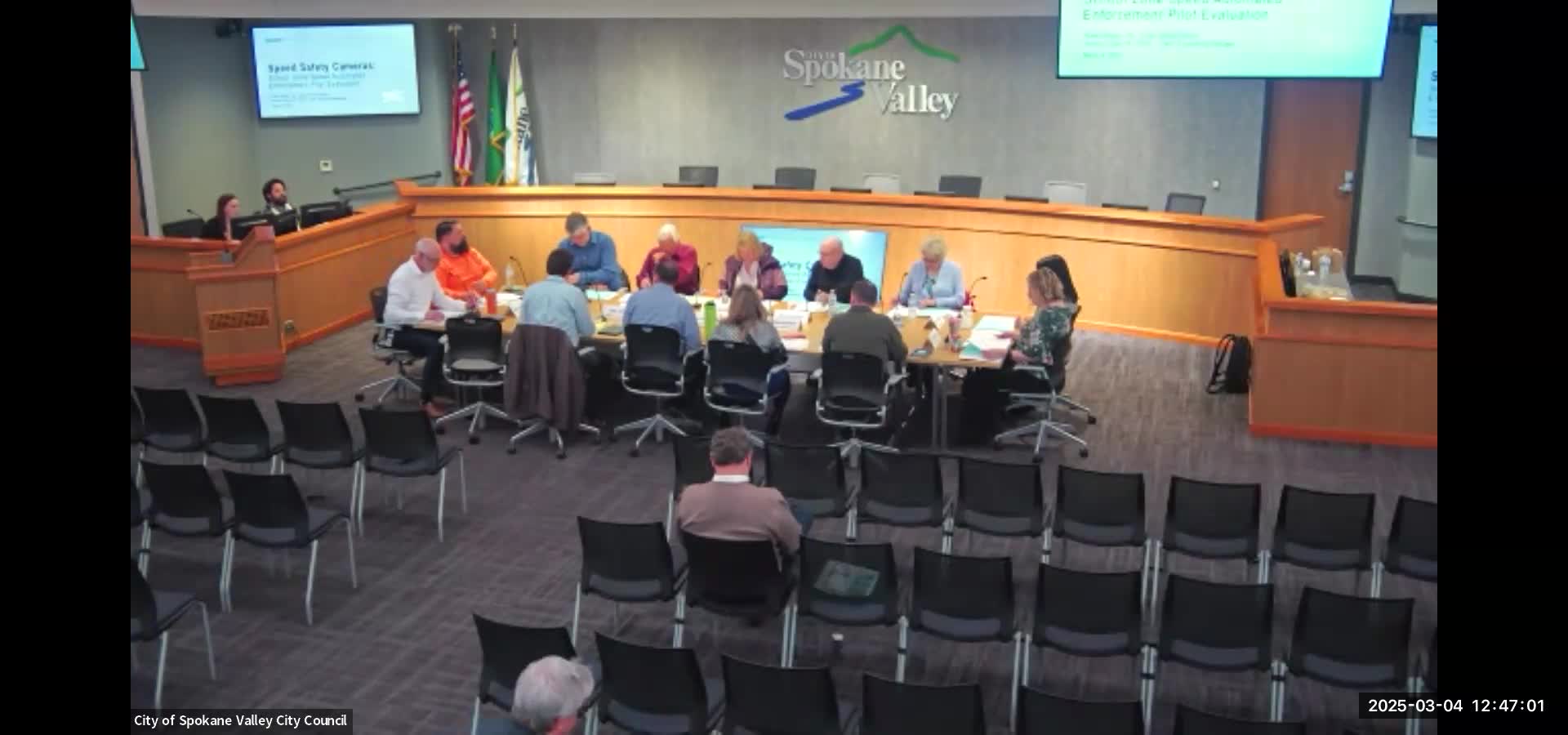
City staff presented preliminary findings on school‑zone automated speed‑enforcement cameras at the March 4 Spokane Valley winter workshop and said the council should review legal limits on how revenue from such programs may be used before moving ahead.
Robert Bacon, a staff presenter, summarized House Bill 2384, which establishes requirements for automatic traffic safety cameras in Washington. The bill permits automated cameras to collect images of vehicles and license plates for enforcement purposes but prohibits capturing driver faces or passenger images; the law also sets reporting and revenue-use provisions and mandates that, after four years of operations, the state receive 25 percent of program revenue for the state transportation safety account.
Staff temporarily deployed loop-based speed measurements at five school locations to gauge potential infractions during arrival and dismissal periods. The data showed material volumes of drivers exceeding posted school-zone limits at three locations during the test days; two locations showed fewer violations. Staff used conservative assumptions—signage usually reduces violations by about half; many drivers stop speeding after their first citation; a minority of citations are successfully appealed—to estimate a cautious revenue range rather than best‑case receipts.
Using conservative vendor-cost and administrative assumptions, staff modeled a three‑camera pilot that could generate net revenue after contractor and administrative fees in the low‑ to mid‑hundreds of thousands of dollars annually under certain behavioral assumptions; staff said the city would also need to account for staff time to review and process citations.
Council members expressed a range of views. Some supported cameras for school‑zone safety and wanted the city to keep cameras active outside narrow school times if mounted; others said the program should not be framed primarily as a revenue source and urged a legal review. Chief Ellis noted the cameras are a deterrent and that school‑zone enforcement is a high-priority call area for his traffic unit.
Staff will return with a legal interpretation of permitted uses for camera revenue, more refined pilot-cost estimates and recommendations on whether to pursue a limited pilot or proceed with a broader program.