
Lawmakers weigh $750 million boost to California film and TV tax credit as industry warns of job losses
Get AI-powered insights, summaries, and transcripts
Sign Up Free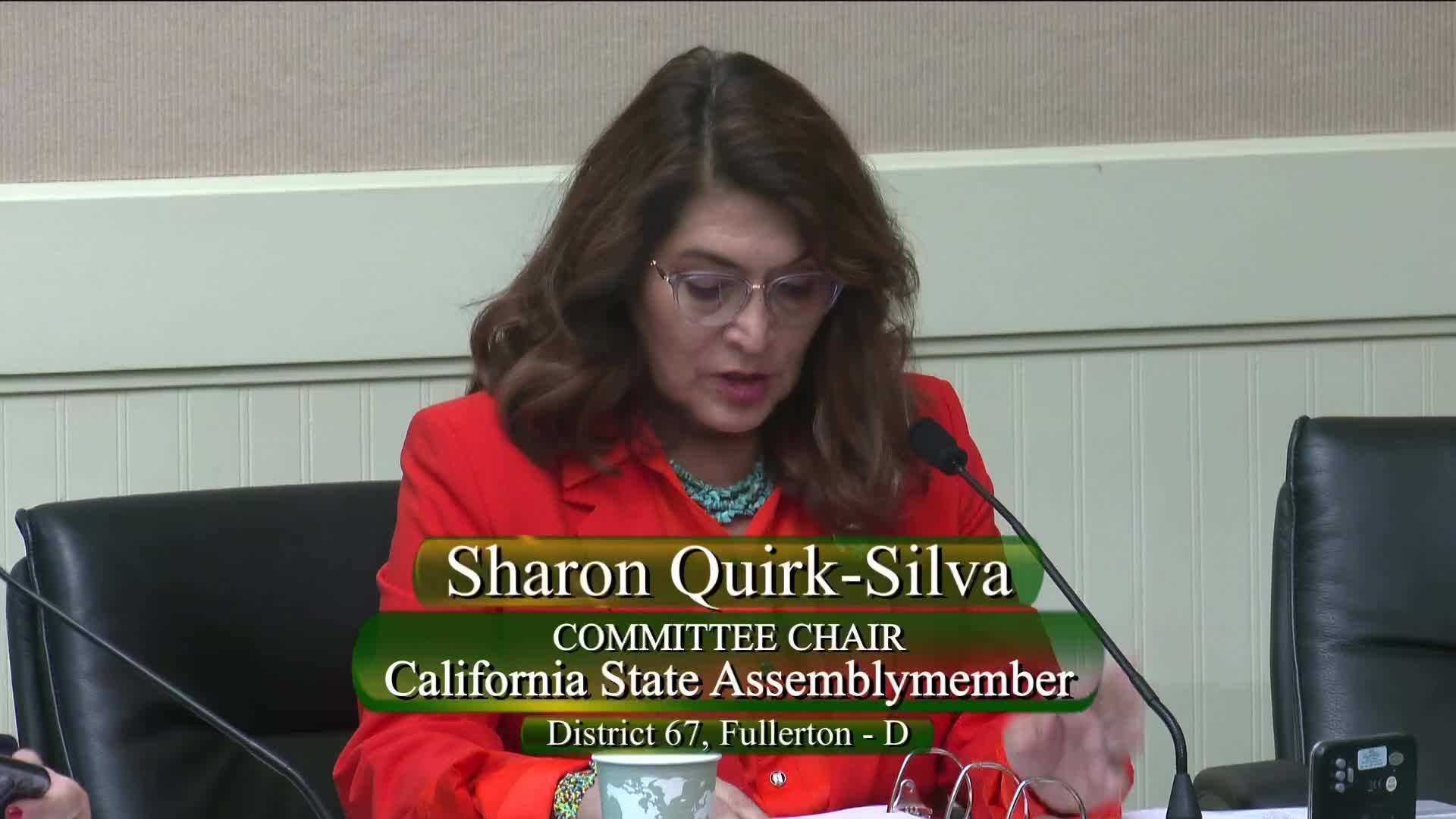
Summary
At an informational hearing of the Assembly Budget Subcommittee 5 on State Administration, witnesses debated Gov. Gavin Newsom’s proposal to raise the annual cap on the California Film and Television Tax Credit to $750 million, with industry groups and unions warning of widespread job losses if the state does not increase funding while the Legislative Analyst’s Office questioned whether the credits reliably grow the state’s overall economy.
Hollywood is a fundamental part of California's identity, Assembly Budget Subcommittee 5 Chair Quirk Silva said as the panel opened an informational hearing on the governor's proposal to raise the annual cap on the California Film and Television Tax Credit to $750 million.
The hearing featured presentations from the California Film Commission, the Governor's Office of Business and Economic Development (GoBiz), the Legislative Analyst's Office (LAO), the Department of Finance and industry groups, followed by more than a hundred public commenters including union members, production crews and small-business vendors.
Why it matters: Supporters say the program keeps productions and thousands of middle‑class union jobs in state and fuels local small businesses; the LAO and other analysts said the evidence that tax credits grow the overall state economy is weak and urged caution about adding recurring costs while the state faces budget pressures.
"California has long been the heart of the global entertainment industry," Colleen Bell, Director of the California Film Commission, told the committee, arguing the credit keeps productions and supply-chain spending in state. Lauren Greenwood, Deputy Director of Legislative and External Affairs at GoBiz, described the administration's request as intended to "increase the film and television tax credit to $750,000,000 to ensure we continue to get our share of the $660,000,000,000 media and entertainment industry." GoBiz officials and the California Film Commission noted program changes coming this summer, including refundability and new diversity provisions.
The Legislative Analyst's Office offered a narrower assessment. "So the governor's proposal would make California's credit the most generous among, states or countries that have a cap on tax credits," Rowan Isaacs of the LAO said, and cautioned that while tax credits do increase production activity, they do not reliably enlarge overall state economic output. "We estimate that the current tax credit increases spending by about 1 and a half billion dollars per year," Isaacs said after accounting for so‑called windfall effects — credits that may go to projects that would have filmed in California anyway.
LAO analysts also noted that state-level studies of other jurisdictions typically find that tax incentives do not fully pay for themselves: the LAO cited recent New York and Georgia reports that recovered roughly 31¢ and 19¢, respectively, in state tax revenue for every dollar of credit awarded.
Administration and industry witnesses pushed a different case. JT Creighton of the Department of Finance said "the administration strongly supports ... the governor's budget proposal to raise the cap," framing it as an investment to preserve middle‑class union jobs. Shannon Sedgwick of the Los Angeles County Economic Development Corporation (LAEDC) presented the commission's economic-impact findings: "for each tax credit dollar allocated total economic activity or output in the state increased by $24.40," she said, and reported that the second iteration of the program generated what LAEDC estimated as roughly $21.9 billion in economic output and more than 110,000 jobs tied to credits awarded in that round.
GoBiz and the Film Commission emphasized loss of projects to other jurisdictions. Greenwood told the committee that roughly "69% of applicants who apply for our program leave for other states," and Colleen Bell said legislative changes to the program were designed to maximize jobs-per-credit through a competitive jobs-ratio scoring system.
Industry witnesses and unions filled the committee room and public-comment period, describing layoffs, lost health coverage and small-business closures. Actor and SAG‑AFTRA national-board member Jason George said the question is not only fiscal math but livelihoods: if the state does not act "we'll lose sustainable jobs, revenue for our small businesses, tax revenue, tourism revenue, rental income, and real estate values," he said. IATSE and other union leaders described multi‑year drops in production hours and pension/health‑plan hours, and said members are leaving the industry or the state.
Diversity and program design: Committee members pressed the California Film Commission on new diversity, equity, inclusion and accessibility (DEIA) requirements that will accompany program 4. Bell described a phased reporting and compliance framework: productions that elect the DEIA uplift must complete a CFC DEIA checklist with applications, submit a DEIA work plan within 30 calendar days of credit award, file interim assessments and later demonstrate they made a "good faith effort to follow their DEIA work plan and receive 100% of that tax credit amount," she said. CFC staff also said the DEIA uplift is voluntary for applicants and noted constitutional constraints, referencing the California Equal Protection Clause and Proposition 209 when describing why the program cannot impose hiring quotas.
Lawmakers asked for more benchmarks, metrics and transparent math. Several members asked GoBiz and CFC for the detailed formulae used to compute the jobs ratio and economic multipliers; CFC staff said they would provide the scoring and methodology used for competitive allocation.
Post‑production and animation: A number of witnesses urged the committee to consider a carve‑out for post‑production, visual effects and animation. Members of the Motion Picture Editors Guild, music scoring professionals and representatives of the Animation Guild said much work has already moved to other states and countries and that a targeted incentive or a requirement to record scores in California could preserve specialized local jobs.
No formal action: The hearing was informational; no vote was taken. Committee members said the issue will return during the budget process and asked administration and agency staff to provide requested calculations, benchmarking options and evidence on regional distribution of benefits.
What comes next: The Legislature will consider the governor's budget proposal during the budget process this spring. Several members urged caution given the state's projected operating deficits, and the LAO recommended that, if the Legislature expands the program, it adopt explicit benchmarks and fiscal guardrails to evaluate whether the expanded credit meets the state's goals.
— Ending note: Committee testimony underscored a split in evidence and priorities: administration and industry witnesses framed the proposal as necessary to stem a decline in California production and protect jobs; the LAO urged the Legislature to weigh the program as a targeted jobs policy rather than a broadly revenue‑paying economic development tool. The subcommittee gathered technical follow‑up materials and scheduled the issue for continued review in the budget cycle.