Get Full Government Meeting Transcripts, Videos, & Alerts Forever!
Get email alerts on the Health And Provider Services topic
No spam. Unsubscribe anytime.
Senate committee advances bill requiring AEDs and school cardiac response plans
Summary
The Senate Health Committee moved Senate Bill 350 as amended after hours of testimony from parents, educators and medical groups; the measure would require site-specific cardiac emergency response plans and accessible automated external defibrillators (AEDs) at school athletic activities and permits local health departments to help purchase units.
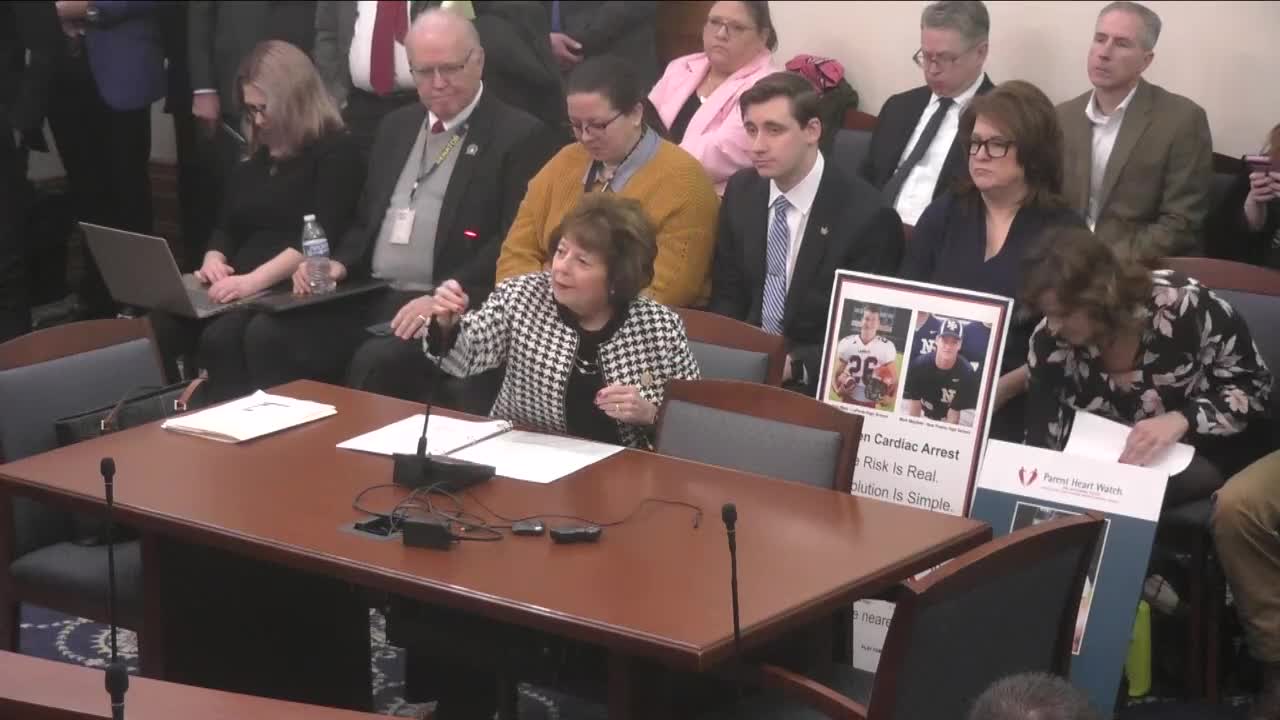
Senator Deb Rogers urged the Senate Health Committee to pass Senate Bill 350, legislation that would require an automated external defibrillator (AED) to be located on the premises where a school athletic activity occurs and call for a site-specific cardiac emergency response plan intended to make an AED accessible within three minutes. "What the legislation does is it requires an AED located on the premises where the athletic activity occurs, and the goal is to be accessible within 3 minutes," Senator Rogers told the committee.
The bill's author framed the measure as an education and safety policy after several testimony speakers described children or young athletes who suffered sudden cardiac arrest. Julie West, whose son collapsed in a football practice, and other parents with personal stories urged lawmakers to approve the bill. Tanya Arts, a teacher and school safety advocate, recounted a student death at her school and said staff and students lacked preparation for cardiac arrest; she described a program that has designated dozens of schools as "heart safe" and trains teams in AED use.
Medical and emergency-services groups also testified. Dr. Elizabeth Struble of the Indiana State Medical Association said early CPR and defibrillation are the best way to help patients who suffer out-of-hospital cardiac arrest. Hank Harris of the Professional Firefighters of Indiana told the committee that placement, maintenance and training tied to a cardiac emergency response plan increase survival rates. Several witnesses cited national statistics offered during testimony — among them an estimate that about 23,000 children age 18 and younger experience out-of-hospital sudden cardiac arrest annually and that survival chances fall roughly 10 percentage points for every minute CPR is withheld — and urged annual drills and local EMS coordination.
Committee members pressed the author on operational details. Senator Brown and others asked how the bill would work at outdoor venues, school-shared fields, and volunteer-run activities (cross-country meets, youth soccer at parks) where multiple schools and public parks are used and no single entity is responsible. Rogers agreed to work with senators on language clarifying responsibilities and noted that the bill allows county health departments to use funds authorized in earlier legislation to buy AEDs for schools and that some local health departments already purchase units for school districts. Senator Bahat Jr. pointed out that coaches often carry first-aid kits and could make an AED part of event equipment, an approach other witnesses said many programs already use.
The committee adopted an amendment making local health-department purchases optional and emphasizing school–health-department collaboration. The panel voted 12–0 to pass the bill as amended with a recommit to Appropriations. The vote included recorded "aye" votes from Senators Yoder, Jackson, Ford, Bush, Dirie, Brown, Bohachac, Kreider, Becker, Leising, Johnson and Chair Charbonneau.
Why it matters: The measure responds to repeated accounts of preventable deaths in school athletics and aims to combine equipment placement with mandatory planning and training. Supporters said a combination of equipment, rehearsed plans and coordination with EMS can substantially improve survival after sudden cardiac arrest. Opponents did not mount sustained formal opposition at the hearing, but committee members asked for clearer language on who is responsible at multi-user outdoor venues and how schools will maintain traveling AEDs.
What comes next: The committee recommitted the bill to Appropriations for fiscal review and additional drafting on operational language.