Get Full Government Meeting Transcripts, Videos, & Alerts Forever!
Get email alerts on the Walters Waste Transfer Cup topic
No spam. Unsubscribe anytime.
Blaine council approves Walters transfer‑station expansion with new odor‑control requirements
Summary
After hours of public comment and council debate, the Blaine City Council approved an amendment to Walters’ conditional use permit to increase annual throughput to 230,000 tons and added tightened odor‑management, monitoring and reporting conditions.
The Blaine City Council on Wednesday approved an amended conditional‑use permit (CUP) allowing Walters Recycling & Refuse to increase annual throughput at its Zylight Street transfer station to 230,000 tons, provided the company implements a package of odor‑mitigation, monitoring and reporting requirements.
The decision followed nearly three hours of public comment and a lengthy council discussion that centered on recurring neighborhood odor complaints, the reliability of proposed monitoring methods and the limited role of local enforcement while state odor rules are still being finalized.
City planner Sheila Selman told the council Walters currently operates under a CUP limiting annual capacity to 140,000 tons and said the company’s amended request—originally 340,000 tons at the planning commission—was reduced to 230,000 tons. Selman summarized the applicant’s proposal to use a “green bag” approach and robotic sorting to separate organics and described proposed physical and operational controls, including roof‑mounted updraft fans and third‑party monitoring. She told the council the planning commission had recommended denial of a larger expansion at its October hearing.
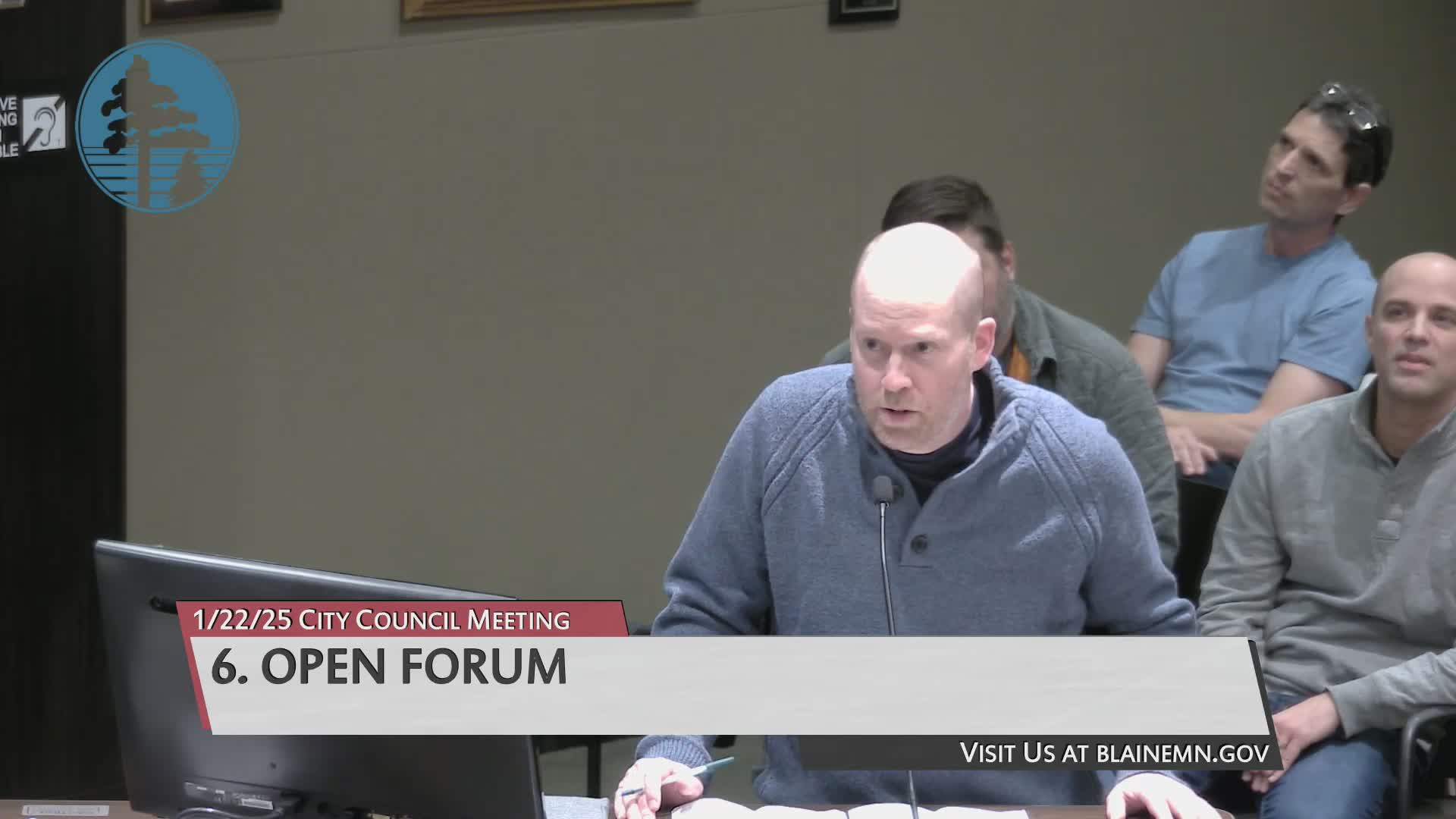
Residents who live near the facility urged the council to reject the expansion. Mark Rohrer, who lives on Zylight Street, criticized the proposed reliance on the Nasal Ranger and described his visit to a Walters facility in Newport: “The Nasal Ranger only affects how much air you inhale. It takes 0 actual measurements. The only measurement is the user's nose, and it is highly subjective.” Several residents described repeated summertime odors that they said disrupted outdoor activities. Todd Wright, a neighbor, said of his children, “Dad, it stinks again,” and described moving kids indoors during summer practices because of odor events.
Walters’ chief operating officer, Jeff Newsom, defended the mitigation package and described the technical differences between the company’s current practices and the systems it proposed for Blaine. “The one we are proposing is, like, a vaporization system…to treat the air before it is drawn out in the updraft system. But that is a different enhancement over what we do have today,” Newsom said.
Council members balanced competing concerns. Council member Robertson repeatedly said she wanted verifiable, local data showing the mitigation measures actually reduce neighborhood complaints before she would give full support. “I need to see in this application what can this council do…to reduce the complaints coming from the neighborhood,” she said. Other council members noted state and county responsibility for meeting Minnesota’s organics‑recycling goals and the practical impacts of denying the CUP: without the “bag” approach proponents said denial would force a county‑wide alternative that could increase costs and truck traffic for residents.
After extended amendments, councilmember Newland moved to approve an amended CUP. Key amendments adopted during the meeting include requiring Walters to install updraft fans and replace its current odor system with a vaporization (EcoSorb‑type) odor‑vaporization system; reducing the threshold that triggers required corrective action from eight verifiable off‑site odor incidents to four and shortening the required response period from 90 days to 30 days; removing a proposed three‑year automatic sunset on some obligations; requiring Walters to supply the city with copies of written complaints or regulatory contacts from agencies, residents or businesses within five business days of receipt; and requiring Walters to fund third‑party odor monitoring with the company to provide biannual reports to the city plus additional monthly reports if monitoring shows noncompliance. Attorney Tom Lunan explained the city can revoke the amended CUP if Walters fails to meet conditions.
Council approved the motion by voice vote. Mayor Sanders and council members acknowledged the difficulty of the decision, with some members saying the mitigation package offered the best path to reduce odors while allowing the city and state to move toward organics‑recycling goals.
Votes at a glance
- Agenda item 9.1 — Walters Recycling & Refuse conditional use permit amendment (increase to 230,000 tons): Approved (motion to approve with amendments carried by voice vote). Key adopted conditions: install updraft fans and an odor‑vaporization system; third‑party odor monitoring with biannual reporting; lower trigger for corrective action (4 verifiable incidents); 30‑day response window; city receipt of complaints/agency contacts within five business days; removal of three‑year automatic cessation clause.
- Agenda item 9.2 — Rezoning at 4324 100th and 17th Ave NE (farm residential to R‑1 single family): Approved.
- Agenda item 9.3 — Preliminary plat to create a second lot at the same property: Approved.
- Agenda items 9.4/9.5 — 100th & Fifth sign ordinance and sign‑plan amendment (change to wall‑sign allowances on south side): Approved with modification (total wall signage reduced to 200 sq. ft. per building and up to 3 wall signs per building; monument sign left at 15 sq. ft.).
- Agenda item 9.6 / 10.1 — Zoning and code updates related to adult‑use cannabis (zoning districts, registration and operational rules): Approved (ordinance and code amendments advanced as presented).
- Agenda item 10.2 — Purchase agreement for 2101 100th Avenue (redevelopment area acquisition using TIF proceeds): Approved (purchase agreement accepted; closing target on or before April 1).
What happens next
The amended Walters CUP is now effective under the conditions council adopted. City staff and the community‑standards office will receive Walters’ monitoring reports and copies of complaints; the city attorney noted the MPCA (Minnesota Pollution Control Agency) retains primary enforcement authority for statewide odor rules that are still being finalized. If Walters fails to meet the CUP conditions the council retains authority to revoke the amendment and revert to prior approvals.
The council’s action does not end community oversight: multiple council members asked staff to ensure timely reporting to the MPCA and to create clearer complaint‑intake procedures so the city and state can better document alleged odor events and trigger enforcement if required.