Metropolitan Mosquito Control briefs Lakeville on surveillance, drones and likely July surge of cattail mosquitoes

5622943 · February 3, 2025

Loading...

AI-Generated Content: All content on this page was generated by AI to highlight key points from the meeting. For complete details and context, we recommend watching the full video. so we can fix them.

Summary

Metropolitan Mosquito Control District told the Lakeville City Council about its surveillance, treatment methods and a planned expansion of drone use, and warned of a likely surge of cattail mosquitoes in July based on 2024 surveillance and precipitation.

Alex Carlson, public affairs manager for the Metropolitan Mosquito Control District, told the Lakeville City Council on Feb. 3 that the district uses year-round surveillance and a mix of larval and targeted adult controls to reduce disease risk and nuisance mosquitoes.

Carlson said the district, established by state law in 1958 and funded by property taxes, conducts wetland inspections, trap-based adult surveillance and local testing for West Nile virus. “Bug spray is the gold standard,” Carlson said when asked about personal protection; he also recommended light-colored, loose clothing and avoiding peak activity periods.

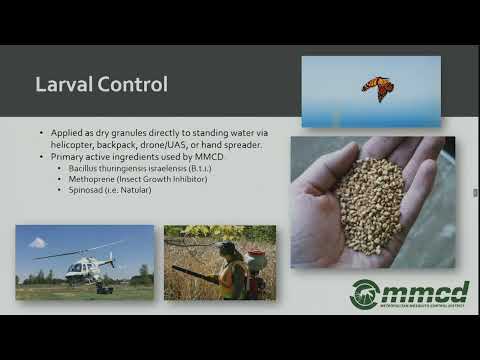
The presentation outlined the agency’s integrated pest management approach, focused on larval control wherever possible. Carlson said the district applied about 144,000 acres of larval control in 2023 and that 2024 saw significantly more acreage because of higher rainfall. The primary larvicide named in the presentation was Bacillus thuringiensis israelensis (Bti); the district also uses methoprene and spinosad for longer-lasting control in standing water.

Carlson described surveillance methods: long-handled dippers to sample wetlands, CO2 traps for adult collections, and a small team of three full-time entomologists supported by seasonal staff who identify specimens at a Saint Paul laboratory. He said traps and weekly averages help the district map mosquito abundance and species for local public-health coordination.

On technology and operations, Carlson said the Rosemount facility serving Lakeville received a drone this year and that all six field facilities will use drones for treating medium-sized wetlands in 2025. He said drones and helicopters allow broader, more even distribution of larvicides in wetlands that are otherwise unsafe or inefficient to treat by hand.

Turning to outlook, Carlson said it is too early to predict overall seasonal severity but warned the district expects a substantial surge this year in the cattail mosquito (a species that overwinters as larvae and typically peaks in July). He attributed this forecast to last season’s surveillance and precipitation patterns and the lab’s predictive model. Carlson advised residents to use repellents, remove standing water, and sign up for the district’s trap maps and treatment alerts available on its website.

Council members asked several technical questions about repellents and traps; Carlson cautioned that consumer traps can attract mosquitoes closer to homes and recommended repellents and permethrin-treated clothing for outdoor recreation. The presentation closed with information on free tire pickup and outreach events the district plans to attend in Dakota County.