Get Full Government Meeting Transcripts, Videos, & Alerts Forever!
Get email alerts on the Budget Staffing Model topic
No spam. Unsubscribe anytime.
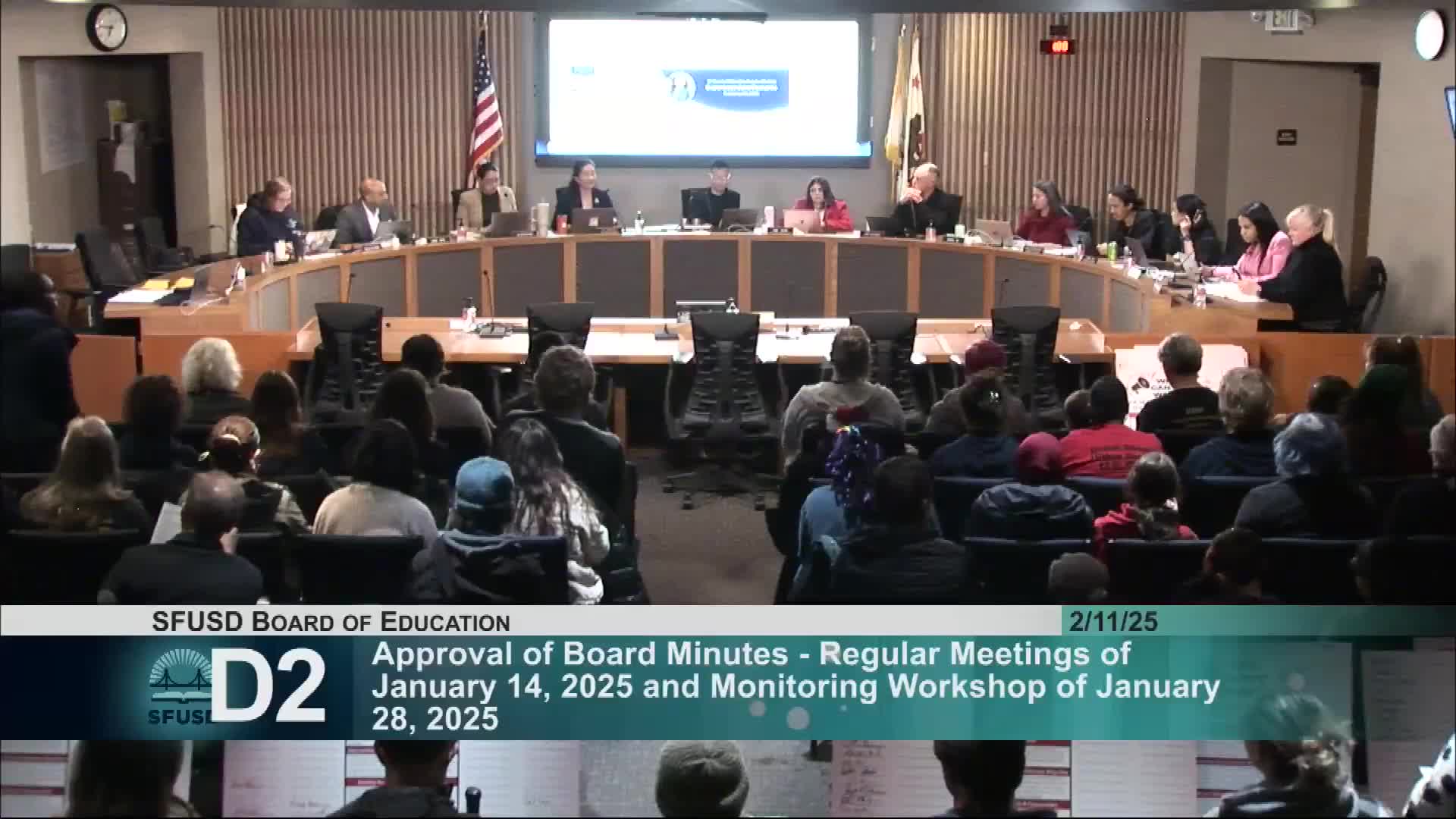
SFUSD outlines $113.8M budget gap; public and staff urge protection of counselors, social workers and neighborhood schools
Summary
Superintendent presented a staffing model and a $113.8 million deficit during a Feb. 11 meeting. Public comment—dominated by teachers, parents and students—focused on proposed combination classes, threatened cuts to counselors and social workers, and the potential impact at Sheridan and Cobb elementary schools.
San Francisco Unified School District leaders told the board Feb. 11 that the district faces a projected $113,800,000 budget shortfall — roughly 10% of the district’s budget — and outlined an initial “staffing model” that would fund a pared‑down base allocation first while identifying additional services to be paid from restricted and grant funds.
Superintendent Dr. Hsu presented the district’s current budget picture and told the board: “we are, at this moment in time, facing a very large deficit. Dollars 113,800,000.0 represents 10% of our budget and it requires us to make really difficult decisions.” The superintendent said district payroll is large and warned that, without reductions, the district could exhaust one‑time reserves and face cash shortfalls in 2026.
Assistant Superintendent Melli Lau Smith described the proposed staffing model as a multi‑tier approach: a base enrollment‑driven allocation (teachers, principals, clerks, custodians and core operational costs), followed by funding for sports, library, arts and music (PEAF/SLAM) and then grant‑funded school resources and site discretionary funds. Additional student services — including instructional coaches, counselors and A‑G course offerings — were shown as dependent on “pending available funding” from restricted sources.
Officials said they are exploring a voluntary early‑retirement incentive (SERP), a 20% reduction in certain central‑office costs (about $20 million on the unrestricted side), contract reviews and, as a last resort, staffing reductions. Superintendent Hsu said the district will present more detailed multi‑year projections at a March 11 second‑interim budget meeting and hopes for clarity after the Governor’s May revision.
The public comment period that followed was dominated by teachers, parents and students urging the board not to cut counselors, social workers and school‑based positions and objecting to proposed kindergarten‑first‑grade combination classes at schools such as Sheridan Elementary and Cobb Elementary.
Teachers and parents from Sheridan described the school as a neighborhood community that would lose a bilingual kindergarten teacher and would be forced into a K‑1 combination class under proposed staffing scenarios. Speakers cited academic and social‑emotional harm for young learners if kindergarten and first grade are combined, and multiple speakers noted Sheridan’s demographics — for example, one speaker said Sheridan serves a high share of students of color, students eligible for free/reduced lunch, unhoused students and students with special education needs.
“Combination classes often disadvantage younger and struggling students,” said Alyssa Arno, a TK teacher at Cobb Elementary and a bargaining team member. “The district’s proposed combination classes not only violate the teacher contract, but directly harm our students and families,” she told the board.
A speech‑language pathologist urged the board to consider the range of developmental readiness between 4‑year‑old kindergarteners and 7‑year‑old first graders and said a K‑1 split creates untenable demands on a single teacher. Several student speakers also said split classes impaired learning and urged the board to preserve single‑grade classrooms.
Union and staff representatives pressed for rapid bargaining dates after multiple canceled sessions; Josh Davidson, a chef and SEIU Local 10 to 1 steward, asked the board to “encourage your labor relations and human resources and budget folks to do their homework” and restore stalled bargaining dates.
Other commenters urged the board to protect grant‑funded positions (student success funds, community schools grants, PTA‑funded posts) and to prioritize social workers and counselors as essential to students’ well‑being. United Educators of San Francisco (UESF) negotiator Adan Louvano, a school psychologist, said more than 3,500 members responded to the union’s survey identifying bargaining priorities and that the union planned to bring sunshine notices to start contract talks.
District staff said site leaders have begun cohort briefings about the draft staffing approach and that principals will receive tools and guidance to plan site budgets; staff emphasized more work is required to map restricted funding to the district’s priorities. The superintendent said a final balanced budget will be brought to the board for adoption in June.