Get Full Government Meeting Transcripts, Videos, & Alerts Forever!
Get email alerts on the Ovsjg Budget Fy26 topic
No spam. Unsubscribe anytime.
Nonprofits, survivors and council members urge restoration of D.C. victim‑services and legal‑aid funding
Summary
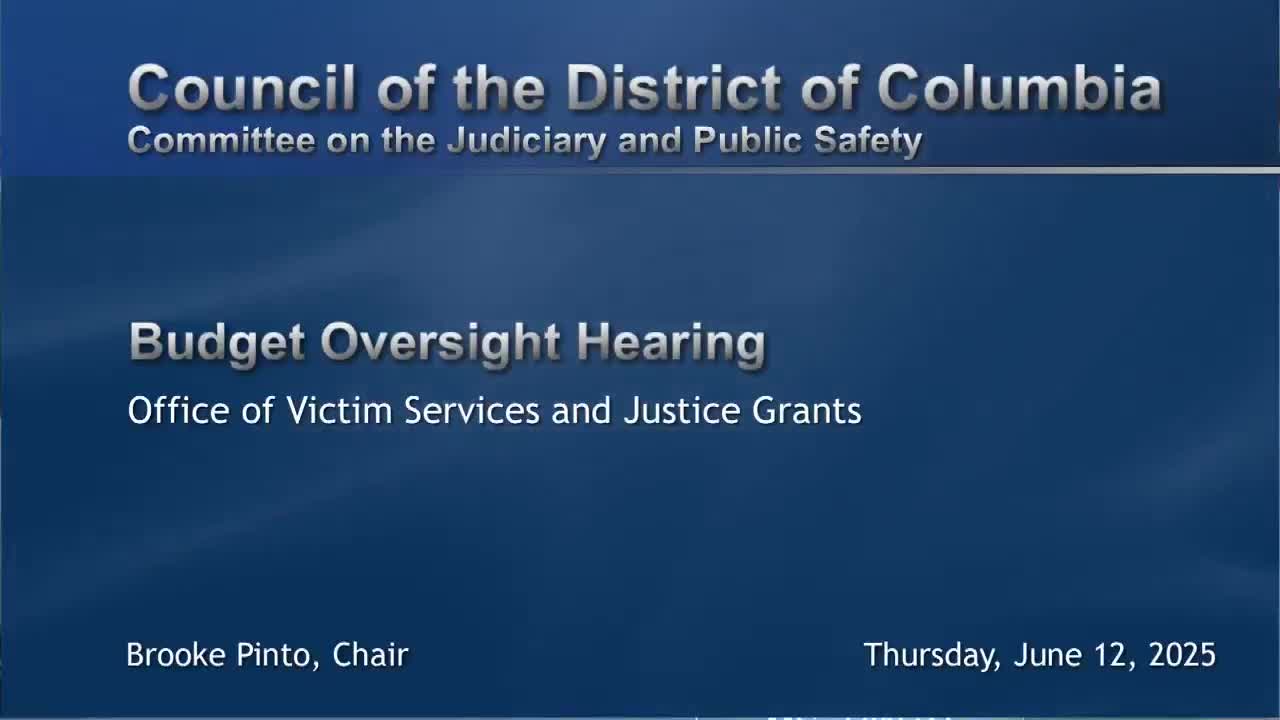
Councilmember Brooke Pinto opened a June 12 hearing of the Committee on the Judiciary and Public Safety on the mayor's proposed FY26 budget for the Office of Victim Services and Justice Grants (OVSJG), telling the room the proposal "offers a total of $83,300,000 for OVSJG, which reflects a decrease of almost 24%."
Councilmember Brooke Pinto, chairwoman of the Committee on the Judiciary and Public Safety, opened the June 12 public hearing on Mayor Muriel Bowser's proposed FY26 budget for the Office of Victim Services and Justice Grants (OVSJG) in Room 412 of the John A. Wilson Building. Pinto said the mayor's proposal "offers a total of $83,300,000 for OVSJG, which reflects a decrease of almost 24%."
Why it matters
Nonprofit legal‑aid groups, domestic‑violence shelters, reentry programs and trauma‑care providers told the committee the reductions would force layoffs and cut services that thousands of residents rely on for safety, housing and legal protection. Witnesses pressed the council to restore funding for two areas they said are most at risk: the Access to Justice Initiative, which funds civil legal aid, and OVSJG's victim‑services grants.
Key figures and requests
- Mayor's proposed OVSJG total: $83,373,718.79 (as announced by the agency). - Access to Justice proposed in the mayor's FY26 budget: about $10.4 million, a roughly 67% cut from last year's level (witnesses said the FY25 baseline was about $31.6 million). - OVSJG victim‑services line in the mayor's proposal: roughly $50.0 million, down about $5.8 million from the prior published budget figures after federal grants were reestimated. - The Victim Assistance Network (VAN) and many providers asked the council to add $9.33 million in recurring local funding to restore victim services to a $59.41 million baseline and to restore $21.2 million to the Access to Justice Initiative.
What witnesses said
Survivors and service providers filled the hearing room for nearly seven hours of testimony. Julia Coleman, a survivor who testified about escaping domestic violence, said volunteer legal advocates "provided life saving services" that helped secure a civil protection order and safety for her. Sarah Tennant, executive director of Volunteer Legal Advocates, told the committee: "The FY26 budget and the proposed cuts to both the access to justice funding and victim services are deeply concerning and will be devastating for volunteer legal services and the community we serve."
Kuvang Gaje, president and CEO of the District Alliance for Safe Housing and co‑chair of the VAN, summarized the sector's position: "We cannot cut our way to safety," and urged the council to follow the VAN platform, which asks for the recurring local additions described above.
Nonprofit leaders described concrete services that rely on the funding. Neighborhood Legal Services reported handling nearly 1,300 cases and helping almost 3,900 low‑income residents in the prior year; Volunteer Legal Advocates said it helped more than 3,000 adults and children in 2024 and that pro bono attorneys contributed roughly 48,000 hours of legal work valued at over $18 million. Legal Aid DC said Access to Justice grants provide more than 40% of its revenue and sustain roughly 80 of its 120 staff.
Direct service and public‑safety impacts
Witnesses described what cuts would mean on the ground: fewer emergency shelter beds, longer waits for crisis therapy, elimination of legal clinics that prevent eviction or secure public benefits, reduced language access for limited‑English survivors, and the closure of culturally specific programs for immigrant communities and LGBTQ+ survivors. SafeShores (the D.C. Children's Advocacy Center), DASH (safe housing), DCFNE/DC Forensic Nurse Examiner (24/7 forensic services), and the DC LGBTQ+ Community Center, among others, reported rising demand and said recent local investments had expanded capacity that would be hard to sustain.
Several reentry and workforce programs for people leaving incarceration testified that OVSJG justice and reentry grants support case management, job training and housing placement that reduce recidivism. The National Reentry Network's policy director said such programs have demonstrated measurable drops in repeat incarceration when funded.
Agency response and process questions
Director Jennifer Porter, who leads OVSJG, described the mayor's proposal as a response to a constrained fiscal year and said the agency's budget is more than 95% grants. Porter told the committee the proposed FY26 agency total includes $50 million for victim services, $19.8 million for justice grants (reentry and similar programs), and roughly $10.5 million for Access to Justice in the budget document, and she said the administration has made a recurring $3.0 million investment for implementation of the Sexual Assault Victims' Rights Amendment Act (SAVRAA).
Porter and agency staff explained that some apparent year‑to‑year reductions on paper are tied to federal grant estimates that were higher in the published FY25 budget than the grants ultimately yielded; they said the FY26 numbers "right‑size" those federal projections. Porter also described a one‑time investment in a new grants management system and said OVSJG will prioritize existing grantees while using peer reviewers, agency data, and partner input to allocate constrained funds.
What the committee asked for
Committee members repeatedly pressed the agency on how it will prioritize limited funds and how it will ensure compliance, transparency and continuity for programs that are legally required or that serve people in crisis. Pinto emphasized the committee's intention to work quickly before the committee markup on June 24; she thanked witnesses and said the committee and council will explore options to fill gaps.
Closing, next steps
No formal votes took place at the hearing. The committee will proceed to markup on June 24 as part of the FY26 budget process. Witnesses asked the council to restore local recurring funding to prior levels for Access to Justice and to add the $9.33 million recurring VAN baseline for victim services; council staff and OVSJG said they would continue follow‑up work with grantees to clarify the grants picture and to explore other short‑term revenues or private‑sector matches that could help bridge gaps.
Ending
Several witnesses closed by asking the council to remember that budget decisions affect "real lives," and Director Porter told the committee the "resources allocated to our agency play a critical role in supporting safety, justice for all residents of the District Of Columbia." The committee convened additional budget work ahead of the June 24 markup.