Get Full Government Meeting Transcripts, Videos, & Alerts Forever!
Get email alerts on the County Budget topic
No spam. Unsubscribe anytime.
Santa Clara County approves revised budget moves and across‑the‑board object‑2 reductions
Summary
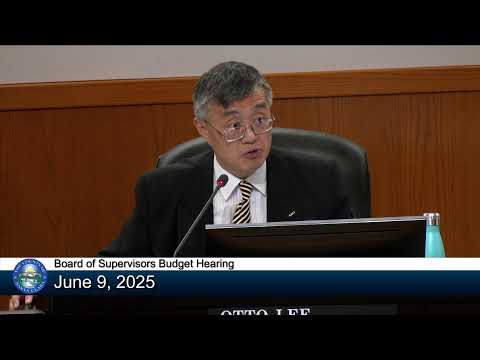
The Santa Clara County Board of Supervisors on Monday approved the county's recommended budget and a set of revised recommendations that include an across‑the‑board object‑2 negative appropriation to help close a shortfall, and asked departments to return with more detailed program‑level swaps over the summer.
The Santa Clara County Board of Supervisors on Monday approved the county's recommended fiscal plan and a set of revised recommendations that administrators said are meant to hold the county steady while staff develops more targeted reductions.
The board adopted the recommended budget and accepted a package of revised recommendations that includes an across‑the‑board object‑2 negative appropriation for departments to implement. County Budget Director Ezekiel Vega and County Executive James Williams told the board the item is intended as a temporary, transparent mechanism while departments and the board work through program‑level swaps and more precise reductions.
Williams said the county faced last‑minute downward revisions in projected general‑fund revenues and federal and state risks tied to Medi‑Cal and food‑assistance programs. He told the board administrators had limited time to identify further permanent solutions and proposed a short‑term object‑2 approach that asks departments to freeze or cut nonessential services and supplies and to return with proposed swaps if needed. "We will be working with departments beginning with this week's department head meeting and engage in robust conversations around strategies and approaches," Williams said.
Under the approved framework, departments were asked first to identify savings in travel, supplies and other services and to avoid cutting contracted services without bringing specific swap proposals back to the board. Several supervisors said they want to see the full package of departmental swaps and their programmatic impacts returned to the board at once rather than approved piecemeal. "We need to see the whole landscape at once," Supervisor Ellenberg said during the discussion.
The board voted on multiple elements related to the budget during the hearing. The formal adoption of the recommended budget was recorded as unanimous. Later, the board approved revised recommendations that included the object‑2 negative appropriation and a board motion to add $1.95 million intended to restore gender‑based violence prevention funding to the prior level; that motion carried 4‑1.
County staff told the board they will return in the fall with department‑level proposals to implement the object‑2 reductions or to substitute position swaps and other alternatives. The administration warned that larger revenue risks are expected in fiscal 2026–27 and that the county will face additional, larger choices related to Medi‑Cal enrollment changes and state actions.
Supervisor members emphasized the need for transparency and timely follow‑up: several asked that departments present full program impacts, expected service reductions and proposed mitigations when they return with swap proposals.
Votes at a glance: • Adopt recommended budget (item 8): approved 5–0 (Supervisor Abakova: Aye; Supervisor Yoon: Yes; Supervisor Ellenberg: Yes; Vice President Arenas: Yes; President Lee: Aye). • Approve revised recommendations including object‑2 negative appropriation and add $1.95 million for gender‑based violence services (item 9 motion): approved 4–1 (Abakova: Nay; Yoon: Yes; Ellenberg: Yes; Arenas: Yes; Lee: Aye).
The board set a timeline for administration to work with departments through the summer and to return with detailed proposals instead of immediately finalizing program‑level eliminations. The administration cautioned that without new state or federal revenue, the county faces larger structural deficits in the year ahead.