Get Full Government Meeting Transcripts, Videos, & Alerts Forever!
Get email alerts on the Historic Preservation topic
No spam. Unsubscribe anytime.
San Antonio board grants clear‑vision exception but denies taller fence for Montevista property
Summary
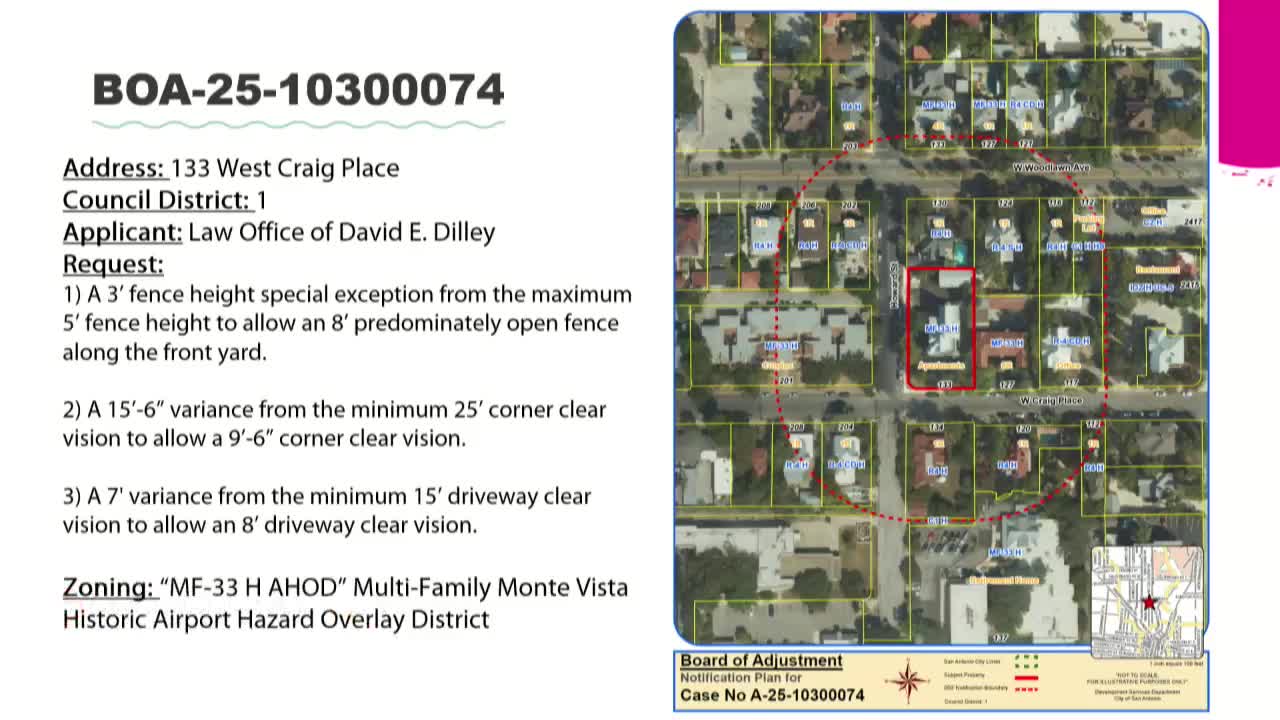
The San Antonio Board of Adjustments on Monday granted an exception to the city’s clear‑vision requirement for a fence at 133 West Craig Place in the Montevista Historic District, but it denied a request to allow a substantially taller privacy fence across the property.
The San Antonio Board of Adjustments on Monday granted an exception to the city’s clear‑vision requirement for a fence at 133 West Craig Place in the Montevista Historic District, but it denied a request to allow a substantially taller privacy fence across the property.
The board heard a staff recommendation to deny the special exception and zoning variances after city planners and the Office of Historic Preservation said the fence would alter the character of the historic district. Joel Vela, senior city planner, told the board the staff recommended denial because the requested height and material would “alter the character” of the area and impede clear sight lines at the corner; staff mailed 48 notices and received one in favor and multiple objections, including from the Montevista Historic Association and the District 1 neighborhood association.
The applicant’s representatives said the property is a multiunit building with 10 units and that the fence was intended to provide security for residents. The applicant’s presenter, who identified herself as Yeidy, said the proposed iron fence is predominantly open, that its design fits the building’s scale and ornamentation, and that lowering it to the 4‑foot height recommended by the Historic Review Commission would degrade the property’s appearance and harm tenants’ safety. David De León, who also represented the owner, said the owner would comply with the board’s decision.
Community members and neighborhood leaders urged denial of the height variance. Tom Arthur, president of the Montevista Historic Association, and several recorded voicemail and phone commenters said the property’s historic designation and long effort to protect district character weighed against permitting a taller, nonconforming fence. Brian Reed, president of the Montevista Neighborhood Association and architectural committee, told the board the association supported staff’s recommendation for a 4‑foot, predominately open fence as a reasonable compromise.
After argument and public comment, a motion to grant an exception to the clear‑vision requirement passed; multiple commissioners concurred that the fence as proposed would still allow adequate sight lines at the corner. A separate motion to grant the height variance to allow a taller fence failed, which means the board did not approve the owner’s request to keep the fence at the greater height sought. Board members discussed that, if some relief were needed, the property owner might still be able to construct a predominantly open fence at up to 5 feet under certain code allowances or pursue remedies with the Historic Review Commission.
The board also heard from Edward Holmes of the Office of Historic Preservation, who described the Certificate of Appropriateness process and said the Historic Review Commission approved a certificate limiting front fences in Montevista to 4 feet. Holmes said the historic guidelines favor predominantly open, lower fences to preserve sight lines and the district’s appearance.
The board’s action split its decisions: it granted the limited clear‑vision exception but declined to approve the broader height variance or to overturn the historic‑preservation determinations. Commissioners deliberated at length about enforcement timing: city staff said the Preservation Office first received a report on March 1 that the fence work was underway, followed by enforcement notices and a Certificate of Appropriateness application submitted in early March. The record includes multiple citizen voicemail statements and written comments entered in opposition.
With the height variance denied, the board’s rulings leave the property subject to the historic‑review recommendations and the city’s fence standards. The applicant was given the opportunity to amend plans or continue pursuing administrative and historic‑review remedies.
Speakers recorded in the hearing included Joel Vela, senior city planner; Edward Holmes, Historic Preservation staff; Yeidy (applicant representative); David De León (applicant representative); Brian Reed (Montevista Neighborhood Association president); Tom Arthur (Montevista Historic Association president); and multiple board members who identified themselves during roll call and the vote.