Cotati police present Q1 public-safety report; council approved ALPR data-sharing with 30‑day retention

3585814 · May 29, 2025

Loading...

AI-Generated Content: All content on this page was generated by AI to highlight key points from the meeting. For complete details and context, we recommend watching the full video. so we can fix them.

Summary

Chief Simmons told the Cotati City Police Advisory Committee the department handled 3,248 events in Q1 2025, recorded 22 arrests and reported zero formal citizen complaints; the City Council approved data sharing to allow access to fixed automated license-plate-reader feeds with a 30‑day retention window.

Chief Simmons, the police chief for Cotati City, presented the Cotati City Police Department’s first-quarter 2025 report to the Cotati City Police Advisory Committee, saying the department recorded 3,248 events and made 22 arrests during January–March. He told the committee the department had “0 formal citizen complaints” for that period and reported nine use-of-force events involving 10 applications of force.

The report matters because it sets baseline metrics the committee and public will use to assess staffing, training and new technology. Simmons said the City Council approved a data‑sharing agreement that will allow the department to subscribe to fixed automated license-plate reader (ALPR) feeds — including cameras at a local Lowe’s — and that the council set a 30‑day retention period for that ALPR data.

Simmons described the quarterly statistics and operational context. “We had 3,248 events,” he said, and noted the split between dispatched calls and officer-initiated activity is roughly even. He said arrests in the quarter totaled 22 (compared with an equivalent quarter in 2024 of about 39 under the same accounting method). On uses of force, Simmons said there were nine events and 10 applications of force: five control holds (typically handcuffing resistors), four firearm displays and one pepper-spray display. He emphasized that none of the incidents met the Department of Justice threshold for reportable severe force (shootings or force resulting in serious bodily injury) during the quarter.

Simmons also gave a staffing update: the department had two sworn vacancies at the time of the report, one recruit was midway through the police academy and a lateral candidate was in background checks. He said the department recently hired a part‑time dispatcher and had three other dispatch candidates in background review.

On training and community engagement, Simmons listed several in‑person and online trainings the department conducts, including de‑escalation and scenario-based perishable-skills instruction. He said training costs are amplified by overtime to backfill officers who attend courses.

Public commenters raised a range of concerns during the meeting. Jim Duffy (Zoom participant) urged the city to consider a local surveillance-technology ordinance and asked whether the vendor Flock shares data with federal immigration agencies; Simmons responded that Flock access as approved by the council does not enable immigration enforcement by the department. Kevin and other speakers asked about body-worn camera retention and complaint processes; Simmons said body-worn camera footage that is not flagged as evidence is purged after two years and that hard-copy complaint forms are available at dispatch and an online complaint form also exists.

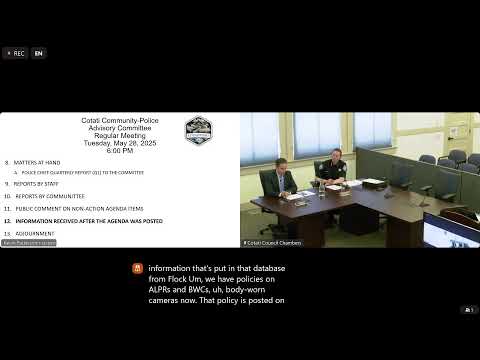
On ALPRs and cameras, Simmons said the council’s approval permits the department to take a subscription that includes two fixed cameras (the typical entry package) and, by subscribing, gain restricted access to other participating cameras in the region. “We started out with about a one-year retention, then it went to six months,” he said. “Balancing that with privacy concerns, going to 30 days, I don’t think is going to have any sort of significant impact.” He added that if the department later finds a sustained investigative need, he will return to council with factual justification for longer retention.

Simmons described the ALPR data as secured and encrypted in a cloud system and noted the subscription and longer retention both raise costs. He also clarified the difference between vehicle-mounted ALPR units and fixed cameras: Cotati’s patrol cars have four vehicle-mounted ALPR units that alert officers locally, but fixed ALPR cameras and a subscription (e.g., Flock) provide regional alerts and access to feeds hosted by businesses and agencies.

The advisory committee formally approved the meeting minutes from the Feb. 27, 2025 packet earlier in the meeting; a motion to approve carried. No other formal committee actions were recorded during the police report agenda item.

Ending: Simmons closed by inviting questions, reiterating that complaint and commendation forms are accepted in writing or in person at dispatch or via the department website, and saying he would bring staffing and retention questions back to council if operations show a need for changes in camera-data retention or other policies.