Get Full Government Meeting Transcripts, Videos, & Alerts Forever!
Get email alerts on the Transportation Impact Fees topic
No spam. Unsubscribe anytime.
Marion County adopts phased increase to transportation impact fees, delays new car-wash and drive‑thru categories
Summary
The Marion County Commission declared extraordinary circumstances and approved a phased increase in transportation impact fees to raise local transportation revenue, while deferring debated categories such as automated tunnel car washes and a new drive‑thru restaurant rate for further local study.
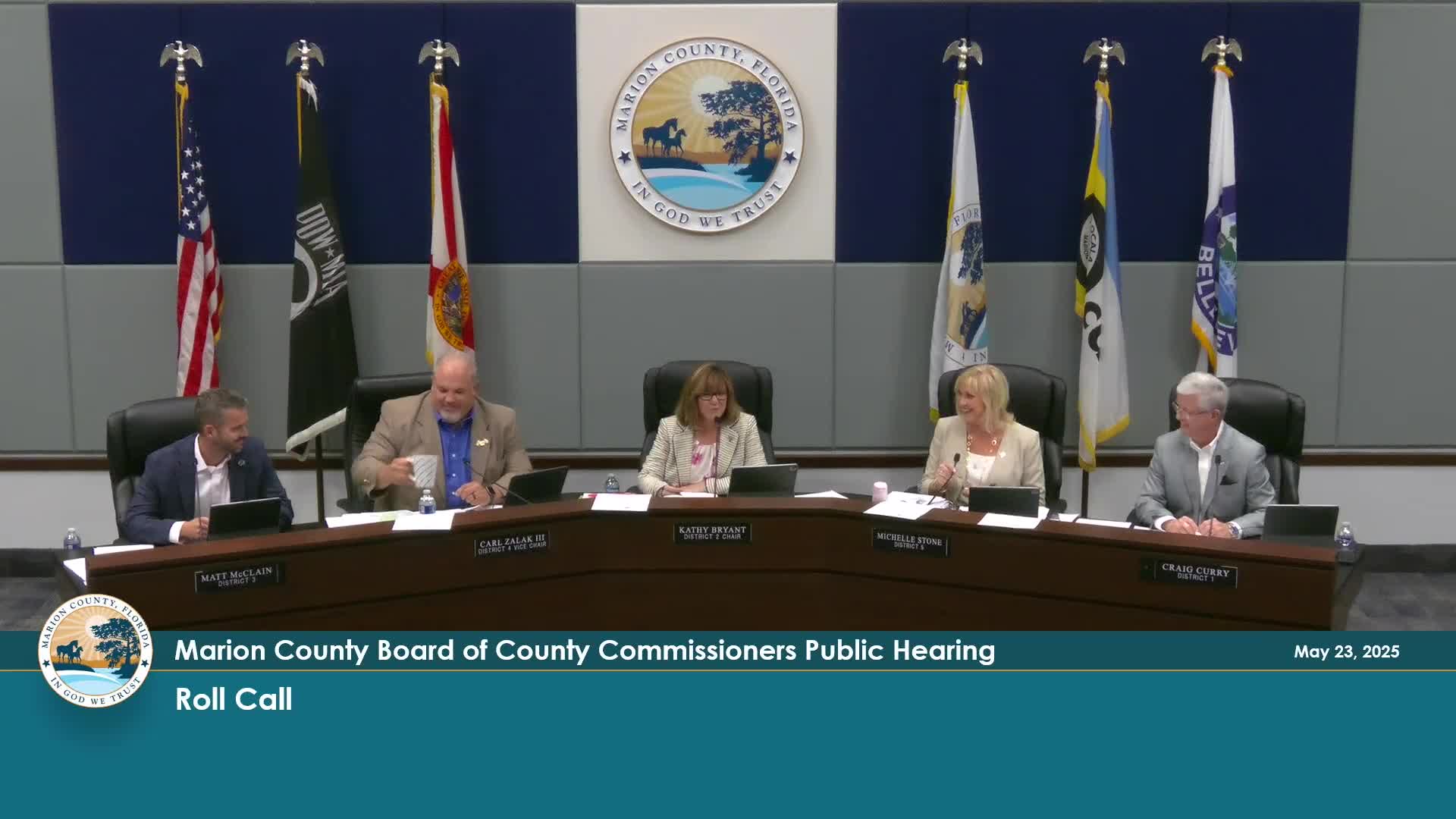
The Marion County Board of County Commissioners voted 4–1 on May 23 to adopt changes to Chapter 10 of the county code updating transportation impact fees, declaring the study-supported “extraordinary circumstances” cited by staff and a consultant and establishing a phased-in fee schedule intended to boost transportation capital revenues over the next several years.
The move sets new transportation impact fees at 70% of the study’s calculated full rate effective Oct. 1, 2025, with scheduled increases of 10 percentage points on Oct. 1 of 2026, 2027 and 2028. The board also approved related ordinance changes: repeal of annual indexing, revisions to developer-credit rules, a three‑district expenditure map that adds the City of Ocala as a distinct district for fee expenditure, and several procedural updates. Commissioner McLean cast the lone “no” vote.
Why it matters: county staff and consultants said Marion County faces long‑term transportation capacity needs far larger than projected revenues from the recently renewed penny sales tax. The consultant’s study — which county staff placed into the record — concluded that, using current assumptions, the county will face roughly a half‑billion dollar shortfall on capacity projects over the next 20 years unless impact fees and other funding sources are increased. Commissioners said the phased approach balances the stated infrastructure needs with community concerns about housing affordability and legal and market risks.
The consultant, Negan Kemp of Benesch (consultant to Marion County), summarized the study’s central calculation: “The total calculated fee for a midsize single‑family home is about $5,300; the currently charged fee is about $1,400,” Kemp said during the hearing. The study estimated total county transportation needs of about $1.4–$1.5 billion over 20 years and projected approximately $900 million in sales‑tax revenue for that same period, leaving a substantial funding gap that impact‑fee increases are intended to help close.
The board’s action and key ordinance changes - Fee adoption and phase‑in: The board approved new fee schedules that begin at 70% of the study’s calculated rates on Oct. 1, 2025, rising by 10 percentage points each Oct. 1 in 2026–2028. The schedule and precise dollar rates for each land‑use category will be published with the ordinance. The county clerk will execute the statutorily required 90‑day notice before the Oct. 1 effective date. - Extraordinary‑circumstances finding: Commissioners made the finding required by Florida law to allow increases above the statutory indexing/phase limits; the two‑thirds threshold for that finding (as in current law) was met with the board vote. - Indexing removed: The ordinance repeals the county’s prior indexing provision (automatic annual increases tied to CPI or other indices), because state law limits increases to once every four years unless extraordinary circumstances are found. - Developer credits and durations: The ordinance retains dollar‑for‑dollar credits for developer‑built infrastructure at fair‑market value, restores the prior practice that agreements are typically five years with the ability to request longer periods (up to 20 years) subject to board approval, and adds language to allow credits to be transferable to developments in an adjoining road‑construction district where the contribution provides direct benefit to the assignee development. - Exemptions: The draft ordinance was revised so certain government properties and private schools are treated like public schools and exempted from impact fees; the board approved adding those exemptions to the ordinance. - Administration and liens: The updated ordinance includes administrative charges capped at actual costs per state law. After discussion the board removed language that had made unpaid fees run with the land and removed a separate lien provision; staff retains the ability to withhold certificate of occupancy until fees are paid.
Deferred categories and next steps Commissioners and staff agreed to defer adoption of two contentious new or reclassified categories pending localized county studies: large automated tunnel car washes and a distinct “fast‑food with drive‑thru” restaurant category. County staff will perform localized trip‑generation and trip‑length studies and return to the board with proposed fee amounts; until those studies are completed and adopted the county will continue to use existing comparable categories for permit and traffic review. The board also instructed staff to publish the impact‑fee procedures manual and a GIS boundary layer for the Ocala district to clarify where the city district begins and ends in county fee maps.
Public comment and stakeholder positions Public testimony ran more than an hour. Speakers from business and home‑building sectors warned large, immediate increases would worsen housing affordability and could chill commercial investment. The Ocala Metro Chamber and Economic Partnership urged a phased approach and recommended beginning at 50% to protect competitiveness, saying in part that “sudden high impact fees make Marion County less attractive to businesses and developers,” (Tamara Fleischhacker, interim CEO, Ocala Metro Chamber and Economic Partnership). Builders and the Marion County Building Industry Association urged moderation, citing rising costs for lots and materials and their effect on price and sales.
Advocates for higher fees said growth has already placed extraordinary strain on county roads and argued developers should pay more of the cost of new capacity. Len Rasciopi of the Marion County Republican Executive Committee urged the board to adopt the maximum allowed rates to avoid future shortfalls and the need for additional taxes.
Legal and technical issues discussed Consultants and legal counsel reviewed the state legal framework that governs impact fees, including Florida Statute 163.31801 (the Impact Fee Act) and recent state legislation cited by the consultant and counsel. The board heard questions about data sources: consultants rely on the Institute of Transportation Engineers (ITE) trip‑generation manual blended with Florida studies and the county travel‑demand model; some commenters and attorneys argued parts of the demand data are stale or not sufficiently localized, and requested additional localized studies for certain land‑use categories (notably automated car washes and drive‑thru restaurants).
What the ordinance will require of developers and staff Developers retain the statutory option to submit their own independent, localized traffic study to justify a reduced fee for a particular land use or project; developer credits continue to be negotiated via credit agreements at fair market value; credits generally will be tracked and approved by agreement, and credits may be transferred within or to adjoining districts where they provide direct benefit.
Implementation and timeline The board approved publication of the ordinance and the attached rate schedule and directed staff to run the 90‑day notice so the first scheduled rates will take effect Oct. 1, 2025. Staff will return to the board with localized studies for automated car washes and drive‑thru restaurants and with a finalized interlocal agreement approach with the City of Ocala regarding dual collection in city and county areas.
Ending note County commissioners described the vote as an attempt to balance the county’s large, long‑term transportation funding gap against near‑term concerns about affordability and legal risk. Chair Bryant (Marion County Commission chair) framed the hearing by pointing to the county’s infrastructure shortfall and the need for tools to address congestion and long‑range capacity, and Commissioner McLean recorded the sole dissent, citing affordability concerns and the magnitude of the proposed increases.
(See below for action records, speaker list, cited authorities, clarifying figures and transcript provenance.)