Get Full Government Meeting Transcripts, Videos, & Alerts Forever!
Get email alerts on the Traffic Speed Survey topic
No spam. Unsubscribe anytime.
Planning commission backs 2025 citywide speed survey recommendations; several limits to change and one segment deferred
Summary
After a multi-hour presentation and discussion, the Cathedral City Planning Commission recommended the engineering findings from the 2025 citywide speed-limit survey to City Council. The study evaluated 74 roadway segments and proposed speed modifications on 13 segments; one segment (Whispering Palms Trail between 30th and McCallum) was deferred.
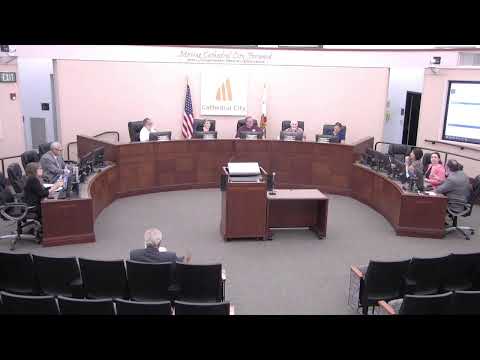
On May 20, 2025, the Cathedral City Planning Commission voted to recommend that City Council adopt the findings of the citywide 2025 engineering and traffic speed survey, which evaluated 74 roadway segments and recommended enforceable speed-limit modifications on 13 segments. The motion passed with four votes in favor and one abstention; the transcript does not record the name of the commissioner who abstained.
Traffic engineer findings and state law:
Traffic-engineering presenter Mr. Balanzaro told the commission the study followed the California requirements for establishing speed limits (including use of 85th-percentile speeds), a review of collision history (three-year SWITRS data), 24-hour traffic counts and radar speed surveys. The presenter noted recent state law changes under Assembly Bill 43 (AB 43) that allow local agencies greater flexibility to reduce posted limits for safety and land-use reasons (for example, proximity to schools, children, seniors or pedestrians) and that AB 43 can extend the interval between comprehensive citywide surveys when justified. "The speed limit is normally set at the 80 fifth percentile and that represent 85% of the people driving... The speed limits established on these basis confirm the majority of the vehicles as to what speed is reasonable and prudent," Balanzaro said.
Key recommendations and exceptions:
- The consultant reviewed 74 roadways and proposed modifications on 11–13 segments across the city (the presentation referenced both figures as the analysis proceeded and the staff report sent 13 segments forward for formal action). Many recommended changes were reductions; the only recommended increase noted in the presentation was San Tropez (Santoro) from 25 to 35 mph on one segment.
- Council-requested re-evaluations: City Council asked that several segments be re-reviewed; staff reported the engineer could justify reductions on five of six re-evaluated segments. Whispering Palms Trail between 30th Avenue and McCallum Way could not be justified with current data and the engineer recommended postponing action on that specific segment until after a planned Class 3 bike-route project is completed and new counts can be taken.
- Vista Chino: The report recommended reducing portions of Vista Chino (previously raised to 55 mph in 2019) back to 50 mph in some segments because of nearby residential uses and pedestrian considerations; commissioners discussed cross-jurisdictional effects where speed changes at city limits meet Palm Springs.
Commission discussion and concerns:
Several commissioners pressed staff about methodology and local impacts. Vice Chair Lee asked whether setting limits by 85th-percentile speed would simply ratify prevailing speeding behavior: "Does that mean if everyone decides to speed on a certain road, we'll end up putting the speed limit up because they're speeding?" Mr. Balanzaro responded that 85th-percentile is one factor and that additional statistical and safety factors (collision history, land use, pedestrian presence) are applied.
Commissioners raised specific concerns about Cathedral Canyon, where the posted limit is 25 mph in a segment while the study's 85th-percentile figure for one stretch was 38 mph and the median speed 31 mph. Commissioners said they had observed regular enforcement (tickets) on that hill and questioned whether posted speeds and enforcement practice match travel behavior and local safety conditions. Staff noted the "residential district" designation can alter allowed posted speeds when statutory thresholds (dwelling units per quarter-mile) are met and that the engineer used prior surveys and AB 43 guidance in recommending which posted limits to maintain or change.
Motion and next steps:
Commissioner Lee moved, and the motion was seconded (recorded as Chairman Malakoff as seconder in the minutes), to recommend that City Council adopt the engineering and traffic survey findings. The clerk recorded the motion as passing with four ayes and one abstention. Staff and the city attorney told the commission the item will go to City Council for adoption (a first reading is expected), and staff noted that changes to roadway design—new bike lanes, bridges or turn lanes—would trigger site-specific speed surveys outside the citywide-cycle interval.
The commission asked staff to include in the Council transmittal the discussion points and commissioner concerns (particularly the Cathedral Canyon segment) so Council would see the commission's questions and the areas commissioners asked to be re-examined.