Get Full Government Meeting Transcripts, Videos, & Alerts Forever!
Get email alerts on the Cannabis Regulation topic
No spam. Unsubscribe anytime.
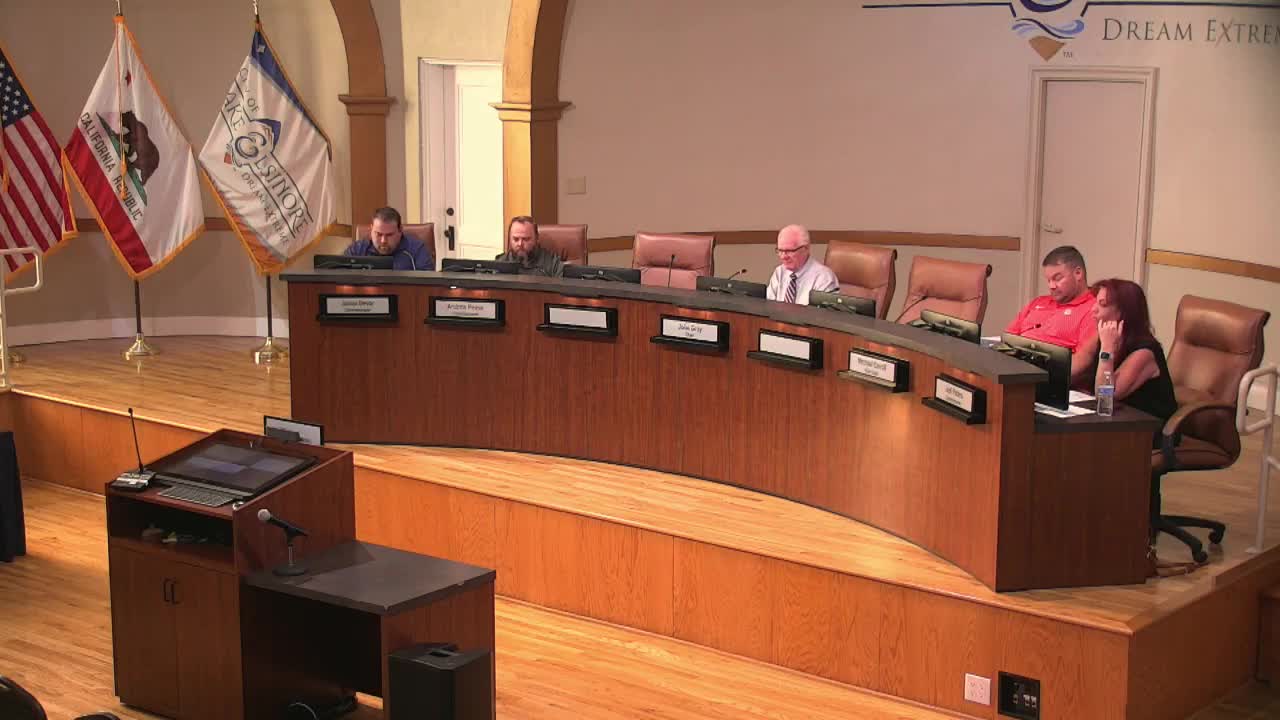
Lake Elsinore planning commission approves cannabis zoning and development agreement changes
Summary
The Lake Elsinore Planning Commission voted unanimously to amend municipal zoning rules for cannabis uses and to recommend development-agreement changes that lower community benefit fees for six existing businesses.
The Lake Elsinore Planning Commission voted unanimously to approve amendments to Chapter 17.156 of the Lake Elsinore Municipal Code on cannabis uses and to recommend that the City Council approve amendments to development agreements for six existing cannabis businesses.
The ordinance amendment consolidates the cap on the number of cannabis permits to a maximum of 10 total across the city's industrial zones (M1 and M2) rather than the previous split of five in each zone. The change also removes the prior requirement that the city make a finding of public convenience to allow more than the capped number. Staff recommended extending permitted hours for cannabis operations from 9 p.m. to 10 p.m., removing the 25% cap that had limited the proportion of retail space within a business, and clarifying and consolidating language throughout the code to simplify administration. Staff said retail businesses will no longer be allowed to operate as stand-alone retail; retail must be accompanied by a non‑retail component such as cultivation, manufacturing, distribution, or testing.
Planning staff reported that since the 2017 ordinance the city had approved 20 cannabis businesses: 15 are currently operational, four permits have expired and one business is in the permit process. Staff said most businesses are in compliance but that the city had identified issues primarily tied to cultivation uses and some complaints about unpermitted signage, special events and late hours for retail operations.
On the related development-agreement amendments, staff presented a proposed new community-benefit-fee (CBF) structure that creates separate rates for retail and non‑retail floor area. Under the proposal the retail CBF would be capped at $25 per square foot and would stop annual 4% increases; non‑retail uses (cultivation, manufacturing, distribution, testing) would face a reduced CBF of $5 per square foot with no annual 4% increase. The amendments would allow monthly CBF payments (the current agreements require annual payment), clarify definitions of retail versus non‑retail floor area for the purpose of the fee, and explicitly make the new rates effective going forward (not retroactive for fees already paid in 2025). Staff recommended the planning commission find the DA amendments exempt from CEQA under Class 1 for existing facilities and forward a recommendation to the City Council.
During discussion commissioners asked staff to confirm that the combined 10‑permit cap could be split unevenly between zones (for example 7 in M1 and 3 in M2), and staff confirmed the ordinance removes the fixed 5-and‑5 split. Commissioners also asked for clarification on how retail floor area and non‑retail floor area are defined in the DA template; staff pointed attendees to the development agreement template (Attachment 7) which lists examples of areas counted as retail (reception, entrance lobby, retail product storage, offices and the customer shopping area) and non‑retail (cultivation, distribution, manufacturing, testing, and ancillary storage and support spaces).
Representatives of affected businesses spoke during the public hearing. Gilbert Alba (Alba) thanked the commission for considering the adjustments. Javier Montes and Darren Hagen of The Healing Tree said the changes were important to their ability to continue operating and described industry efforts to support public-health education. Jason McGee, an owner who said his business had taken over a failing CRB, asked whether the new rates would apply automatically; staff replied that DAs are negotiated per business and operators would need to submit an amendment to their development agreement to obtain the new rates.
The planning commission approved the ordinance amendment on a motion by Commissioner Pease, seconded by Commissioner Devore, and the motion passed unanimously. Later the commission voted to adopt the recommendation on the development-agreement amendments for the six named businesses on a motion by Commissioner Devore, seconded by Commissioner Pease; that motion also carried unanimously.
The commission session closed with staff and city-attorney comments deferred (no comments) and commissioners welcoming Commissioner Pease as a new member. The commission adjourned to the next regular meeting on June 3.