Get Full Government Meeting Transcripts, Videos, & Alerts Forever!
Get email alerts on the Oah Budget Adr Accountability topic
No spam. Unsubscribe anytime.
Office of Administrative Hearings reports increased alternative dispute resolution use, handles police‑accountability MOUs
Summary
The Office of Administrative Hearings told the subcommittee its FY26 budget is largely personnel funding and reported a rise in cases resolved through alternative dispute resolution (ADR). OAH said it has handled more than 100 police accountability cases and has MOUs with approximately 20 jurisdictions for those hearings. Analysts recommended OAH
The Office of Administrative Hearings (OAH) told the Public Safety and Administration Subcommittee that its FY26 budget centers on personnel and rent, that it has increased use of alternative dispute resolution techniques, and that it is handling police accountability cases under new statutory frameworks.
Jacob Polikoff, the agency analyst, said OAH’s FY26 budget rises by about 2.2% to roughly $20 million, with 86% of the allowance funding personnel to support 117 regular positions. Polikoff reported five vacancies as of the November snapshot and explained the agency’s practice of recruiting multiple administrative law judges at once because training takes months. OAH expects new hires to fill current ALJ vacancies in March.
Polikoff said OAH disposed of a slightly smaller total of cases in fiscal 2024 but improved the percentage of decisions issued “in a timely manner” to 99.9%. He also noted that the average number of days from receipt of an appeal to disposition increased by about 4.5 days year‑over‑year and cited contributors such as postponements for good cause, more multi‑party cases, and increased motions practice.
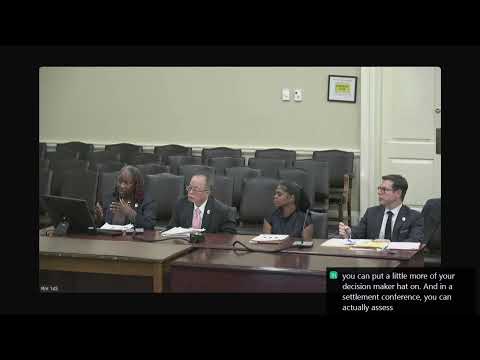
On ADR, Chief Administrative Law Judge Chung Park described two primary techniques used by OAH: mediation and settlement conferences. “In mediation, the ALJ is the mediator… taking their cues from the parties,” Park explained; in a settlement conference the ALJ may put “a little more of your decision‑maker hat on” and provide an assessment of strengths and weaknesses to facilitate agreement. Park said OAH resolved 37.1% of cases using ADR in FY24, up 9.2 percentage points from the prior year but still below a decade high of 50.6% in FY18.
Park told the committee OAH has received 106 police‑accountability cases to date under Maryland’s accountability law, has disposed of most of them, and has entered into memoranda of understanding with about 20 law‑enforcement agencies to provide ALJs for hearings. Funding for jurisdictional participation follows an MOU and any funds received are returned at fiscal‑year end to the general process noted by the panel.
Analysts recommended committee narrative asking OAH to provide additional metrics about which case types ADR resolves most successfully and to include related measures in its annual Managing for Results submission.
Ending: OAH agreed with the governor’s allowance, said it will continue to recruit ALJs to fill vacancies, and indicated it would work with the subcommittee on any requested ADR and police‑accountability reporting.