Get Full Government Meeting Transcripts, Videos, & Alerts Forever!
Get email alerts on the Dpscs Budget Contracts Staffing topic
No spam. Unsubscribe anytime.
Legislative analysts flag medical-contract and staffing problems as DPSCS budget grows slightly for FY26
Summary
The Maryland Department of Public Safety and Correctional Services presented a $1.9 billion fiscal 2026 allowance while legislative analysts pressed the agency on an Office of Legislative Audits report about prior medical contractor failures and on persistent staffing and overtime problems.
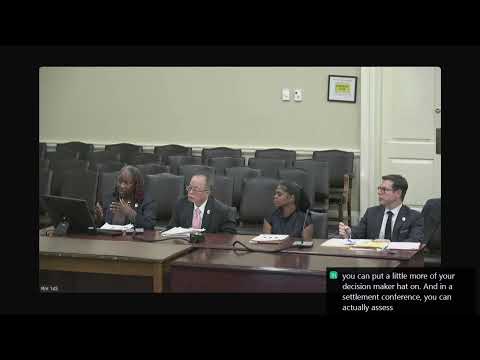
The Maryland Department of Public Safety and Correctional Services (DPSCS) presented its fiscal 2026 budget to the Public Safety and Administration Subcommittee, showing a roughly 1.2% increase to about $1.9 billion and renewed attention on medical contracts, staff vacancies, and overtime costs.
In an overview, Catherine Barber, a budget analyst with the Department of Legislative Services, said the fiscal 2026 allowance “increases by $22,600,000 or about 1% to $1,900,000,000” and described major cost drivers including personnel, contractual services and higher inmate health costs tied to a new vendor contract.
The panel's review focused on two central issues: problems identified in a November 2024 Office of Legislative Audits report about the previous medical contractor and the agency’s ongoing shortages of correctional officers and community supervision staff. Barber told the subcommittee that the audit found nine findings concerning medical contracts and procurements between April 2018 and December 2023, and noted that DPSCS moved from YesCare to Centurion in May 2024 for medical and mental‑health services.
Barber summarized audit concerns: the use of a fixed‑fee contract model, evidence gaps about DPSCS’s benchmarking for contractor payment structures, staffing and monitoring failures under the prior contractor, and increases in health care spending despite a long‑term decline in average daily population. “The audit concluded that DPSCS failed to monitor its contractor, which resulted in numerous policy violations,” she said, noting missed intake exams and delayed mental‑health evaluations documented by OLA.
DPSCS Secretary Carolyn J. Scruggs responded that the new contracts require aligning hourly rates with the top 25% of earners based on Federal Bureau of Labor Statistics data for the DMV region to improve recruitment and retention. “The new medical service contracts bring 1,294 healthcare positions to our facilities, which is nearly a 40% increase over the previous contracts,” Scruggs said, describing steps taken to expedite background checks and onboarding with Centurion and a biweekly staffing report requirement.
Scruggs also told the subcommittee that Centurion committed to a minimum 85% fill rate by April 2025 and that DPSCS has required corrective action plans addressing OLA findings, which the department submitted to the Joint Audit Committee. She said the department’s Office of the Inspector General will audit progress on those corrective actions.
Analysts recommended budget language restricting $500,000 pending a report describing how DPSCS incorporated OLA feedback into the current contract; Barber said the language would appear in the Q00A administration analysis.
On personnel and overtime, Barber said the FY26 allowance includes 9,229 regular authorized positions and noted vacancy and overtime trends: vacancies rose from earlier levels and overtime spending climbed from under $100 million in FY17 to about $223.4 million in the FY25 working appropriation. The FY26 allowance includes $228.5 million for overtime. Barber recommended budget language restricting $250,000 pending a report on DPSCS hiring goals for FY26.
Secretary Scruggs said the department has reduced its vacancy rate from roughly 17% when she took office to about 10% and described intensified recruitment, stricter background checks and onboarding reforms. She stressed that aging incarcerated populations and medical‑related posts increase staffing and overtime needs and described retention incentives including signing bonuses and longevity pay.
Other FY26 items discussed included deficiency appropriations to cover shortfalls, $2.2 million for safety improvements in probation and parole offices after a parole agent’s murder during a home visit in May 2024 (covering placement of armed guards and new multi‑threat ballistic vests), and a DOC pilot to purchase body‑worn cameras in locations lacking CCTV. Barber noted a $4.1 million general fund increase to purchase body worn cameras for correctional officers as part of a pilot program.
The subcommittee pressed DPSCS on whether Centurion and the department had established minimum hourly rates and whether corrective actions already submitted have been implemented; Scruggs described ongoing steps but did not provide an exhaustive status timeline for each corrective action.
The hearing closed with members recommending continued oversight of staffing, contractor monitoring, and the department’s implementation of OLA corrective actions.
Ending: The department agreed to provide the committee follow‑up reports requested in the analysts’ recommended language and to work with the Department of Legislative Services and the Joint Audit Committee on verifying corrective actions.