Get Full Government Meeting Transcripts, Videos, & Alerts Forever!
Get email alerts on the Homeowners Association Regulation topic
No spam. Unsubscribe anytime.
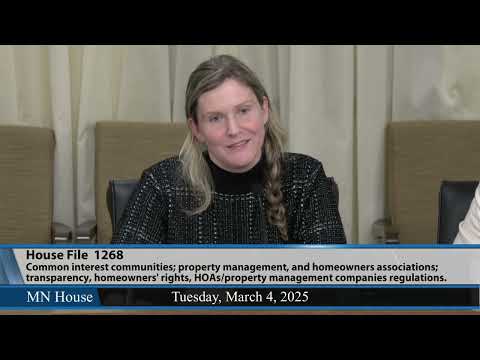
Committee advances bipartisan HOA reform bill with consumer protections; amendment adopted
Summary
The Minnesota House Committee on Housing Finance and Policy voted to adopt an author's amendment (A5) and to refer House File 1268 — a bipartisan bill that creates consumer protections and governance guardrails for homeowners associations and common-interest communities — to the Judiciary Finance and Law Committee.
The Minnesota House Committee on Housing Finance and Policy on Thursday adopted an author's amendment and voted to refer House File 1268 to the Judiciary Finance and Law Committee, advancing a bipartisan package of changes that supporters say will add consumer protections for homeowners in homeowners associations (HOAs) and common-interest communities (CICs).
The bill, as described by Representative Hunter, “creates a strong framework of consumer protections for homeowners and solid guardrails to set up association boards and property managers for success.” An author’s amendment labeled A5 was adopted by voice vote before the committee moved the bill onward.
HF 1268 incorporates recommendations from a legislative working group made up of homeowners, board members, property managers, attorneys and industry groups. Representative Hunter told the committee the working group met 14 times and held public listening sessions across the Twin Cities metro area. The draft bill addresses governance, open meetings and governing documents, dissolution, dispute resolution, fines and fees, liens and foreclosure procedures, and conflict-of-interest rules for boards and contractors. Nonpartisan staff summarized the bill’s sections for members, noting that the measure would also push the effective date for statutory changes affecting housing cooperatives (chapter 308C) from 2025 to 2026.
Supporters at the hearing said the bill responds to persistent complaints from homeowners. Roxanne Young Kimball, president of the Minnesota Homeownership Center, testified that the working group heard “troubling stories about HOAs that are not functioning as intended” and urged the committee to back the bill’s transparency, dispute-resolution and conflict-of-interest provisions. Jenny Sanford of Twin Cities Habitat for Humanity said Habitat frequently helps homeowners harmed by problematic HOA governance and supports “standards of practice for the HOA boards and enhanced consumer protections.”
Industry and governance stakeholders raised concerns about specific provisions. Several property managers, attorneys and HOA leaders warned that hard caps in the text — such as proposed dollar limits on fines, late fees and recoverable attorney fees — could make routine enforcement ineffective and push associations toward costlier litigation that would be borne by other homeowners. Attorney Aaron Brooksby said statutory limits could “become just a cost of doing business” for repeat violators, while Cities Management president Matt McNeil and others worried that conflict-of-interest language and fixed numeric caps could conflict with nonprofit conflict-of-interest standards and immediately raise operating costs.
The League of Minnesota Cities expressed concern about Article 3 of the bill, which the League said could be read to prohibit local governments from conditioning development approvals on mechanisms (including HOAs) to ensure private common-area maintenance and insurance. League representative Daniel Lightfoot warned the committee that overly broad preemption could force cities to accept privately created infrastructure as public responsibility or reduce development flexibility (for example, private streets that allow higher residential density).
Committee members and bill authors said the measure seeks to strike a balance. Representative Bonner, a co-author, said the bill is “a start” to provide statutory guardrails while recognizing additional work will be needed — including potential budgets for an ombudsman office and a task force on insurance — and that some items will travel separately because of fiscal implications. The committee’s co-authors invited stakeholders to submit specific language changes for future consideration.
Procedural actions: Representative Mecklen moved adoption of the A5 author’s amendment; the committee adopted the amendment by voice vote. Later the committee voted by voice to refer House File 1268 to the Judiciary Finance and Law Committee. The record shows voice votes with “aye” called; no roll-call tallies with individual member votes were provided in the transcript.
The bill will be considered next in the Judiciary Finance and Law Committee, where authors and stakeholders said they expect additional negotiation on proxy voting rules, caps and the interface with local government authority.
Votes at a glance: - A5 (author’s amendment to HF 1268): Mover — Representative Mecklen; outcome — adopted by voice vote. (No named roll-call in transcript.) - HF 1268 (referral to Judiciary Finance and Law): Mover — Representative Bonner (renewed motion); outcome — referred by voice vote. (No named roll-call in transcript.)
The committee concluded its agenda and said it will reconvene the following day for further business.